
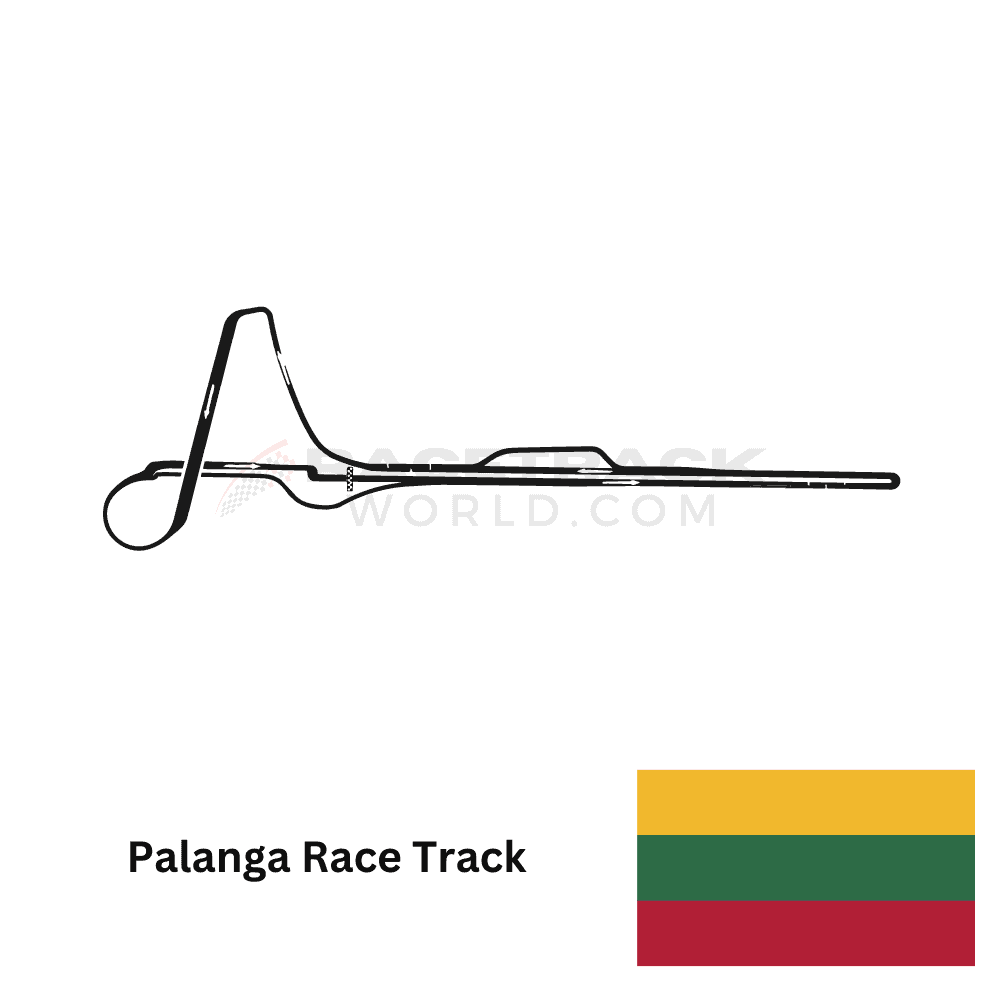
Palanga Circuit
Palanga Circuit at a glance
- Location
- Palanga, Klaipėda County
- Type
- street circuit
- Length
- 2.681 km (1.666 mi)
- Turns
- 12
- Direction
- clockwise
- Surface
- asphalt (public road)
- Opened
- 2000
- Owner
- Racing.lt / Lithuanian Automobile Sports Federation
- Website
- racing.lt
Track map and layout

The Palanga circuit is a genuine oddity in international motorsport: a temporary street course built once a year on a real highway interchange just outside the Baltic resort town of Palanga, using two entrance/exit ramps, U-turns across the central median, and cone-slalom chicanes to slow cars down. Rather than closed-off city streets, the layout runs cars over an actual cloverleaf-style junction, and competitors refuel at a working petrol station on one of the straights instead of a conventional temporary pit lane. The result is a fast but disorienting 2.681 km, 12-turn lap that changes character depending on which ramps and slip roads are incorporated that year.
Configurations
| Layout | Length | Used for |
|---|---|---|
| Full circuit | 2.68 km | current 2.681 km layout used for the Aurum 1006 km race |
Events and race weekends
The circuit exists almost entirely for one race: the Aurum 1006 km (known at various points as the 1000 km lenktynės, Horn 1003 kilometrų lenktynės and ENEOS 1006 kilometrų lenktynės under different title sponsors), an FIA-sanctioned touring car and GT endurance race held annually since 2000. Open to GT3, GT4 and TCR cars alongside club-level and older homologation machinery, the race grew from 18 teams at its 2000 debut to as many as 60 in its biggest years, drawing entries from across Europe to race on public highway for one weekend a year.
| Event | Series | When | Notes |
|---|---|---|---|
| Aurum 1006 km powered by Hankook | Endurance / GT3-GT4-TCR | July | run annually since 2000; distance and title sponsor have changed several times |
Getting there and parking
Palanga is a small Baltic Sea resort town in western Lithuania with its own international airport, making it one of the more accessible temporary circuits in Europe for a race weekend. The circuit itself sits on the highway junction on the edge of town, a few kilometres from the centre and the airport.
- Palanga International Airport (PLQ) · about 10 min drive
Parking
Parking for the race weekend is arranged around the circuit and in the town; specifics are published by the organiser each year.
Because the circuit is a live highway junction the rest of the year, it only exists as a race track for the Aurum 1006 km weekend — there is no permanent facility to visit outside that event.
Hotels and camping near Palanga Circuit
Palanga is Lithuania's leading seaside resort and has a full range of summer hotels, guesthouses and holiday apartments, which fill up quickly for the July race weekend since it coincides with the peak of the Baltic beach season.
Where to look
Palanga town centre and the beachfront, both close to the circuit.
Track days, driving experiences and lap records
There are no public track days: the circuit is a normal public road junction for 364 days of the year and is only closed off and converted into a racing circuit for the Aurum 1006 km race weekend, so the only way to drive it competitively is to enter that event.
Spectator guide
Spectators line the highway embankments and ramps around the circuit for free or low-cost viewing, with the slip-road sections and the petrol-station pit area among the most popular spots to watch the unusual mix of racing and roadside refuelling.
Best places to watch
The ramp and slip-road sections give the clearest view of cars negotiating the highway interchange, and the petrol station on the main straight is a unique vantage point to watch pit stops.
Weather
- July: warm Baltic summer, typically 18-22°C, race weekend timing
History of Palanga Circuit
A race built on a highway junction
The Palanga circuit was created in 2000 for a single purpose: to host an endurance race on the public highway interchange just outside the Baltic Sea resort town of Palanga in western Lithuania. Rather than building a permanent facility, organisers close off a real cloverleaf-style road junction once a year, incorporating its entrance and exit ramps, U-turns across the median, and cone chicanes into a 2.681 km, 12-turn lap — a format almost unique in international motorsport.
Growth of the Aurum 1006 km
The race itself, now known as the Aurum 1006 km, began with 18 teams in 2000 and grew steadily as it gained FIA sanctioning, attracting international entries from across Europe. Entry numbers climbed to 34 teams by 2004 and peaked at around 60 in the race's busiest years. The distance and name have shifted with sponsorship: it was extended to 1003 km in 2005 under title sponsor Horn beer and TV3, then to its current 1006 km distance in 2016 to mark a change of promoter. Competitors range from FIA GT3, GT4 and TCR cars down to club-level and expired-homologation machinery, all racing together in a genuine multi-class endurance format.
A one-weekend-a-year circuit
What sets Palanga apart from almost every other circuit on the world's racing calendar is that it has no permanent existence as a track: for the other 364 days of the year the site is simply a working highway junction carrying everyday traffic. Cars refuel during the race at a real petrol station built into one of the straights rather than a temporary pit lane, a detail that has made the event a cult favourite among endurance racing fans looking for something stranger than a conventional circuit. The race continues to run annually each July, timed to coincide with Palanga's peak beach season.
Frequently asked questions
Is the Palanga circuit a permanent racetrack?+
No. It is a real highway interchange on the edge of Palanga that is closed off and turned into a temporary street circuit once a year for the Aurum 1006 km race; the rest of the year it carries normal traffic.
How long is the Palanga circuit?+
The current layout is 2.681 km (1.666 miles) with 12 turns, built around a highway cloverleaf junction.
What is the Aurum 1006 km race?+
An FIA-sanctioned touring car and GT endurance race held annually at Palanga since 2000, open to GT3, GT4, TCR and club-level cars, with the distance and name having changed several times with title sponsorship.
Why do cars stop at a petrol station during the race?+
The circuit incorporates a real, working petrol station on one of its straights, which competitors use for refuelling instead of a conventional temporary pit lane — one of the race's best-known quirks.
Can the public drive the Palanga circuit?+
No. There are no public track days since the site is a normal highway junction outside of the single annual race weekend.
Other tracks nearby
- Biķernieki Complex Sports Base · 225 km · road course
- auto24ring · 343 km · road course
- Solvalla · 428 km · historic circuit (defunct)
- Råbelövsbanan · 432 km · historic circuit (defunct)
- Lange Motokeskus · 432 km · motocross
- Mantorp Park · 445 km · road course
Facts checked against 3 sources including the official circuit website. Last reviewed 2026-09-11.
