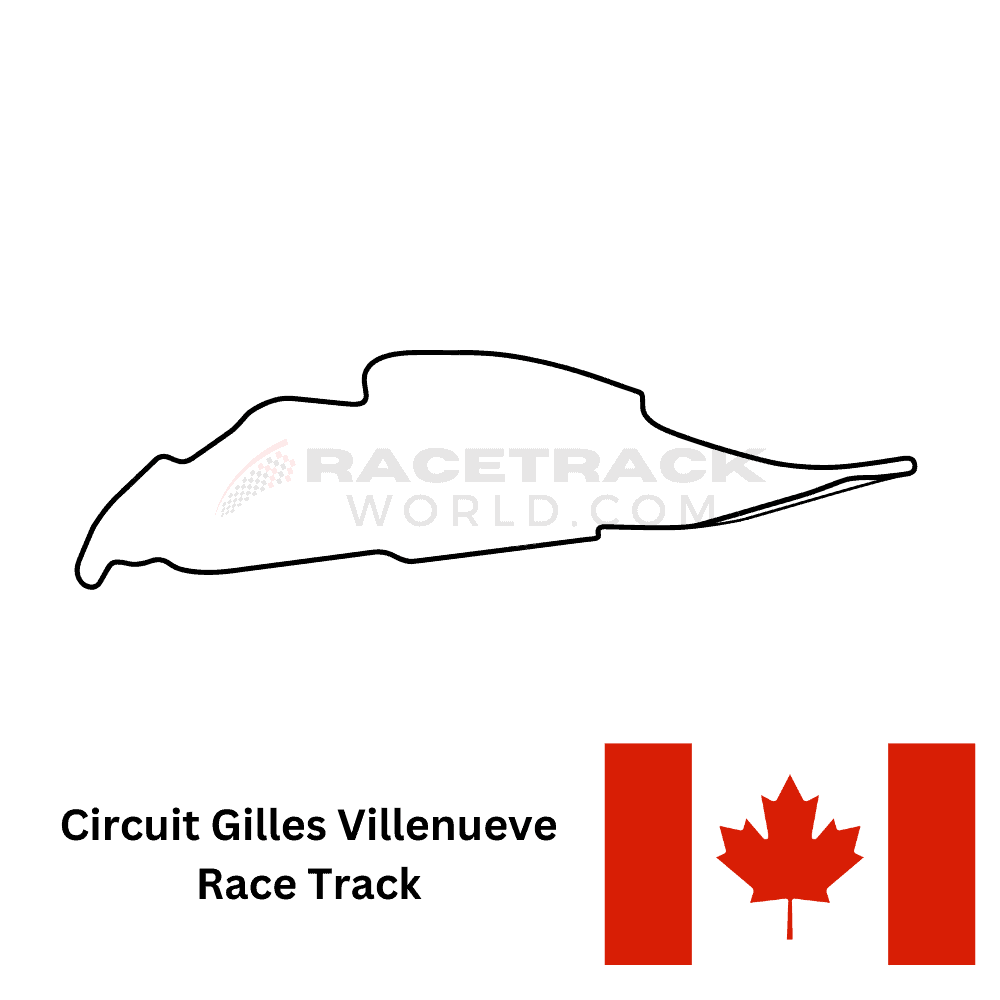
Circuit Gilles Villeneuve
Circuit Gilles Villeneuve at a glance
- Location
- Montreal, Quebec
- Type
- street circuit
- Length
- 4.361 km (2.71 mi)
- Turns
- 14
- Direction
- counter-clockwise
- Surface
- asphalt
- Opened
- 1978
- Owner
- City of Montreal
- Capacity
- 100,000
- Website
- circuitgillesvilleneuve.ca
Track map and layout

Circuit Gilles Villeneuve is a semi-permanent street circuit laid out on the public roads and parkland of Île Notre-Dame, an artificial island in the St. Lawrence River built for Expo 67. Unlike a pure street track through a city centre, its roads are wide and its run-off is generous by street-circuit standards, but the low-grip surface, close concrete walls and bumps still punish the smallest mistake. The lap starts with the Senna S, a quick left-right flick named for Ayrton Senna, threads along the waterfront past the Casino de Montréal, and ends with a long run to the hairpin (l'Épingle) before the final chicane at the Wall of Champions, where the track narrows sharply into the pit straight wall. High average speeds combined with heavy braking zones make it a favourite for late-braking overtakes in both Formula 1 and Formula 2.
Named corners and sections
- Senna S (Turns 1-2). A fast left-right combination named after Ayrton Senna that opens the lap and sets up the run down to the hairpin.
- Pont de la Concorde (Turn 8). A quick left-hander taken at high speed under the Concorde Bridge.
- L'Épingle (Hairpin, Turn 10). A tight 180-degree hairpin that is the slowest point on the lap and a key overtaking spot.
- Wall of Champions (final chicane, Turn 14). The last chicane before the pit straight, where the outside wall caught three former or future world champions during the 1999 race, earning the nickname.
Events and race weekends
The Canadian Grand Prix has run at the circuit almost every year since 1978, making it one of the longest-serving venues on the modern Formula 1 calendar; the race sat out 2009 and the 2020-21 seasons before returning to a regular slot, now held in May from 2026. F1 Academy and FIA Formula 2 support the Grand Prix weekend, and the island roads have previously hosted Champ Car and NASCAR's Xfinity Series. Outside race weekends, Parc Jean-Drapeau opens the circuit roads to the public for walking, running, cycling and skating.
| Event | Series | When | Notes |
|---|---|---|---|
| Canadian Grand Prix | Formula 1 | May | moved to a May slot from the 2026 season |
| Canadian Grand Prix support races | FIA Formula 2 / F1 Academy | May | run on the same weekend as the Grand Prix |
Getting there and parking
The circuit sits on Île Notre-Dame in Parc Jean-Drapeau, a short ride from downtown Montreal on the city's métro system. There is no dedicated spectator parking on the island, so the STM métro is the standard way in and out on race weekend; most visitors fly into Montréal-Trudeau and stay downtown, taking the métro out to the circuit rather than driving.
- Montréal-Trudeau International Airport (YUL) · about 25 min drive
Parking
No designated public parking exists on Île Notre-Dame; parking passes are only bundled with certain premium Paddock Club packages, so most spectators park downtown and take the métro.
Jean-Drapeau métro station gets extremely congested after the race; allow significant extra time to leave, or walk to a quieter downstream station.
Hotels and camping near Circuit Gilles Villeneuve
Almost all visitors base themselves in downtown Montreal, a short métro ride from the circuit, rather than near the track itself, since Île Notre-Dame has no hotel stock. Rooms in the city sell out and prices spike well ahead of the Grand Prix weekend, so booking months in advance is standard practice.
Where to look
Downtown Montreal (Ville-Marie), the Quartier des Spectacles and Old Montreal are the most popular bases, all connected to the circuit by the métro's Yellow Line via Jean-Drapeau station.
Track days, driving experiences and lap records
Circuit Gilles Villeneuve is primarily a race and public-park facility rather than a regular track-day venue; when the island roads are not closed for the Grand Prix or other race meetings, Parc Jean-Drapeau opens them to cyclists, runners, in-line skaters and pedestrians rather than to private car or motorcycle lapping days.
Lap records
| Category | Time | Driver | Car | Year |
|---|---|---|---|---|
| Formula 1 | 1:13.078 | Valtteri Bottas | Mercedes W10 | 2019 |
Spectator guide
Grandstands line the start-finish straight, the hairpin and the final chicane at the Wall of Champions, while general-admission areas around the rest of the island give broader, more affordable views of the lakeside layout. The circuit's compact island footprint means most seating areas are within easy walking distance of the métro station.
Seating
Main grandstands run along the pit straight, at the hairpin (l'Épingle) and around the Wall of Champions chicane; general admission mounds and standing areas cover much of the rest of the lap along the waterfront.
Best places to watch
The Wall of Champions chicane and the hairpin are the two most popular general-admission and grandstand viewing points for overtakes.
Weather
- May-June: mild Montreal late spring, highs typically in the high teens to low 20s °C (60s-70s°F), rain is common
History of Circuit Gilles Villeneuve
From Expo island to Formula 1 fixture
Circuit Gilles Villeneuve was built on Île Notre-Dame, an artificial island in the St. Lawrence River created from excavation material for Montreal's 1967 World's Fair. It opened in October 1978 as the Île Notre-Dame Circuit and immediately hosted the Canadian Grand Prix, won in front of a delirious home crowd by Montreal-born Ferrari driver Gilles Villeneuve. The result made the circuit's debut one of the most celebrated in Canadian sporting history.
A name that honours a national hero
Villeneuve was killed during qualifying for the 1982 Belgian Grand Prix, and Montreal renamed the circuit in his honour later that year. His son Jacques Villeneuve went on to race at the venue himself, including a dramatic moment in 1999 when he, Michael Schumacher and Damon Hill all crashed into the same outside wall on the final corner during the same race weekend, a coincidence that gave the barrier its enduring nickname, the Wall of Champions.
Reconfigurations and modern era
The layout has been revised several times since 1978, with notable changes in 1988, 1994, 1996 and 2002 aimed mainly at improving safety around the chicanes and pit exit; the current configuration dates from 2002. The race has occasionally fallen off the calendar, missing 2009 amid a contract dispute and 2020-21 due to the COVID-19 pandemic, but has otherwise been a near-constant fixture. From the 2026 season the Canadian Grand Prix moved to a new May date on the F1 calendar. Today the circuit remains one of the sport's most popular stops, prized by drivers for its high-speed, low-grip walls-close character and by fans for its lakeside island setting a few minutes from downtown Montreal.
Frequently asked questions
How long is Circuit Gilles Villeneuve?+
The circuit is 4.361 km (2.71 miles) long with 14 turns.
Why is it called the Wall of Champions?+
The outside wall on the final chicane earned the nickname after Jacques Villeneuve, Michael Schumacher and Damon Hill all crashed into it during the 1999 Canadian Grand Prix weekend.
How do you get to Circuit Gilles Villeneuve without a car?+
Take Montreal's STM métro Yellow Line to Jean-Drapeau station on Île Sainte-Hélène, then walk or take the shuttle to the circuit on neighbouring Île Notre-Dame; there is no dedicated spectator parking on the island.
Who is the circuit named after?+
It is named after Gilles Villeneuve, the Quebec-born Ferrari driver who won the circuit's first race in 1978 and was killed in 1982; his son Jacques Villeneuve went on to win the 1997 F1 World Championship.
When is the Canadian Grand Prix held?+
From the 2026 season the race moved to a May date on the Formula 1 calendar, having traditionally been held in June.
Can you drive or cycle the circuit when there is no race on?+
Yes, Parc Jean-Drapeau opens the island roads to pedestrians, cyclists, runners and skaters outside race weekends, though it is not run as a private car or motorcycle track-day venue.
Other tracks nearby
- Montreal Street Circuit (Montreal ePrix) · 3 km · historic circuit (defunct)
- Autodrome Saint-Eustache · 35 km · historic circuit (defunct)
- Sanair Super Speedway · 50 km · dormant
- Circuit Mont-Tremblant · 114 km · road course
- Circuit Trois-Rivières (GP3R) · 120 km · street circuit
- Calabogie Motorsports Park · 247 km · road course
Facts checked against 4 sources including the official circuit website. Last reviewed 2026-09-11.