
Race Track World Logo
Home/Europe/France/Circuit de Monaco

Circuit de Monaco

Circuit de Monaco at a glance

Location
Monaco, Monaco
Type
street circuit
Length
3.337 km (2.074 mi)
Turns
19
Direction
clockwise
Surface
asphalt (closed public roads)
Elevation change
144 ft
Opened
1929
Owner
Automobile Club de Monaco (ACM)
Capacity
37,000
Website
acm.mc

Track map and layout

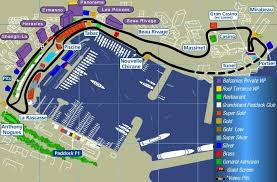
Circuit de Monaco Map
Circuit de Monaco track layout

The Circuit de Monaco threads the closed public streets of Monte-Carlo, La Condamine and Fontvieille, running clockwise over 3.337 km (2.074 mi) and 19 corners with 44 metres of elevation change and gradients up to 12%. The lap opens with the fast right-hander at Sainte-Dévote, climbs past the Casino to Mirabeau and the tight Fairmont Hairpin (Formula 1's slowest corner at roughly 48 km/h), then drops through Portier into the harbourside tunnel before the Nouvelle Chicane, Tabac and the Swimming Pool complex lead back along the harbour to La Rascasse and the final corner, Anthony Noghès. Barriers line almost every metre of track, leaving essentially no run-off, which makes Monaco widely regarded as the most demanding circuit on the modern calendar despite being one of the shortest and slowest in terms of average speed.

Named corners and sections

  • Sainte-Dévote. The fast right-hander that opens the lap after the start-finish straight, named after a chapel dedicated to Monaco's patron saint; a frequent first-lap incident spot.
  • Casino Square. A fast, blind, undulating left-right sequence past the famous Monte-Carlo Casino, taken flat out despite the bumps and camber changes.
  • Fairmont Hairpin. Formula 1's slowest corner, a tight 180-degree hairpin outside the Fairmont hotel, taken at around 48 km/h; formerly known as the Loews or Station Hairpin.
  • Portier. A right-hander leading into the harbourside tunnel, a common site of high-profile crashes including Ayrton Senna's famous 1988 retirement.
  • Nouvelle Chicane. A tight chicane immediately after the tunnel exit, slowing cars sharply from the tunnel's high speed.
  • Piscine (Swimming Pool). A fast left-right-left-right sequence around Monaco's harbourside swimming pool, one of the most demanding sections of the lap.
  • La Rascasse. A slow, tight corner near the harbour, the scene of Michael Schumacher's controversial 2006 qualifying incident.

Configurations

LayoutLengthUsed for
Grand Prix street circuit3.34 kmthe only layout; the full closed-road course used for every Monaco event

Events and race weekends

The Monaco Grand Prix, held every year since 1929 (with wartime and a handful of other gaps) and on the Formula 1 calendar continuously since the championship began in 1950, is the circuit's centrepiece and one of the most prestigious races in world motorsport. The Monaco ePrix brings Formula E to the same streets in a shortened configuration in the spring. The Monaco Historic Grand Prix, held in alternate years, gathers historic Grand Prix cars from across F1's history for a weekend of vintage racing on the full circuit.

EventSeriesWhenNotes
Monaco Grand PrixFormula 1Mayrun at Monaco every year since 1929, on the F1 calendar continuously since 1950
Monaco ePrixFormula EMayrun on a shortened version of the street circuit
Monaco Historic Grand PrixHistoric racingMayheld in odd-numbered years on the full circuit, alongside the modern Grand Prix weekend

Getting there and parking

Nice Côte d'Azur Airport, about 25 km west along the coast, is the main gateway, with a direct rail and road link to Monaco taking well under an hour outside race-weekend traffic. Monaco Monte-Carlo railway station sits within walking distance of much of the circuit, and TER regional trains connect Monaco to Nice, Menton and other Riviera towns, making rail by far the easiest way to reach the circuit during the Grand Prix when road access is heavily restricted.

  • Nice Côte d'Azur Airport (NCE) · about 35 min drive

Parking

Public roads through and around the circuit are closed for the event; the principality has very limited parking, and organisers and hotels strongly recommend arriving by train rather than driving in.

Base yourself along the Nice-Menton rail corridor and use the frequent TER trains into Monaco Monte-Carlo station; driving into the principality on race weekend is heavily restricted and best avoided.

Hotels and camping near Circuit de Monaco

Monaco's own hotels are extremely limited in number and become some of the most expensive rooms in the world for Grand Prix weekend, booking out roughly a year ahead. Most visitors instead stay along the coast in Nice, which offers far more hotel capacity with an easy 25-minute train ride in, or in Menton, just 10 km away and reachable by TER train in under 15 minutes, which is considerably cheaper than Monaco itself.

Where to look

Menton, roughly 10-15 minutes by train, offers the best value close to the circuit; Nice, about 25 minutes by train or road, has the widest range of hotels; Monaco's own hotels are limited, extremely expensive on race weekend, and sell out furthest in advance.

Camping

None. Monaco is a dense urban principality with no camping facilities; there is no trackside or nearby camping option for any event.

RV

Not applicable — no motorhome or caravan facilities exist in or around the circuit.

Track days, driving experiences and lap records

There are no public track days or driving experiences on the Circuit de Monaco. The circuit exists only as closed public roads used for a handful of scheduled events each year, and Monaco's dense urban streets are never made available for general track-day driving at any other time.

Lap records

CategoryTimeDriverCarYear
Formula 1 (race lap record)1:12.909Lewis HamiltonMercedes W122021

Spectator guide

Grandstands are built temporarily along the harbourfront, the Swimming Pool section, Tabac and Rascasse, offering close-up views of the tightest, most technical parts of the lap, while premium terrace and balcony packages on hotels and apartments overlooking the circuit are a Monaco institution in their own right. General viewing on public terraces or Fairmont Hairpin-adjacent spots can be booked well ahead but sell out fastest, and much of the town centre is inaccessible without an event ticket during the Grand Prix.

Seating

Grandstands cluster around the harbour, Swimming Pool, Tabac, Rascasse and Sainte-Dévote; terrace and balcony hospitality on buildings overlooking the track is a distinctive, pricier alternative to fixed grandstands.

Best places to watch

The Swimming Pool grandstands and harbourside terraces give some of the best value close-up racing; a hotel or apartment terrace overlooking Casino Square or the harbour is the classic premium Monaco vantage point.

Weather

  • May (Grand Prix): typically warm and settled, highs around 20-23°C, with occasional Mediterranean showers

History of Circuit de Monaco

A street race born from a cigarette magnate's idea

The Monaco Grand Prix was first run in 1929, conceived by Antony Noghès, a Monégasque tobacco businessman and president of the Automobile Club de Monaco, who wanted to stage a major motor race through the principality's streets to boost its profile. The inaugural race, won by William Grover-Williams in a Bugatti, used essentially the same harbourside route that survives today, making Monaco one of the very few circuits still recognisable from its earliest editions nearly a century later.

A founding round of the World Championship

Monaco became a round of the Formula 1 World Championship from its first season in 1950 and has remained on the calendar in almost every year since, surviving eras when other classic street and road circuits fell away from top-level motorsport on safety grounds. Its tight, barrier-lined streets have hosted some of the sport's most dramatic moments, from Ayrton Senna's record six wins in the 1980s and 1990s to controversial incidents such as Michael Schumacher's 2006 qualifying stoppage at La Rascasse.

Surviving as a modern anachronism

Despite offering little overtaking and average lap speeds far below other circuits, Monaco has retained its place through prestige, history and the spectacle of Formula 1 cars navigating streets barely wider than the cars themselves. The principality has hosted Formula E's Monaco ePrix since 2021 on a shortened layout, and the biennial Monaco Historic Grand Prix draws historic Grand Prix and Formula 1 cars from across the sport's history. Debate over Monaco's place on the modern F1 calendar recurs regularly, but its status as a round every driver wants to win, alongside Le Mans and the Indianapolis 500 as part of motorsport's Triple Crown, has so far kept it secure.

Frequently asked questions

How long is the Monaco Grand Prix circuit?+

The circuit is 3.337 km (2.074 miles) long with 19 corners, one of the shortest and slowest circuits on the Formula 1 calendar.

Can the public drive the Monaco circuit?+

No. There are no public track days at Monaco; the circuit is simply closed public roads used only for scheduled events such as the Grand Prix, the Historic Grand Prix and the Formula E ePrix.

Where should I stay for the Monaco Grand Prix?+

Monaco's own hotels are limited, very expensive and sell out roughly a year ahead; most visitors stay in Menton (about 10-15 minutes by train) or Nice (about 25 minutes by train), both connected to Monaco Monte-Carlo station by regular TER services.

What is the slowest corner in Formula 1?+

The Fairmont Hairpin at Monaco, taken at roughly 48 km/h, is widely cited as the slowest corner on the F1 calendar.

What is the lap record at Monaco?+

The Formula 1 race lap record is 1:12.909, set by Lewis Hamilton in a Mercedes W12 during the 2021 Monaco Grand Prix.

Is there camping near the Monaco Grand Prix?+

No. Monaco is a dense urban principality with no camping or motorhome facilities; visitors stay in hotels along the coast in Monaco, Menton or Nice.

Other tracks nearby

Facts checked against 4 sources including the official circuit website. Last reviewed 2026-09-10.