
Circuit Paul Ricard
Circuit Paul Ricard at a glance
- Location
- Le Castellet, Var
- Type
- road course
- Length
- 5.842 km (3.63 mi)
- Turns
- 15
- Direction
- clockwise
- Surface
- asphalt
- Opened
- 1970
- Owner
- Groupe Bernard / Circuit Paul Ricard SAS
- Capacity
- 90,000
- Address
- 2760 Route des Hauts du Camp
- Phone
- +33 4 94 98 36 66
- Website
- circuitpaulricard.com/en
Track map and layout

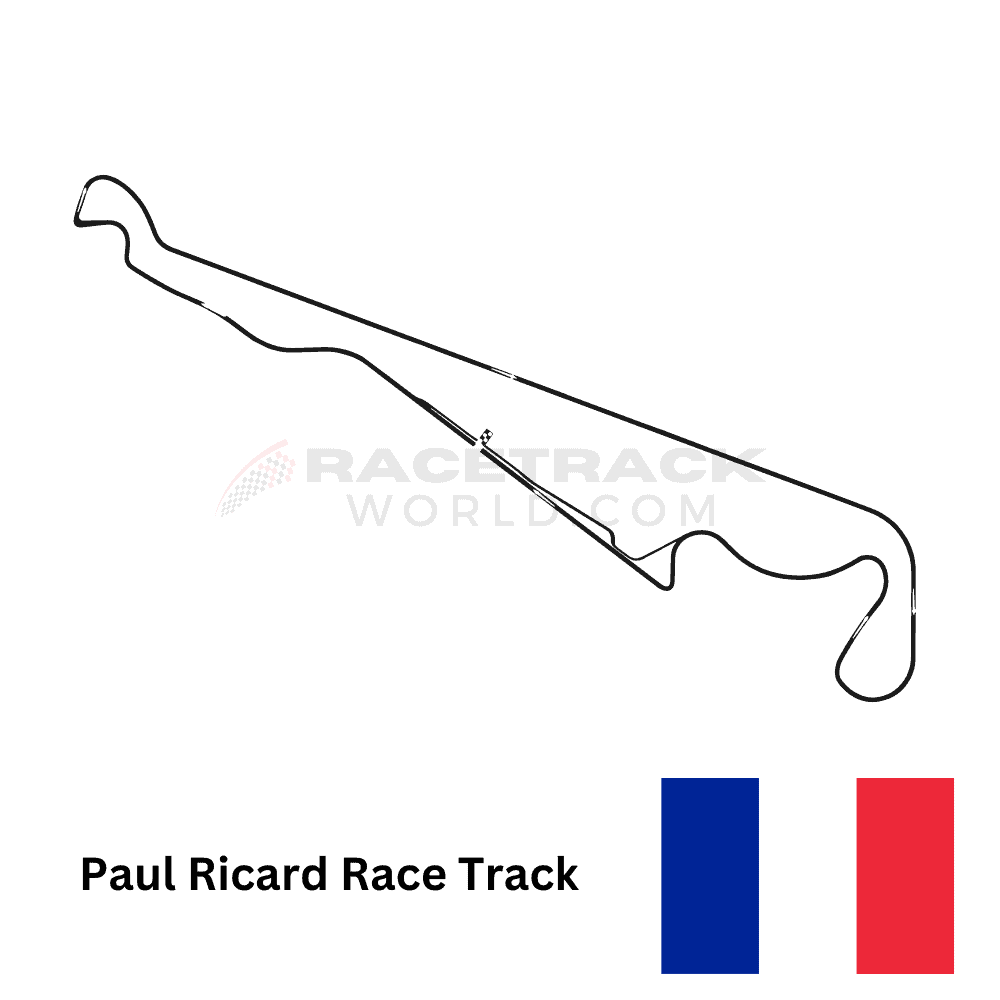
Circuit Paul Ricard sits on a windswept plateau above Le Castellet, its Grand Prix layout running clockwise over 5.842 km (3.630 mi) and 15 corners. The lap's signature feature is the 1.8 km Mistral Straight (Ligne Droite du Mistral), which ends at the fast, sweeping right-hander at Signes, one of the most demanding high-speed corners on any modern F1 calendar. From there the track winds through the tighter Beausset and Bendor complexes before returning to the start-finish straight. The circuit is best known for its distinctive blue-and-red asphalt run-off areas, introduced in the 2000s as a safer, more consistent alternative to gravel traps, and for its huge, reconfigurable layout: painted road markings allow the track to be run in numerous shorter configurations, from the tight Club circuit to the full Grand Prix loop.
Named corners and sections
- Signes. A long, fast right-hander at the end of the Mistral Straight, taken at very high speed and widely regarded as one of the toughest corners on the F1 calendar.
- Beausset. A tightening, decreasing-radius left-hander named after the neighbouring village, testing traction and patience after the high-speed first half of the lap.
- Ligne Droite du Mistral (Mistral Straight). A 1.8 km straight named after the region's strong northerly wind; formerly split by a chicane and one of the longest straights in motorsport.
- Courbe de Virage du Pont. A fast kink taken near maximum speed early in the lap, leading traffic toward the Mistral Straight.
Configurations
| Layout | Length | Used for |
|---|---|---|
| Grand Prix circuit | 5.84 km | full 15-turn layout used for F1, WEC and Bol d'Or |
| Alternative/club configurations | 3.84 km | shorter loops down to roughly 3.8 km, selected using painted road markings for track days and support races |
| Driving Center track | 1.77 km | 1.8 km dedicated training and driving-school circuit separate from the main track |
Events and race weekends
Paul Ricard hosted the French Grand Prix on and off from 1971, including a long run through the 1970s and 1980s, and returned to the F1 calendar in 2018-2019 and 2021-2022. The Bol d'Or, one of endurance motorcycling's oldest and most prestigious races, is held here annually and draws huge overnight crowds. The circuit is also a regular host on the FIA World Endurance Championship calendar and stages major GT and touring car rounds.
| Event | Series | When | Notes |
|---|---|---|---|
| Bol d'Or | FIM Endurance World Championship | September | 24-hour motorcycle endurance classic, one of the sport's oldest races |
| 4 Hours of Le Castellet | European Le Mans Series | April | |
| GT World Challenge Europe round | GT World Challenge Europe | varies | |
| French Grand Prix | Formula 1 | July | hosted 1971-1990 and again 2018-2019, 2021-2022; not on the current F1 calendar |
Getting there and parking
Circuit Paul Ricard is in the hills above Le Castellet in the Var, roughly 45 minutes from Marseille and 30 minutes from Toulon by road via the A50 motorway (exit 11, signed Le Beausset/Circuit du Castellet). Toulon-Hyères is the closest airport, with Marseille Provence a little further and better served internationally; TGV high-speed trains stop at Marseille, Aix-en-Provence TGV, Toulon and Bandol, all requiring a taxi or transfer for the final leg.
- Toulon-Hyères Airport (TLN) · about 35 min drive
- Marseille Provence Airport (MRS) · about 50 min drive
Parking
General on-site parking is included with most event tickets; premium and paddock parking is limited and should be booked ahead for major events such as the Bol d'Or.
TGV trains reach Marseille, Aix-en-Provence TGV, Toulon or Bandol; from any of these a taxi or hire car is needed to cover the final 30-50 minutes to the circuit, as there is no direct rail link to the track.
Hotels and camping near Circuit Paul Ricard
Most visitors base themselves in Le Castellet village, Le Beausset or further afield in Bandol, Toulon or Aix-en-Provence, all within 20-50 minutes' drive. There is no large official campsite culture at Paul Ricard on the scale of Le Mans or Spa, though informal camping and caravan parking are sometimes arranged for major events like the Bol d'Or; hotel rooms in the immediate area are limited and book out quickly for that weekend.
Where to look
The Grand Prix Hôtel & Restaurant and Hôtel & Spa du Castellet sit right by the circuit; wider hotel choice is in Bandol, Le Beausset, Toulon and Aix-en-Provence, all a short drive away.
Camping
No large permanent official campsite; some event-specific camping and caravan areas are set up for major weekends such as the Bol d'Or, details published closer to each event.
RV
Caravan and motorhome parking is offered for select events rather than year-round; check the specific event's ticketing page.
Track days, driving experiences and lap records
Circuit Paul Ricard's Driving Center runs its own car and bike track days and coaching programmes on both the full Grand Prix circuit and the dedicated 1.8 km training track, and the circuit is also booked regularly by car clubs, manufacturers and third-party trackday organisers. Sessions are commonly split into RACE groups for competition cars and SPORT groups for road-going GT cars and supercars, taking advantage of the circuit's wide run-off areas and reconfigurable layout.
Who runs days here
- Circuit Paul Ricard Driving Centerboth
- Winfield Racing School (Paul Ricard test days)car
- Trackdays.co.uk (Circuit Paul Ricard)both
Typical cost: Open-pitlane car track days typically from around €250-€400 per day depending on group and circuit configuration
Lap records
| Category | Time | Driver | Car | Year |
|---|---|---|---|---|
| Formula 1 (race lap record, GP circuit) | 1:32.740 | Lewis Hamilton | Mercedes F1 W10 | 2019 |
Spectator guide
Grandstands line the start-finish straight and the run down to the first corners, with additional viewing around the Mistral Straight and Signes for high-speed action. The circuit's wide, flat plateau setting gives good sightlines across several corners from general admission areas, and its exposed position means wind and sun protection are worth planning for.
Seating
Grandstands are positioned around the start-finish straight and pit complex, with general admission mounds giving views toward the Mistral Straight and Signes.
Best places to watch
The Signes viewing areas give a close look at one of the fastest corners on the calendar; general admission near the Mistral Straight lets fans watch cars at top speed before braking.
Weather
- July (peak summer events): hot and dry, highs often 28-32°C, with the strong regional Mistral wind a factor on the exposed plateau
- September (Bol d'Or): warm days, cooler nights, highs around 24-27°C
History of Circuit Paul Ricard
A pastis magnate's private passion
Circuit Paul Ricard was built in 1970 on a plateau above Le Castellet at the instigation of Paul Ricard, the pastis drinks magnate, who wanted to create a state-of-the-art racing facility on his own land in Provence. Opened in April 1970, it was among the most advanced circuits of its era, purpose-built with driver safety and testing in mind rather than adapted from an airfield or road course, and it quickly became a favoured test venue for Formula 1 teams thanks to its long straight and predictable weather.
The Mistral Straight and French Grand Prix years
The circuit hosted the French Grand Prix on and off from 1971, sharing the race for a period with Dijon-Prenois before becoming its more regular home through the 1980s. Its signature Mistral Straight, uninterrupted by a chicane until 1986, allowed genuinely record speeds and became one of the most famous stretches of tarmac in motorsport, though the flat-out running also raised safety concerns that eventually led to the straight being split.
Run-off innovation and a modern return to F1
After losing its Grand Prix in 1990 and falling into a quieter period through the 1990s, the circuit was bought and extensively modernised in the 2000s, most notably with the introduction of coloured asphalt run-off areas in place of gravel traps, a safety innovation later copied at circuits worldwide. The upgrades, combined with a huge, reconfigurable layout controlled by painted road markings, turned Paul Ricard into one of Europe's premier test and track-day venues. Formula 1 returned to the circuit in 2018 after a 28-year absence, running again in 2019 and for two more seasons in 2021-2022, while the Bol d'Or endurance motorcycle race and rounds of the World Endurance Championship keep the circuit busy on the international calendar.
Frequently asked questions
How long is Circuit Paul Ricard?+
The Grand Prix layout is 5.842 km (3.630 miles) with 15 corners; the circuit can also be reconfigured into several shorter layouts using its painted road markings, and there is a separate 1.8 km driving-school track.
Why does Paul Ricard have blue and red run-off areas instead of gravel?+
The coloured asphalt run-off, introduced in the 2000s, slows cars more predictably than gravel traps and reduces the risk of a car flipping or digging in, an innovation that has since been copied at other circuits.
Does Paul Ricard still host the French Grand Prix?+
It hosted F1's return to France from 2018-2019 and again 2021-2022, but the French Grand Prix is not on the current Formula 1 calendar.
What is the Mistral Straight?+
The Ligne Droite du Mistral is a 1.8 km straight named after the strong regional wind; it was once one of the longest uninterrupted straights in top-level motorsport before safety concerns led to changes.
Can the public drive Circuit Paul Ricard?+
Yes, the circuit's own Driving Center and third-party organisers run car and motorcycle track days on both the Grand Prix circuit and the shorter training track throughout the year.
What is the Bol d'Or?+
The Bol d'Or is a 24-hour motorcycle endurance race held annually at Paul Ricard, one of the oldest and most prestigious events in endurance motorcycling.
Other tracks nearby
- Circuit de Lédenon · 128 km · road course
- Circuit de Monaco · 142 km · street circuit
- Circuit d'Albi · 305 km · road course
- Circuit de Barcelona-Catalunya · 345 km · road course
- Circuit de Charade · 353 km · road course
- Circuit de Montjuïc · 365 km · historic circuit (defunct)
Facts checked against 5 sources including the official circuit website. Last reviewed 2026-09-10.
