
Circuit de Dakar-Baobabs
Circuit de Dakar-Baobabs at a glance
- Location
- Sindia, Thiès Region
- Type
- road course
- Length
- 4.7 km (2.92 mi)
- Turns
- 21
- Surface
- asphalt
- Opened
- 2008
- Owner
- Federation of Senegalese Automobile (Fédération Sénégalaise du Sport Automobile)
- Address
- Sindia
- Website
- circuitdedakar.com
Track map and layout
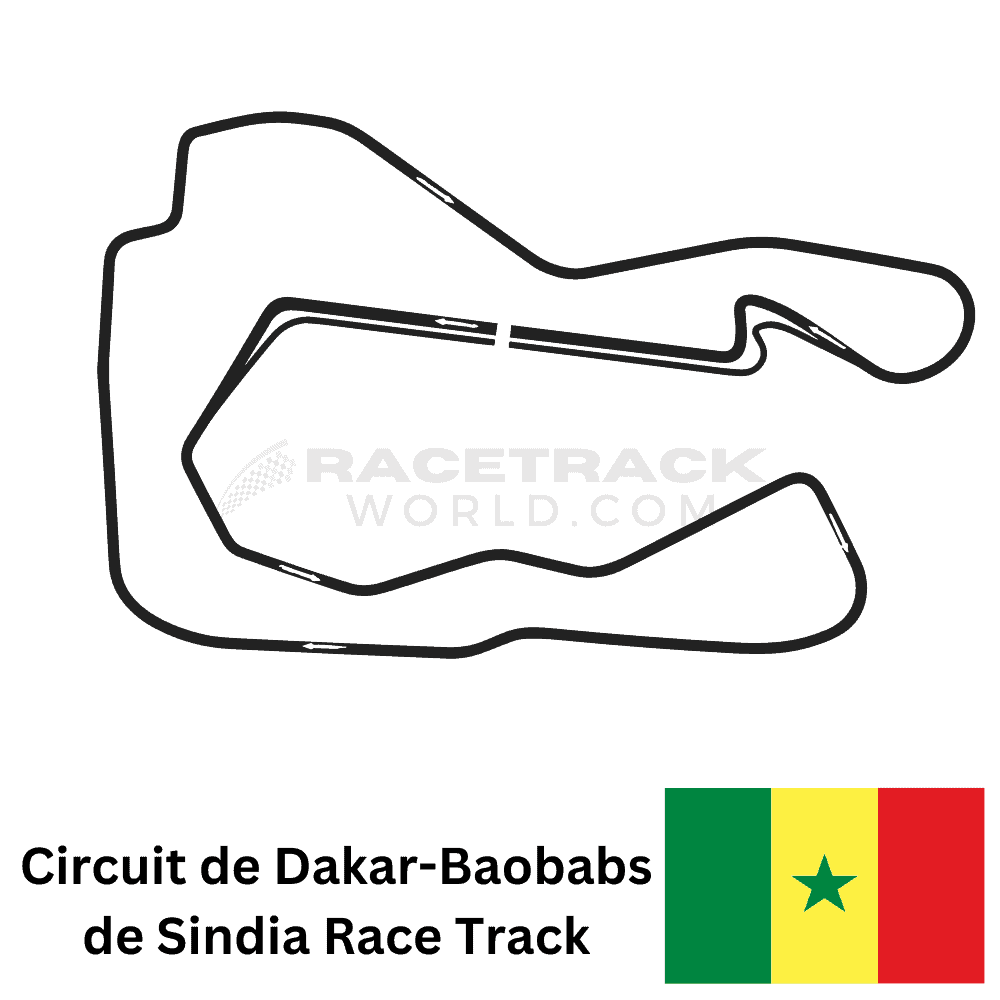
West Africa's first permanent race circuit sits on an 80-hectare site at Sindia, around 60 km south of Dakar. The 4.700 km, 21-turn lap was drawn up by Jean-André Collard for founder Paul Libens and mixes fast, sweeping sections with tighter technical combinations, giving it a reputation as a demanding but rewarding circuit by regional standards. The layout was finalised in the early 2000s after decades of earlier proposals for a permanent Senegalese circuit had stalled, and it was FIA-homologated in 2009 shortly after opening.
Configurations
| Layout | Length | Used for |
|---|---|---|
| Full circuit (2008-present) | 4.70 km | 4.700 km, 21 turns, the only configuration |
Events and race weekends
The circuit is West Africa's main venue for organised circuit racing, hosting national Senegalese motorsport championships and the long-running Dakar 6 Hours endurance race for local and regional teams. It functions primarily as a national and regional facility rather than a stop on international championship calendars, and its FIA homologation supports Senegalese federation events run under FIA-recognised rules.
| Event | Series | When | Notes |
|---|---|---|---|
| Dakar 6 Hours | Senegalese endurance racing | — | long-running regional endurance event; exact current date not confirmed |
Getting there and parking
Sindia lies south of Dakar along Senegal's main coastal road corridor, roughly an hour's drive from the capital and from Blaise Diagne International Airport, which serves Dakar. There is no direct public transport to the circuit gates, so visitors typically arrange a taxi, rideshare or hire car from Dakar or from the airport.
- Blaise Diagne International Airport (DSS) · about 45 min drive
Roads and signage around Sindia are geared to local traffic rather than tourism, so confirming directions with the circuit or a local contact before travelling is worthwhile.
Hotels and camping near Circuit de Dakar-Baobabs
Most visitors base themselves in Dakar, which has the widest choice of hotels and is roughly an hour's drive from Sindia, or along the nearby Petite Côte beach resorts such as Saly, which sit closer to the circuit. There is no trackside camping or on-site accommodation at the venue itself.
Where to look
Dakar (widest hotel choice, about an hour away) or the Petite Côte resort towns such as Saly and Mbour, which are closer to Sindia.
Track days, driving experiences and lap records
The circuit is used mainly for organised national championship and endurance racing rather than a standing public track-day programme; visiting drivers would need to arrange access through the Senegalese motorsport federation or local clubs rather than booking a commercial track-day operator.
Spectator guide
As a regional racing facility rather than a major international venue, spectator infrastructure is modest compared with larger circuits; fans typically watch from general viewing areas around the perimeter rather than large dedicated grandstands.
Weather
- Nov-Feb (dry season): warm and dry, highs around 28-30°C, the most comfortable months to visit
- Jun-Sep (wet season): hot and humid with seasonal rains
History of Circuit de Dakar-Baobabs
A quarter-century in the making
The idea of a permanent race circuit for Senegal was first proposed to national authorities in 1975, but it took until the 2000s for the project to become reality. Belgian entrepreneur Paul Libens, who had lived and worked in Senegal for nearly three decades, bought an 80-hectare site at Sindia, about 60 km south of Dakar, and commissioned his son-in-law Jean-André Collard to design the layout.
Building West Africa's first permanent circuit
Construction moved quickly once the plans were finalised, and the 4.700 km, 21-turn Circuit de Dakar-Baobabs opened in 2008 as the first permanent motor-racing facility in West Africa. The track combines fast sections with technical, tightly linked corners, and it received FIA homologation in 2009, formalising its status for federation-sanctioned competition.
A home for Senegalese motorsport
Since opening, the circuit has served primarily as the base for Senegal's national motorsport scene, hosting championship rounds organised by the Fédération Sénégalaise du Sport Automobile and the long-standing Dakar 6 Hours endurance race, which continued a name and format with roots going back decades in Senegalese racing culture. Rather than becoming a fixture on wider international championship calendars, the venue has functioned mainly as a national and regional hub, giving Senegalese and neighbouring drivers a permanent home for circuit racing where none existed before 2008. It remains, as of the mid-2020s, the principal organised racing venue in French-speaking West Africa.
Frequently asked questions
How long is the Circuit de Dakar-Baobabs?+
The circuit is 4.700 km (2.920 miles) long with 21 turns, and has run in this single configuration since it opened.
Is this the first permanent race circuit in West Africa?+
Yes. When it opened in 2008, it was the first permanent motor-racing circuit built in West Africa.
What events are held at the circuit?+
It hosts Senegalese national motorsport championship rounds and the Dakar 6 Hours endurance race, and is FIA-homologated for federation-sanctioned competition.
How far is the circuit from Dakar?+
Sindia is roughly 60 km south of Dakar, about an hour's drive depending on traffic and route.
Can visitors do a track day at the circuit?+
There is no standing commercial track-day operator; the circuit is used mainly for organised national championship and endurance events run through the Senegalese motorsport federation.
Facts checked against 3 sources including the official circuit website. Last reviewed 2026-09-11.