
Fuji Speedway
Fuji Speedway at a glance
- Location
- Oyama, Suntō District, Shizuoka Prefecture
- Type
- road course
- Length
- 4.563 km (2.835 mi)
- Turns
- 16
- Direction
- clockwise
- Surface
- asphalt
- Opened
- 1966
- Owner
- Toyota Motor Corporation
- Capacity
- 110,000
- Address
- 694 Nakahinata
- Website
- fsw.tv
Track map and layout
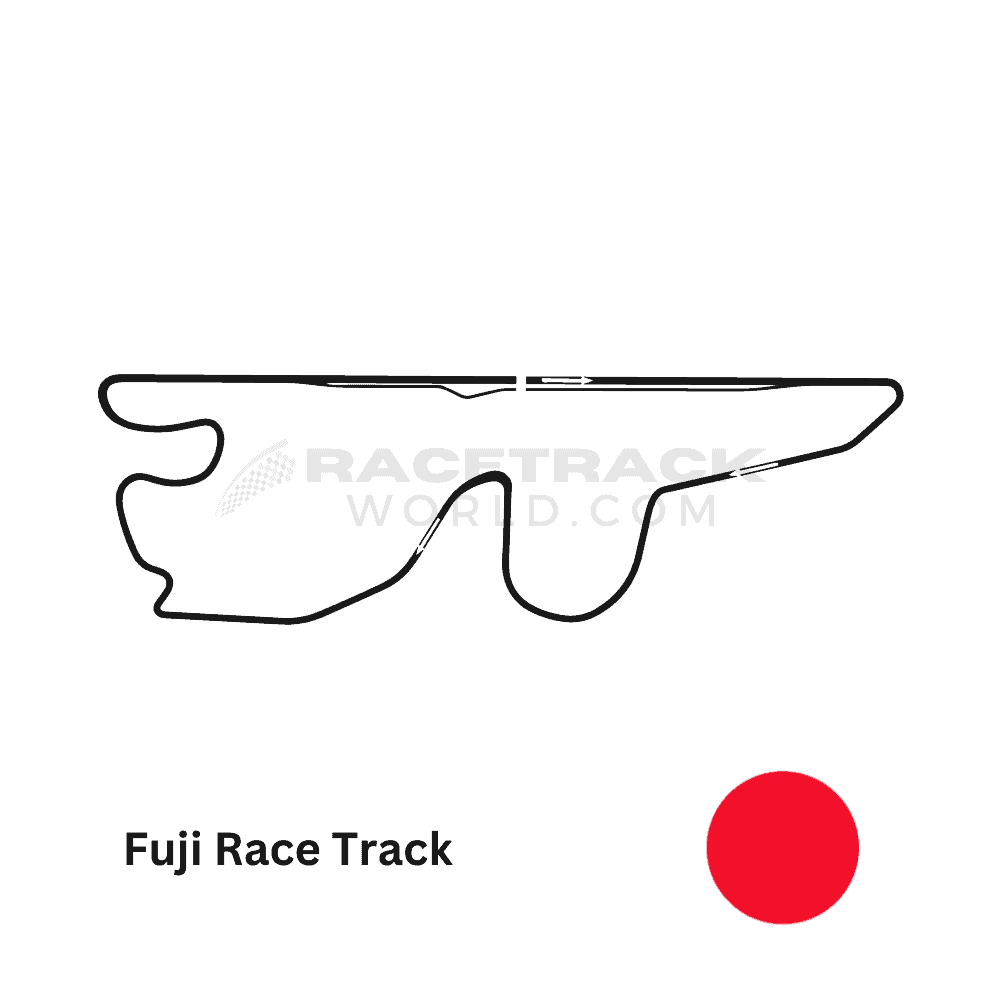
Fuji Speedway's calling card is its front straight, at 1.475 km (0.917 mi) one of the longest in world motorsport, running straight toward the base of Mount Fuji on clear days and setting up hard braking into the first-corner complex. The current layout dates to a 2003-2005 rebuild by circuit designer Hermann Tilke, commissioned by Toyota after it bought the track in 2000, which removed the old high-speed banked turn from the original 1966 design in favour of a more conventional, safety-focused road course. Corners such as the Coca-Cola hairpin and the 100R sweeper reward a mix of heavy braking and high-speed commitment, and the circuit's position at the base of Japan's most famous mountain makes it one of the most scenic tracks on the international calendar.
Named corners and sections
- Turn 1 / Coca-Cola Corner. A tight, heavily braked right-hander at the end of the long front straight, one of the circuit's main overtaking spots.
- 100R. A fast, sweeping right-hand corner named for its radius, testing high-speed commitment mid-lap.
- Dunlop Corner. A technical section named for a former trackside sponsor sign, part of the circuit's flowing middle sector.
Configurations
| Layout | Length | Used for |
|---|---|---|
| Grand Prix course | 4.56 km | 4.563 km current Tilke-designed layout used since 2005 for WEC, Super GT and Super Formula |
Events and race weekends
Fuji Speedway's marquee event is the FIA World Endurance Championship's 6 Hours of Fuji, held in the cooler autumn months and drawing top-tier Hypercar and GT manufacturer teams. Super GT and Super Formula, Japan's leading GT and open-wheel series, both hold rounds at the circuit across the season. Fuji also hosted Formula 1's Japanese Grand Prix in 1976 (the country's first F1 race) and again in 2007 and 2008, and staged the road cycling events for the postponed 2020 Tokyo Olympics in 2021.
| Event | Series | When | Notes |
|---|---|---|---|
| WEC 6 Hours of Fuji | FIA World Endurance Championship | September | Hypercar and GT endurance round |
| Super GT Fuji rounds | Super GT | multiple rounds | includes a long-distance race at the circuit |
| Super Formula Fuji round | Super Formula | varies | Japan's top open-wheel series |
Getting there and parking
Most visitors travel via Shinkansen to Mishima Station (about 55 minutes from Tokyo), then change to the JR Gotemba Line for Gotemba Station (roughly 40 minutes further), which is the main hub for circuit shuttle buses on event weekends. On WEC and other major race weekends, dedicated shuttle buses run from Gotemba Station to the circuit, a 20-30 minute ride.
- Tokyo Haneda Airport (HND)
- Shizuoka Airport (FSZ)
Parking
On-site parking is available for most events; race-weekend parking for major events like the WEC round can fill and is best booked with event tickets in advance.
Check the official event page for shuttle timetables before travelling, since shuttle schedules vary by race weekend and return buses can be crowded right after the chequered flag.
Hotels and camping near Fuji Speedway
Fuji Speedway has its own on-site hotel, the Fuji Speedway Hotel (part of Hyatt's Unbound Collection), overlooking the start-finish straight with Mount Fuji views. Beyond the circuit, most visitors base themselves in Gotemba, a short shuttle ride from the track, or in Mishima, which has larger hotel stock and a Shinkansen connection.
Where to look
Fuji Speedway Hotel (on-site); Gotemba (closest town, geared to circuit traffic); Mishima (bigger hotel supply and Shinkansen access, about an hour from the circuit with the connecting shuttle).
Track days, driving experiences and lap records
Fuji Speedway runs its own sports driving day programmes that let members of the public with a valid licence drive the full Grand Prix circuit in their own road car under circuit supervision, alongside manufacturer and one-make track day bookings. Availability is limited and typically needs advance reservation through the circuit.
Who runs days here
- Fuji Speedway sports driving days (official)car
Lap records
| Category | Time | Driver | Car | Year |
|---|---|---|---|---|
| F1 (current Tilke-era layout) | 1:18.426 | Felipe Massa | Ferrari F2008 | 2008 |
Spectator guide
The main grandstands line the long front straight and first-corner complex, giving views of the braking zone into Turn 1 with Mount Fuji as a backdrop on clear days. General-admission hillside areas around the circuit offer more affordable views of multiple corners.
Seating
Grandstands cluster around the pit straight and Turn 1; some elevated general-admission areas overlook the middle sector.
Best places to watch
The main straight grandstands give the classic Mount Fuji backdrop photo and a view of the heavy braking into Turn 1.
Weather
- September (WEC 6 Hours): still warm, daytime highs around 24-27°C with a chance of typhoon-season rain
History of Fuji Speedway
An oval that never was
Fuji Speedway was originally conceived in the early 1960s as an American-style banked superspeedway, but the mountainous terrain near Mount Fuji made the plan impractical to complete in full. The circuit that opened in December 1965 (racing from January 1966) retained a steeply banked final corner but was otherwise built as a road course, giving Fuji a distinctive, dangerous hybrid character in its early decades. That banking, including a notorious 30-degree turn, produced some of Japanese motorsport's fastest and most feared corners before safety concerns led to its eventual removal.
Japan's first Formula 1 race
Fuji hosted Japan's first-ever Formula 1 World Championship race in 1976, a rain-soaked Japanese Grand Prix remembered for Niki Lauda's withdrawal on safety grounds after his Nürburgring crash earlier that year, and for James Hunt's title-deciding drive to third place. F1 returned in 1977 before a fatal accident involving marshals and spectators led the sport to leave Fuji for three decades.
Toyota ownership and the Tilke rebuild
Toyota purchased Fuji Speedway in 2000 and commissioned a major reconstruction by circuit designer Hermann Tilke, closing the track in 2003 and reopening it in 2005 with the current 4.563 km layout, which removed the old high-speed banking in favour of a more conventional, safety-oriented road course while keeping the signature long front straight. Formula 1 returned for the Japanese Grand Prix in 2007 and 2008 before moving back to Suzuka. Today Fuji is best known for hosting the WEC's 6 Hours of Fuji and long-distance Super GT racing, and it added an on-site Hyatt-branded hotel and expanded hospitality facilities in the 2020s, cementing its status as one of Japan's premier motorsport destinations.
Frequently asked questions
How long is Fuji Speedway?+
The current Grand Prix circuit is 4.563 km (2.835 miles) long with 16 turns, including a 1.475 km front straight, one of the longest in motorsport.
Who owns Fuji Speedway?+
Toyota Motor Corporation has owned Fuji Speedway since 2000 and rebuilt the circuit to its current layout between 2003 and 2005.
How do you get to Fuji Speedway from Tokyo?+
Most visitors take the Shinkansen to Mishima Station, change to the JR Gotemba Line for Gotemba Station, then use a shuttle bus (running on major event weekends) for the final 20-30 minutes to the circuit.
Did Fuji Speedway used to be an oval?+
It was originally planned as an American-style banked oval in the early 1960s, and the track that opened in 1966 kept a steeply banked final corner, but the layout was rebuilt as a conventional road course in the 2003-2005 Tilke redesign.
What events does Fuji Speedway host?+
The circuit's biggest annual event is the WEC 6 Hours of Fuji; it also hosts Super GT and Super Formula rounds and has staged Formula 1's Japanese Grand Prix (1976-77 and 2007-08).
Can you drive Fuji Speedway yourself?+
Yes, the circuit runs official sports driving day sessions for licensed drivers in road cars, bookable in advance through the circuit.
Other tracks nearby
- Tsukuba Circuit · 127 km · road course
- Mobility Resort Motegi (formerly Twin Ring Motegi) · 174 km · road course & oval
- Suzuka Circuit · 225 km · road course
- Sportsland SUGO · 345 km · road course
- Sendai Hi-Land Raceway · 367 km · historic circuit (defunct)
- Okayama International Circuit · 431 km · road course
Facts checked against 4 sources including the official circuit website. Last reviewed 2026-09-11.