
Suzuka Circuit
Suzuka Circuit at a glance
- Location
- Suzuka, Mie Prefecture
- Type
- road course
- Length
- 5.807 km (3.608 mi)
- Turns
- 18
- Direction
- clockwise
- Surface
- asphalt
- Opened
- 1962
- Owner
- Honda (operated by Honda Mobilityland Corporation)
- Capacity
- 155,000
- Address
- 7992 Ino-cho
- Website
- suzukacircuit.jp/eng
Track map and layout
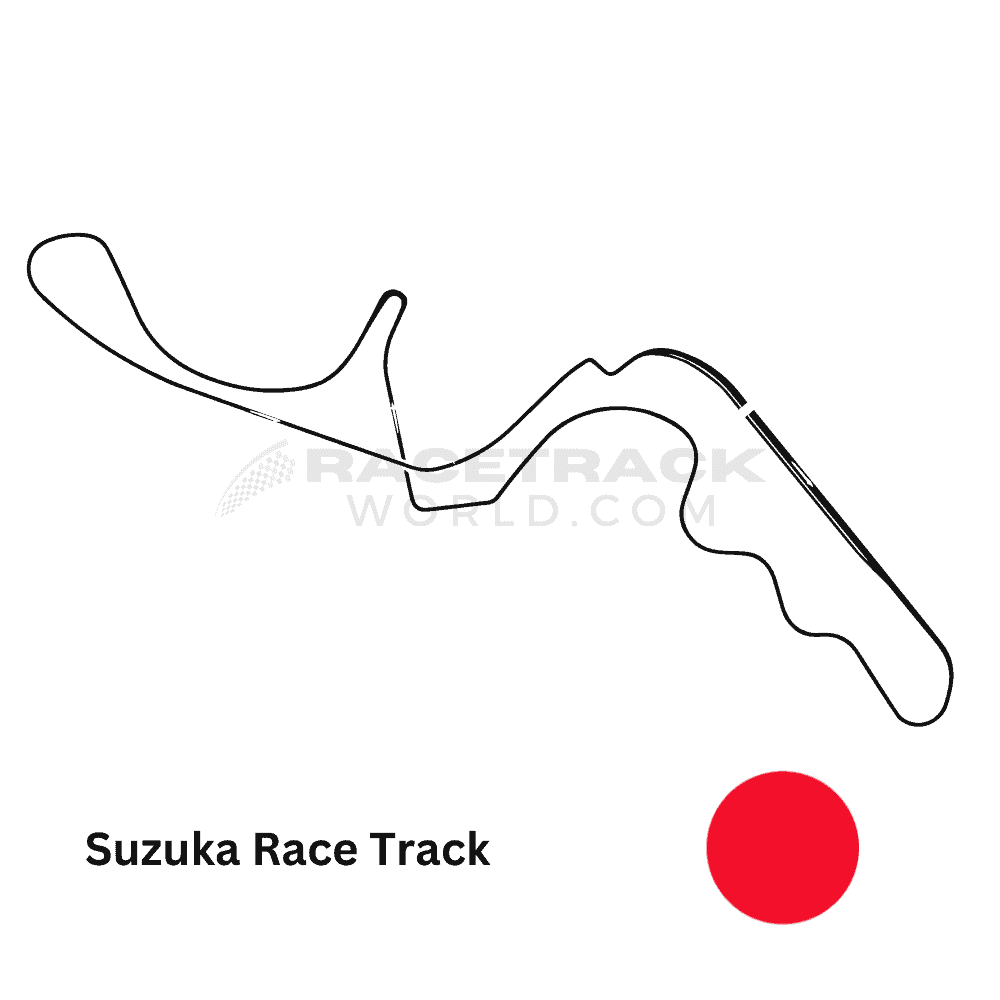
Suzuka is the world's most famous figure-eight circuit, its back straight crossing over the front section on a purpose-built overpass, a layout designed by Dutch engineer John 'Hans' Hugenholtz in 1962 as a Honda test track. The lap opens with the uphill/downhill first-corner complex before the snaking S Curves, sweeps through the fast Degner double-right and under the crossover into the long, banked 130R, then finishes with the tight Casio Triangle chicane onto the front straight. It remains one of only a handful of circuits worldwide to hold an FIA Grade 1 license with a figure-eight layout, and is widely rated by drivers as one of the most technically demanding tracks on the calendar for its blend of high-speed sweepers and tight, low-speed sections.
Named corners and sections
- 130R. A long, high-speed left-hand sweeper taken flat out by modern F1 cars, historically one of the fastest corners in the world; named for its 130-metre radius.
- Spoon Curve. A double-apex right-hander shaped like a spoon, leading onto the back straight toward the crossover and 130R.
- Degner Curve. A fast double-right kink following the first-corner complex, named after motorcycle racer Ernst Degner; a notoriously tricky braking zone.
- S Curves. A rhythmic sequence of high-speed direction changes right after Turn 1, a key test of car balance and driver confidence.
- Casio Triangle. The tight chicane before the start/finish straight, named for a former trackside Casio sign; a common overtaking and first-lap incident spot.
Configurations
| Layout | Length | Used for |
|---|---|---|
| Grand Prix circuit (Full course) | 5.81 km | 5.807 km figure-eight layout used for F1, Super GT and Suzuka 8 Hours |
| East Course | — | shorter configuration used for club racing and driving schools |
Events and race weekends
Suzuka's headline event is the Formula 1 Japanese Grand Prix, one of the sport's most revered rounds and historically the venue of multiple championship-deciding races. In summer (early July in 2026), the Suzuka 8 Hours brings Japan's biggest motorcycle manufacturers together for an endurance classic that doubles as a festival for the country's bike culture. Super GT and Super Formula, Japan's premier GT and open-wheel series, both hold rounds here, alongside domestic touring car and one-make series throughout the season.
| Event | Series | When | Notes |
|---|---|---|---|
| Formula 1 Japanese Grand Prix | Formula 1 | March/April | one of F1's most historic and technically demanding rounds |
| Suzuka 8 Hours | FIM Endurance / motorcycle | July | flagship motorcycle endurance race backed by Honda, Yamaha, Suzuki and Kawasaki |
| Super GT Suzuka round | Super GT | August | Summer 300 km round (22-23 Aug 2026) |
| Super Formula Suzuka round | Super Formula | varies | Japan's top open-wheel series |
Getting there and parking
The circuit has its own station, Ise Railway's Suzuka Circuit Ino, but it is a roughly 25-minute walk from the track with no connecting bus, and during F1 weekend queues there can run over three hours, so it is not the recommended route on race days. Most F1 visitors instead base themselves in Nagoya and take a temporary event shuttle bus from Kintetsu Shiroko Station, which runs only during the Grand Prix weekend.
- Chubu Centrair International Airport (NGO) · about 60 min drive
- Nagoya (via Kintetsu Nagoya Station rail link)
Parking
Circuit car parks are available but fill quickly on Grand Prix weekend and require advance booking through official ticket packages; many fans use park-and-ride shuttle options instead.
During the F1 weekend, take the temporary shuttle bus from Kintetsu Shiroko Station (about 500 yen one-way for adults) rather than Suzuka Circuit Ino station, which has no direct bus link and very long queues.
Hotels and camping near Suzuka Circuit
Hotels immediately around the circuit are limited, geared mainly toward the on-site Suzuka Circuit Hotel, and sell out quickly once Grand Prix tickets go on sale. Most international visitors base themselves in Nagoya, roughly an hour away by train and shuttle, or in Yokkaichi, closer to the circuit but with fewer rooms.
Where to look
Suzuka Circuit Hotel (on-site, limited rooms, free shuttle to the Main Gate); Yokkaichi (closer, smaller city); Nagoya (largest hotel supply, about an hour from the circuit via rail and shuttle).
Camping
The circuit runs a Family Camp area on-site for casual and event camping.
Track days, driving experiences and lap records
Suzuka Circuit is not open for casual paid tourist laps in the way some European tracks are, but the on-site Suzuka Motor Sports Club (SMSC) runs licensed sports-driving sessions for members and visitors at several skill tiers, from beginner 'Enjoy Club' sessions to more advanced club racing, and Honda Racing School Suzuka (HRS-Suzuka) offers structured car and motorcycle instruction on the circuit's shorter configurations.
Who runs days here
Lap records
| Category | Time | Driver | Car | Year |
|---|---|---|---|---|
| F1 race lap record (Grand Prix circuit) | 1:30.965 | Andrea Kimi Antonelli | Mercedes | 2025 |
Spectator guide
Suzuka's grandstands wrap much of the lap, from the first-corner complex through the S Curves and down to the Casio Triangle chicane, giving strong sightlines across several corners from a single seat. The infield 130R and Spoon Curve areas are popular general-admission viewing spots for fans who want to see the circuit's fastest sections up close.
Seating
Grandstands are numbered around the lap (notably near Turn 1, the S Curves, Degner, Spoon Curve, 130R and the Casio Triangle); reserved seats for the Japanese GP sell out well in advance.
Best places to watch
130R and the Spoon Curve give the best view of Suzuka's high-speed character; the Casio Triangle chicane is a good spot for overtaking action late in the lap.
Weather
- April (F1 GP): mild spring weather, daytime highs typically around 18-22°C with a chance of rain
- August (Suzuka 8 Hours): hot and humid, daytime highs often exceeding 32°C
History of Suzuka Circuit
A Honda test track becomes a global icon
Suzuka Circuit opened in September 1962, commissioned by Honda and designed by Dutch engineer John 'Hans' Hugenholtz as a technical proving ground unlike anything else in Japan at the time. Its defining feature, a figure-eight layout with a purpose-built overpass carrying the back straight over the front section, was virtually unheard of on a permanent circuit and remains one of the venue's calling cards today.
Becoming Japan's Formula 1 heartland
Suzuka first hosted the Formula 1 Japanese Grand Prix in 1987 and quickly became one of the most anticipated rounds on the calendar, prized by drivers for its flowing, high-speed character and by fans for its late-season timing, which frequently made it a championship decider. Ayrton Senna's title-clinching moments here in the late 1980s, and numerous dramatic wet-weather races since, cemented Suzuka's reputation as one of the sport's great venues. The Japanese GP moved briefly to Fuji Speedway in 2007 and 2008 before returning to Suzuka, where it has remained.
Motorcycles, endurance racing and today's circuit
Beyond F1, Suzuka has long been the spiritual home of Japanese motorcycle racing, hosting the Suzuka 8 Hours endurance classic since 1978, an event that draws factory teams from Honda, Yamaha, Suzuki and Kawasaki and remains a highlight of the international endurance calendar. Ownership passed from Honda's direct management to subsidiary Honda Mobilityland in 2006, which continues to operate the circuit, its on-site hotel, amusement park and driving school today, alongside a full domestic racing calendar including Super GT and Super Formula.
Frequently asked questions
How long is Suzuka Circuit?+
The Grand Prix circuit is 5.807 km (3.608 miles) long with 18 turns, run in a clockwise direction.
Why does Suzuka have a figure-eight layout?+
Designer John Hugenholtz built the back straight to cross over the front section on an overpass when the circuit was constructed as a Honda test track in 1962; it remains one of very few permanent circuits in the world with this layout.
How do you get to Suzuka Circuit for the Japanese Grand Prix?+
The circuit's own Ise Railway station, Suzuka Circuit Ino, is a 25-minute walk with no shuttle bus and very long queues on race day. Most fans instead stay in Nagoya and use the temporary event shuttle bus from Kintetsu Shiroko Station.
Can the public drive Suzuka Circuit?+
Yes, on a members and visitors basis. The on-site Suzuka Motor Sports Club runs graded sports-driving sessions, and Honda Racing School Suzuka offers structured car and motorcycle instruction, though this is not casual pay-per-lap tourist driving.
What is the F1 lap record at Suzuka?+
Andrea Kimi Antonelli set the current race lap record of 1:30.965 for Mercedes in 2025.
Where do F1 fans stay for the Japanese Grand Prix?+
Hotels immediately around the circuit are scarce and sell out fast; most international visitors base themselves in Nagoya, about an hour away, and travel in daily by shuttle bus.
Other tracks nearby
- Okayama International Circuit · 212 km · road course
- Fuji Speedway · 225 km · road course
- Tsukuba Circuit · 342 km · road course
- Mobility Resort Motegi (formerly Twin Ring Motegi) · 382 km · road course & oval
- Mine Circuit · 504 km · historic circuit (defunct)
- Sportsland SUGO · 523 km · road course
Facts checked against 4 sources including the official circuit website. Last reviewed 2026-09-11.