
Korea International Circuit
Korea International Circuit at a glance
- Location
- Yeongam, South Jeolla Province (전라남도, Jeollanam-do)
- Type
- road course
- Length
- 5.615 km (3.489 mi)
- Turns
- 18
- Direction
- clockwise
- Surface
- asphalt
- Opened
- 2010
- Owner
- Korea Auto Valley Operation (KAVO)
- Capacity
- 135,000
- Phone
- +82-61-288-4207
- Website
- koreacircuit.kr
Track map and layout
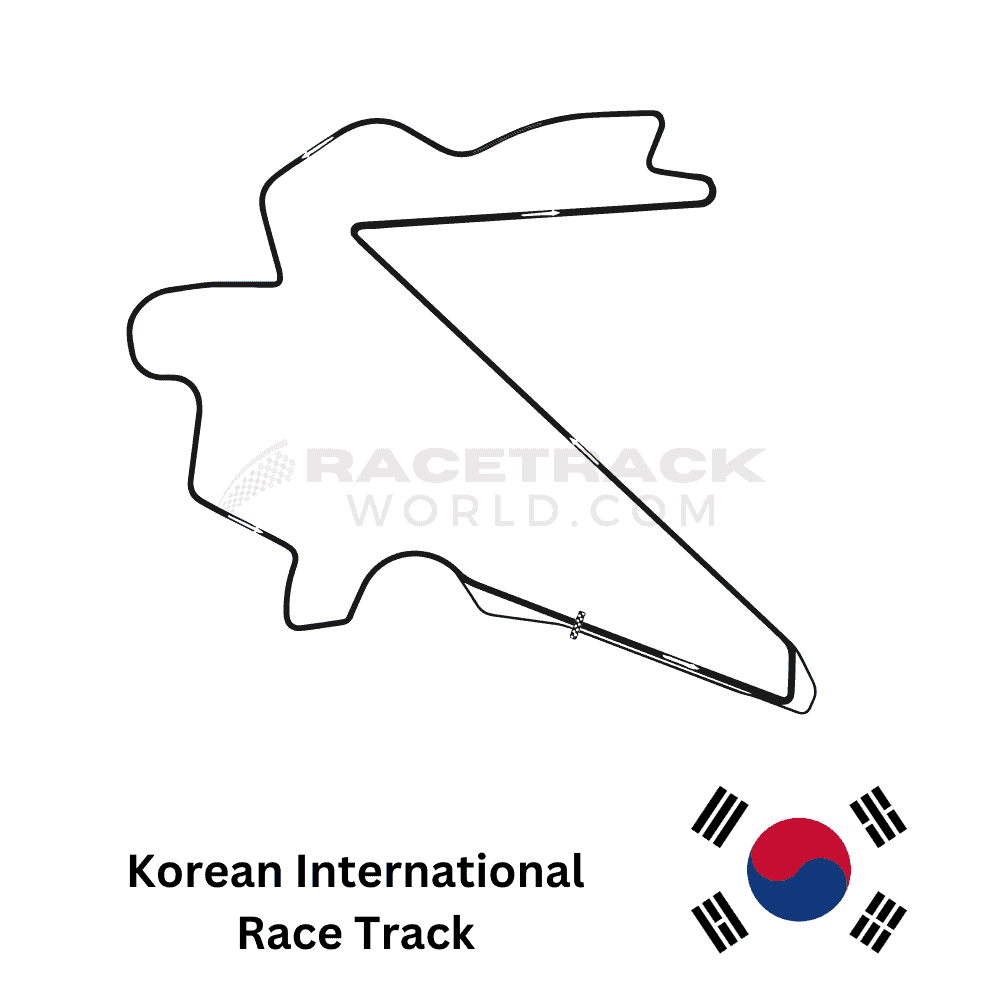
Designed by Hermann Tilke, the Grand Prix circuit combines a permanent northern loop with a temporary-style southern section built around F1-standard pit and paddock facilities, giving the lap a mixed permanent/street-circuit character. The layout mixes long straights and sharp, overtaking-friendly hairpins with a handful of quicker corners, running mostly over flat, reclaimed land near the harbour rather than natural terrain. A 2019 link road created a shorter Grand Prix configuration alongside the original full layout. The pit entry and exit were criticised by Formula 1 drivers, including Robert Kubica, for sitting on the racing line at the exit of a high-speed corner, prompting modifications in 2011 and 2013.
Configurations
| Layout | Length | Used for |
|---|---|---|
| Grand Prix circuit | 5.61 km | 5.615 km, 18 turns; used for the Korean Grand Prix (2010-2013) |
| Short Grand Prix circuit | 3.31 km | 3.312 km, 13 turns; created via a 2019 link road |
| National circuit | 3.04 km | 3.045 km, 11 turns; used for domestic club racing |
Events and race weekends
Built specifically to bring Formula 1 to South Korea, the circuit hosted the Korean Grand Prix for four seasons from 2010 to 2013 before F1 dropped the race amid low attendance and financial disputes with local authorities. Since then the venue's headline event has been the domestic Superrace Championship, Korea's top touring car and GT series, which typically runs rounds here in spring and autumn. The circuit has also hosted various one-make and Asian regional series over the years, including GT Asia Series, TCR Asia and Porsche Carrera Cup Asia rounds, though international support has thinned considerably since the F1 era ended.
| Event | Series | When | Notes |
|---|---|---|---|
| Superrace Championship rounds | Superrace Championship | May and September | Korea's premier touring car/GT series; the circuit's main recurring event today |
Getting there and parking
The circuit sits in Yeongam-gun, South Jeolla Province, about 400 km south of Seoul near the port city of Mokpo. Most domestic visitors drive or take an intercity bus from Seoul or Gwangju; Mokpo is also reachable from Seoul's Yongsan Station by KTX high-speed train in a little over three hours, with local transfers required on to the circuit itself.
- Muan International Airport (MWX) · about 40 min drive
- Gwangju Airport (KWJ) · about 60 min drive
Mokpo, the nearest city with a meaningful hotel base, is roughly 30 minutes from Muan International Airport by bus; onward travel to the circuit itself generally requires a taxi or hire car as there is no dedicated rail link to the track.
Hotels and camping near Korea International Circuit
There is little accommodation immediately at the circuit itself, so most visitors base themselves in Mokpo, the nearest port city, which has a reasonable spread of business and tourist hotels and is connected to Seoul by KTX and intercity bus. Booking ahead is recommended around Superrace weekends, when local hotel supply is limited.
Where to look
Mokpo city centre (widest hotel choice, around 30-40 minutes' drive from the circuit); Yeongam-gun itself has more limited options closer to the track.
Track days, driving experiences and lap records
The circuit is not widely promoted for casual public track days or ride-alongs, and no dedicated tourist track-day operator at the venue was verified. It functions primarily as a domestic racing and testing facility for Korean series such as Superrace, along with occasional manufacturer and club events.
Lap records
| Category | Time | Driver | Car | Year |
|---|---|---|---|---|
| F1 race lap record (Grand Prix circuit) | 1:39.605 | Sebastian Vettel | Red Bull RB7 | 2011 |
Spectator guide
The circuit was built with F1-scale grandstands and a listed capacity of 135,000, though actual attendance at both the Korean Grand Prix and subsequent domestic events has been well below that figure. The harbour-adjacent southern section offers open sightlines across the pit straight and start-finish area.
Seating
Grandstands are concentrated around the pit straight, start-finish and pit-exit area built for the Korean Grand Prix.
Weather
- May: mild spring conditions, daytime highs typically around 20-24°C
- September: warm with typhoon risk in early autumn, highs typically around 25-28°C
History of Korea International Circuit
Built for Formula 1
Korea International Circuit broke ground in September 2009 on reclaimed land near Yeongam, in South Jeolla Province, as part of a government-backed push to establish a "Korea Auto Valley" motorsport and automotive hub near the port city of Mokpo. Designed by Hermann Tilke, the 5.615 km circuit combined a permanent northern loop with F1-standard pit and paddock buildings, and was completed on a tight schedule, with the track surface reportedly still receiving its final layer as the first Korean Grand Prix approached in October 2010.
Four seasons of the Korean Grand Prix
The circuit hosted the Formula 1 Korean Grand Prix for four consecutive seasons from 2010 to 2013. From the outset, drivers criticised aspects of the layout, most notably a pit lane entry positioned on the racing line at the exit of a fast corner; modifications followed in 2011 and again in 2013 to address safety concerns. Despite the Grade 1 FIA license, the event struggled with low attendance and reported financial disputes between the promoter and local government, and the Korean Grand Prix was dropped from the calendar after 2013, never to return.
Life after Formula 1
Since losing its F1 race, the circuit has continued operating as Korea's national motorsport venue, hosting the domestic Superrace Championship and a rotating cast of Asian regional series such as GT Asia, TCR Asia and Porsche Carrera Cup Asia in the years that followed, though at a much smaller scale than its F1-era ambitions. A shorter Grand Prix configuration was introduced in 2019 via a new link road. Today the venue is maintained as an active, FIA Grade 2 permanent facility used mainly for domestic racing, testing and occasional manufacturer events, a quieter second act for a track built for a global stage.
Frequently asked questions
How long is the Korea International Circuit?+
The Grand Prix circuit is 5.615 km (3.489 miles) long with 18 turns, run clockwise. Shorter National (3.045 km) and Short Grand Prix (3.312 km) configurations also exist.
Does Formula 1 still race at Korea International Circuit?+
No. The Korean Grand Prix ran for four seasons from 2010 to 2013 and was dropped from the F1 calendar after 2013 due to low attendance and financial disputes; it has not returned since.
What races are held there now?+
The circuit's main recurring event today is the domestic Superrace Championship, Korea's top touring car and GT series, which typically holds rounds there in spring and autumn.
How do you get to Korea International Circuit?+
The nearest airports are Muan International Airport (about 40 minutes away) and Gwangju Airport; the nearest city with hotels and transport links is Mokpo, reachable from Seoul by KTX high-speed train in a little over three hours.
What was the F1 lap record at the circuit?+
Sebastian Vettel set the race lap record of 1:39.605 driving a Red Bull RB7 in 2011.
Where do visitors stay when attending events there?+
Most visitors base themselves in Mokpo, the nearest city with a reasonable hotel supply, roughly 30-40 minutes' drive from the circuit.
Other tracks nearby
- Taebaek Speedway (MJ Taebaek Circuit) · 351 km · road course
- Inje Speedium · 400 km · road course
- Mine Circuit · 435 km · historic circuit (defunct)
- Autopolis International Racing Course · 455 km · road course
- Shanghai International Circuit · 614 km · road course
- Shanghai Tianma Circuit · 640 km · road course
Facts checked against 4 sources including the official circuit website. Last reviewed 2026-09-11.