
Albert Park Circuit
Albert Park Circuit at a glance
- Location
- Melbourne, Victoria
- Type
- street circuit
- Length
- 5.278 km (3.28 mi)
- Turns
- 14
- Direction
- clockwise
- Surface
- asphalt
- Opened
- 1996
- Owner
- Australian Grand Prix Corporation (Victorian Government statutory authority)
- Capacity
- 125,000
- Phone
- +61 3 9258 7100
- Website
- grandprix.com.au
Track map and layout
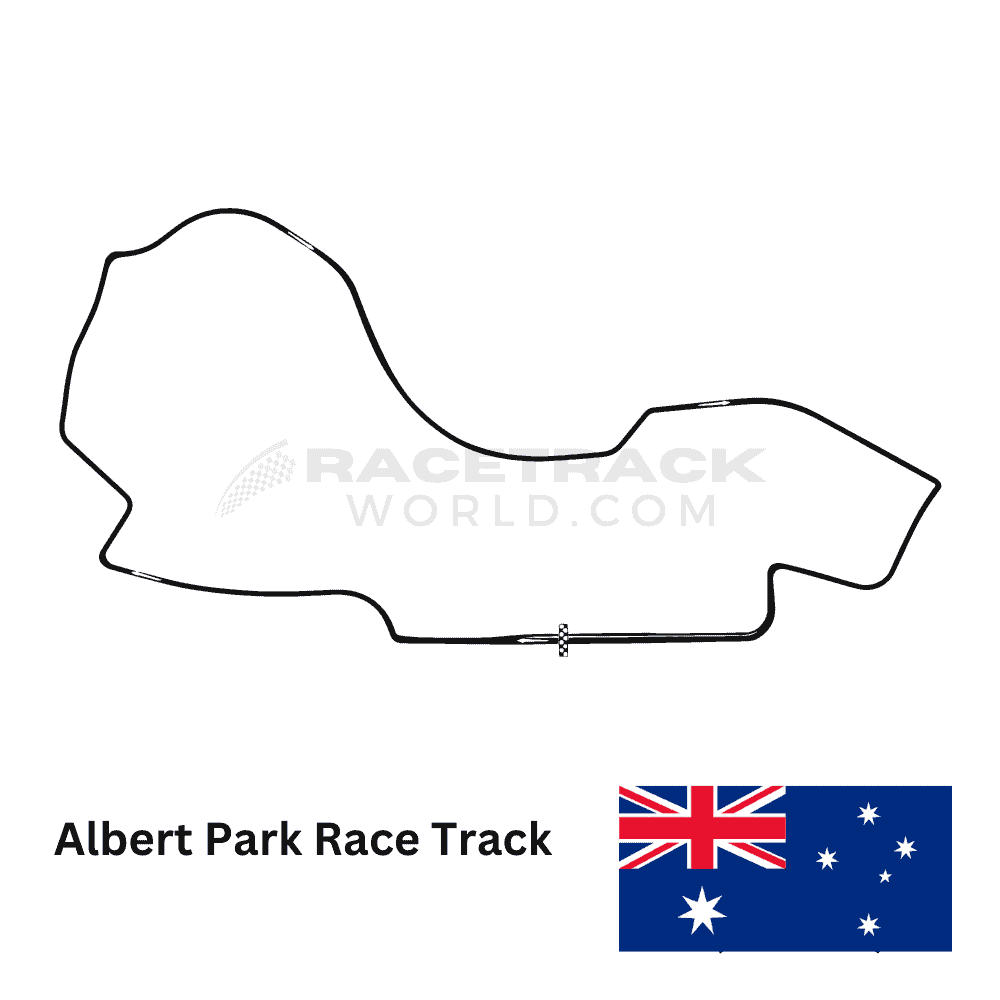
Albert Park is a temporary street circuit laid out on public roads circling Albert Park Lake, a few kilometres south of the Melbourne CBD. Unlike a tight, walled street track, the roads here are wide parkland avenues, so the lap flows at genuine racetrack speed with several long, high-gear sweeps rather than a stop-start chicane crawl. The current 14-turn, 5.278 km layout dates from a 2021-22 rebuild that widened Turn 11 and deleted the old Turn 9-10 chicane, creating a longer run to the final corners and a fresh DRS zone. Outside Grand Prix week the roads revert to normal park traffic, walking and cycling paths, which makes the circuit's annual transformation with grandstands, fencing and pit buildings one of the biggest temporary-venue builds on the F1 calendar. Several corners carry names honouring Australian motor racing figures.
Named corners and sections
- Turn 1 (Jones). A tight, decelerating right-hander into the first braking zone of the lap, named after 1980 F1 world champion Alan Jones.
- Turn 2 (Brabham). A fast, sweeping left taken in a high gear soon after Turn 1, named for triple world champion and Australian racing icon Sir Jack Brabham.
- Turn 5 (Whiteford). A flat-out right-hander along the lakeside, named after Doug Whiteford, winner of the original Albert Park Australian Grand Prix in 1953.
- Turn 7 (Marina). A fast, flowing left-hand sweep past the lake's marina that carries high commitment speed.
- Turn 8 (Lauda). Named for triple world champion Niki Lauda, this corner leads the field toward the tighter, technical middle sector of the lap.
- Turns 11-12. A fast left-right sequence widened in the 2022 rebuild, now the quickest corner combination on the circuit and a key overtaking zone under braking into Turn 13.
Configurations
| Layout | Length | Used for |
|---|---|---|
| Current Grand Prix Circuit (2022-present) | 5.28 km | 14 turns; Turn 9-10 chicane removed and Turn 11 widened for 2022 |
| 1996-2020 Grand Prix Circuit | 5.30 km | 16 turns; used from the circuit's F1 return until the pandemic-delayed 2021 rebuild |
Events and race weekends
The Formula 1 Australian Grand Prix in March is the reason the circuit exists in its modern form, and it remains one of the best-attended events on the F1 calendar, drawing crowds in the low hundreds of thousands across the four-day weekend. The support bill has varied by year but has included FIA Formula 2 and Formula 3, the Supercars Championship's Melbourne SuperSprint, and Porsche Carrera Cup Australia. Outside Grand Prix week the roads carry no other race events; the park is used year-round for walking, cycling, running events and other public recreation.
| Event | Series | When | Notes |
|---|---|---|---|
| Formula 1 Australian Grand Prix | FIA Formula One World Championship | March | Round of the F1 season; contracted to run at Albert Park through 2035 |
| Melbourne SuperSprint | Supercars Championship | March | Runs as a support category on the Grand Prix weekend bill |
Getting there and parking
Albert Park sits about 3 km south of the Melbourne CBD in the inner suburb of the same name. There is no general public parking at the circuit for Grand Prix week, and driving is actively discouraged; instead the Australian Grand Prix Corporation runs free shuttle trams from Flinders Street, Southern Cross and Melbourne Central stations direct to the venue gates, included with every event ticket, alongside regular tram routes that skirt the park. Melbourne Airport is roughly 30 minutes away by road via SkyBus and tram or taxi/rideshare.
- Melbourne Airport (MEL) · about 30 min drive
Parking
No dedicated general parking is available at Albert Park during the Grand Prix; nearby residential streets have strict parking restrictions and clearways, so the Australian Grand Prix Corporation and Public Transport Victoria recommend the free tram/train shuttles instead.
Grand Prix tickets include free travel on the shuttle trams and on regular metropolitan trains and trams on event days, so factor that into travel plans rather than trying to drive in.
Hotels and camping near Albert Park Circuit
Albert Park is an inner-city public park with no trackside accommodation of its own, so almost all Grand Prix visitors base themselves a short tram or taxi ride away in the Melbourne CBD or in the surrounding bayside and inner-south suburbs. CBD hotel occupancy climbs sharply during Grand Prix week and rooms close to the circuit are typically taken up by teams, sponsors and hospitality guests well ahead of the event, so independent travellers should book many months in advance.
Where to look
Melbourne CBD hotels are a few minutes from the circuit by tram; the closer bayside suburbs of Albert Park, South Melbourne, St Kilda and Port Melbourne, plus South Yarra, offer short-stay apartments and hotels within an easy tram ride and are popular alternatives once CBD stock is booked out.
Track days, driving experiences and lap records
Albert Park cannot be booked for track days or ride experiences: it is a public park used by walkers, cyclists and everyday traffic for the rest of the year, and is only closed off and configured as a circuit for the Grand Prix and its support events under a temporary state government permit. There is no public lapping program, hot lap experience or drive day associated with the venue.
Lap records
| Category | Time | Driver | Car | Year |
|---|---|---|---|---|
| Formula One | 1:19.813 | Charles Leclerc | Ferrari SF-24 | 2024 |
| FIA Formula 2 | 1:30.712 | Frederik Vesti | Dallara F2 2018 | 2023 |
| FIA Formula 3 | 1:34.405 | Grégoire Saucy | Dallara F3 2019 | 2023 |
| Supercars Championship | 1:46.006 | Scott Pye | Holden Commodore (ZB) | 2022 |
Spectator guide
General-admission spectators can walk large sections of the lakeside perimeter and watch from grass mounds and standing areas dotted around the park, while reserved grandstands line the start-finish straight and several of the braking zones. Because the lake is in the middle of the layout, many vantage points let fans see cars on two or three different parts of the track from one spot, which is unusual for a street circuit.
Seating
Grandstands are positioned along the pit straight and at key braking zones such as Turn 1/2 and Turn 3; free general-admission viewing areas circle much of the lake on the infield side.
Best places to watch
The general-admission mounds around the lake near Turns 11-13 give sight lines across several corners at once, while grandstands nearer Turn 1 and the pit straight suit fans who want to see start-lap action and pit stops.
Weather
- March: Melbourne autumn conditions, typically mild with highs around 22-24°C, but the city's changeable weather can bring a hot northerly day or a cool, wet southerly change within the same weekend
History of Albert Park Circuit
From park circuit to Grand Prix return
Albert Park first hosted motor racing in 1953, when a circuit was laid out on the roads around the lake and Doug Whiteford won the Australian Grand Prix by six laps in a field of local drivers, including a young Jack Brabham. The event returned in 1956 with a strong field of visiting European talent, but racing at the park ended in 1958 after sustained opposition from local residents and campaigners concerned about safety, crowd control and damage to the parkland, and the site went quiet for racing for over three decades.
Kennett's bid and the move from Adelaide
Albert Park's revival began in the early 1990s as part of a push by Victorian premier Jeff Kennett and businessman Ron Walker to lift Melbourne's international profile through major events. Their campaign succeeded in luring the Formula 1 Australian Grand Prix away from Adelaide, which had hosted the race since F1 first came to Australia in 1985, and the rebuilt Albert Park circuit staged its first F1 race in March 1996, immediately becoming one of the most popular events on the calendar.
Reconfiguration and the present day
The circuit ran largely unchanged for two decades before a pandemic-enforced gap in 2020-21 gave organisers the opportunity to rebuild several corners. The tight Turn 9-10 chicane was progressively softened and then removed altogether for 2022, and Turn 11 was widened, aims squarely at improving overtaking on a track long criticised as hard to pass on. The changes have been broadly welcomed, and with a contract running through 2035, Albert Park remains one of the anchor rounds of the modern F1 season, rebuilt from public parkland into a full Grand Prix venue and back again every year.
Frequently asked questions
How long is the Albert Park circuit?+
The current Grand Prix layout is 5.278 km (3.280 mi) with 14 turns, run clockwise.
Is Albert Park a permanent racetrack?+
No. It is a public park with normal roads used by traffic, cyclists and pedestrians for most of the year; grandstands, pit buildings and fencing are erected and removed around the Grand Prix each year.
What is the F1 lap record at Albert Park?+
1:19.813, set by Charles Leclerc in a Ferrari SF-24 during the 2024 Australian Grand Prix, on the current 14-turn layout.
How do you get to the Australian Grand Prix if you don't drive?+
Free shuttle trams run direct from Flinders Street, Southern Cross and Melbourne Central stations to the circuit gates on event days, included with every ticket, alongside regular tram and train services.
Where do people stay for the Australian Grand Prix?+
Most visitors stay in the Melbourne CBD or nearby suburbs such as St Kilda, South Melbourne and Port Melbourne and travel in by tram, since there is no accommodation at the park itself and nearby hotel rooms are booked out well ahead of race week.
Has the Australian Grand Prix always been held at Albert Park?+
No. Albert Park hosted the Australian Grand Prix from 1953 to 1958, then racing stopped there for decades while the event moved to Adelaide from 1985; Albert Park returned to the F1 calendar in 1996 and has hosted it since (aside from COVID-affected cancellations).
Other tracks nearby
- Sandown International Motor Raceway · 21 km · road course
- Calder Park Raceway · 27 km · road course & oval (Thunderdome dormant)
- Phillip Island Grand Prix Circuit · 76 km · road course
- Winton Motor Raceway · 178 km · road course
- Symmons Plains Raceway · 466 km · road course
- Wakefield Park · 539 km · road course
Facts checked against 5 sources including the official circuit website. Last reviewed 2026-09-10.