
Catalina Park
Catalina Park at a glance
- Location
- Katoomba, New South Wales
- Type
- historic circuit (defunct)
- Length
- 2.092 km (1.3 mi)
- Turns
- 8
- Surface
- asphalt
- Opened
- 1961
- Owner
- Blue Mountains City Council (declared Aboriginal Place, managed with Traditional Owners)
Track map and layout
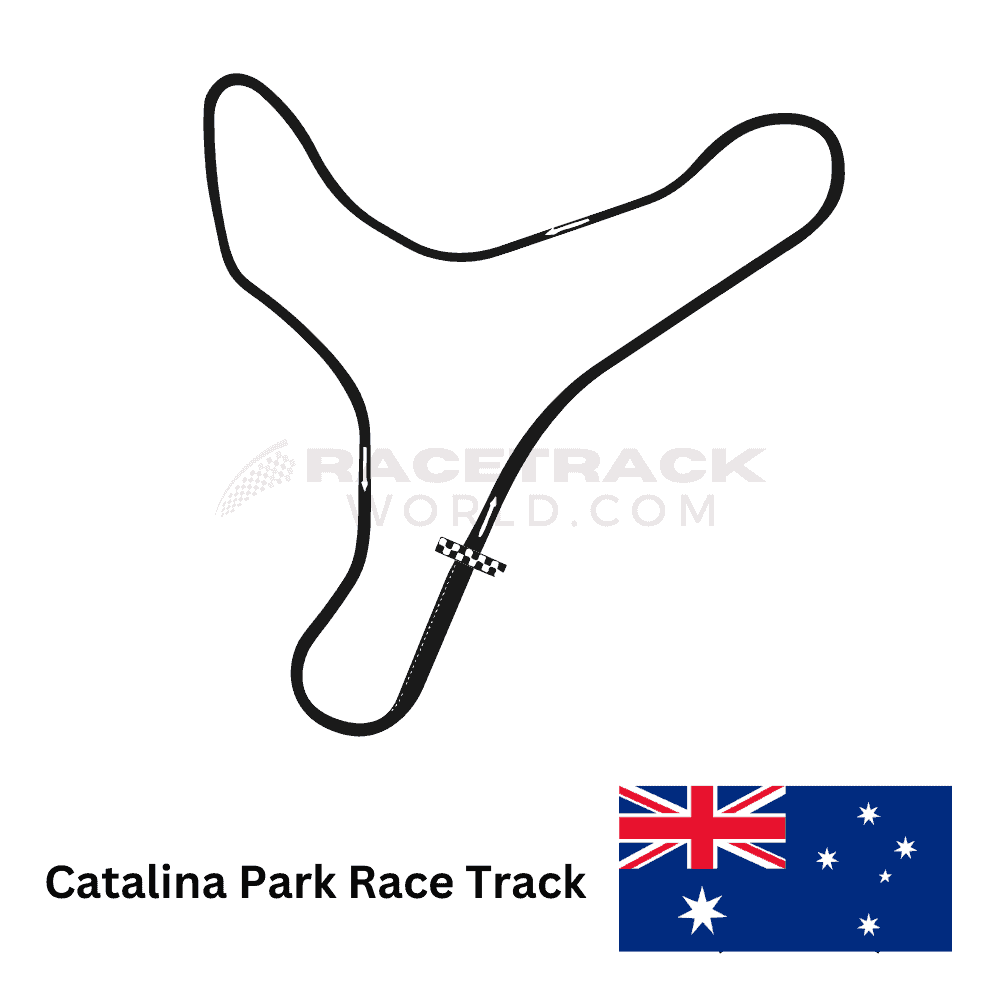
Catalina Park was built into a natural bowl-shaped valley just west of Katoomba's town centre, and its 2.09 km, eight-turn layout used the site's steep contours to create a genuinely undulating, roller-coaster lap for a track of its era. Sections were named for the era's motor racing sponsors rather than geographic features: the KLG Straight led into Dunlop Corner, Craven 'A' Corner and Bosch Corner, with Energol Corner among the tighter turns lower in the valley. Jack Brabham's informal design input in the 1950s and the surrounding bushland gave the circuit a distinctive, hemmed-in character that drivers found demanding despite its short length, and today the same folds in the land carry a public walking and cycling track rather than a racing line, with sealed sections of the old tarmac still visible in places.
Named corners and sections
- KLG Straight. The main straight, named for spark-plug maker KLG, a period sponsor.
- Dunlop Corner. A sponsor-named corner leading off the main straight.
- Craven 'A' Corner. Named for the cigarette brand that sponsored this section of track.
- Bosch Corner. A further sponsor-named corner in the circuit's tighter, lower section.
- Energol Corner. One of the tighter turns in the lower part of the valley.
Configurations
| Layout | Length | Used for |
|---|---|---|
| Road Course | — | 1961-1970 and 1993-2001; the only layout the circuit ever used |
Events and race weekends
Catalina Park has hosted no motorsport since its final closure in February 2001 and there is no prospect of racing returning; council policy now manages the whole valley as an Aboriginal Place. In its two active periods it staged national-level touring car, open-wheeler and motorcycle meetings in the 1960s under the Blue Mountains Sporting Drivers Club and the Australian Racing Drivers Club, and a smaller programme of rallycross, hillclimbs and vintage car events after its 1993 reopening.
Getting there and parking
The former circuit, also known as Frank Walford Park, sits at the western edge of Katoomba in the Blue Mountains, about 110 km west of Sydney via the M4 and Great Western Highway. Public access to the site today is as a walking and cycling track, reached from a small entrance at the Katoomba Sports and Aquatic Centre car park off Farnells Road; there is no racing facility, gate or admission fee. The nearest airport with scheduled flights is Sydney (Kingsford Smith).
- Sydney (Kingsford Smith) Airport (SYD) · about 90 min drive
Parking
Free public parking is available at the Katoomba Sports and Aquatic Centre, which adjoins the Gully walking track entrance.
Treat a visit as a walk through a significant Aboriginal Place, not a motorsport attraction: read the interpretive signage installed along the track in 2013, which explains the site's Aboriginal history alongside its racing past, and stay on the marked path.
Hotels and camping near Catalina Park
There is no race meeting to plan around, so visitors would simply use Katoomba's ordinary tourist accommodation, which is extensive given the town's role as the main base for exploring the Blue Mountains. Options range from budget guesthouses to heritage hotels, almost all within a few minutes' drive or a short walk of the Gully walking track.
Where to look
Katoomba town centre has the largest concentration of hotels, motels and guesthouses; nearby Leura and Wentworth Falls offer quieter alternatives a short drive away.
Track days, driving experiences and lap records
Catalina Park does not host track days, driving experiences or any form of motorsport. The site is a declared Aboriginal Place managed for conservation and cultural interpretation, and Blue Mountains City Council's current plan of management is converting more of the old tarmac into formal walking and cycling paths rather than preserving it for vehicle use.
Lap records
| Category | Time | Driver | Car | Year |
|---|---|---|---|---|
| Outright | 0:53.4 | Frank Matich | Matich SR4-Repco | 1969 |
Spectator guide
There is no racing to watch. The valley's natural, bowl-like slopes once let large crowds view most of a lap for free, which made Catalina Park popular with spectators in the 1960s, but the site is now used only for walking, cycling and cultural interpretation.
Seating
None; the circuit relied on natural grassed slopes rather than grandstands.
History of Catalina Park
A place of much older significance
Long before any racetrack existed, the valley known as the Gully was a summer camping ground for the Gundungurra and Darug peoples, and by the late nineteenth century it had become home to a permanent Aboriginal community, drawn by its reliable water and shelter close to Katoomba. In 1946 part of the valley was cleared for a tourist attraction featuring a lake, a miniature train and a decommissioned Catalina flying boat, which gave the site its later name.
Built on a forced eviction
In 1957, the Gully's Aboriginal residents were forcibly evicted from their homes, which were then demolished, after a group of 83 local businessmen, trading as the Blue Mountains Sporting Drivers Club and backed by the Blue Mountains council, secured the site for a motor racing circuit. Some families resettled elsewhere in Katoomba while others left the district permanently; by 1958 a number of Gully children had also been removed from their families. Future world champion Jack Brabham reportedly had some informal design input in the mid-1950s, and after funding delays construction went ahead in 1957, with the circuit opening on 12 February 1961.
Racing years and a second life as an Aboriginal Place
Catalina Park hosted national-level touring car, open-wheeler and motorcycle racing through the 1960s, with Frank Matich setting the outright lap record in 1969, before the Australian Racing Drivers Club relocated its major meetings to Amaroo Park and Catalina Park closed in January 1970. A smaller-scale revival from 1993 brought rallycross and vintage events until a final closure in February 2001. In 2002 the Gully was declared an Aboriginal Place, the largest in New South Wales at the time, formally recognising the 1957 eviction and the site's much longer Aboriginal history. A public walking track opened in 2013, and council's current plan of management is progressively returning more of the old track to native bushland and cultural use, a process some motorsport heritage advocates have asked to balance against preserving physical traces of the racing years.
Frequently asked questions
Does Catalina Park still exist?+
The physical location does, as Frank Walford Park in Katoomba, but it has not hosted motorsport since its final closure in February 2001. Parts of the old tarmac survive within a public walking and cycling track.
Can you visit Catalina Park?+
Yes. It is open to the public as a walking track, accessed from the Katoomba Sports and Aquatic Centre car park, but it is managed first as a declared Aboriginal Place, not a motorsport site.
What is at Catalina Park now?+
A sealed and unsealed walking/cycling loop with interpretive signage covering both the site's Aboriginal history and its motor racing years, within the Gully Aboriginal Place declared in 2002.
Why is Catalina Park's racing history considered sensitive?+
The circuit was built after the Gully's Aboriginal residents were forcibly evicted from their homes in 1957 to make way for the track, a history now formally acknowledged through the site's 2002 declaration as an Aboriginal Place.
What was the Catalina Park lap record?+
The outright lap record was 53.4 seconds, set by Frank Matich in his self-built Matich SR4-Repco sports car in 1969.
Why did Catalina Park close?+
It closed the first time in 1970 when the Australian Racing Drivers Club shifted its major meetings to the newer Amaroo Park, reopened for smaller events in 1993, and closed for good in February 2001 as the site's Aboriginal heritage significance became the priority for management.
Other tracks nearby
- Oran Park Raceway · 51 km · historic circuit (defunct)
- Sydney Motorsport Park · 53 km · road course
- Amaroo Park · 59 km · historic circuit (defunct)
- Sydney Olympic Park Street Circuit · 72 km · historic circuit (defunct)
- Mount Panorama Circuit, Bathurst · 75 km · street circuit
- Wakefield Park · 138 km · road course
Facts checked against 5 sources including the official circuit website. Last reviewed 2026-09-10.