
Red Bull Ring
Red Bull Ring at a glance
- Location
- Spielberg, Styria
- Type
- road course
- Length
- 4.326 km (2.688 mi)
- Turns
- 10
- Direction
- clockwise
- Surface
- asphalt
- Elevation change
- 213 ft
- Opened
- 1969
- Owner
- Dietrich Mateschitz Beteiligungs GmbH (Red Bull)
- Capacity
- 105,000
- Address
- Spielberg 1
- Website
- redbullring.com
Track map and layout
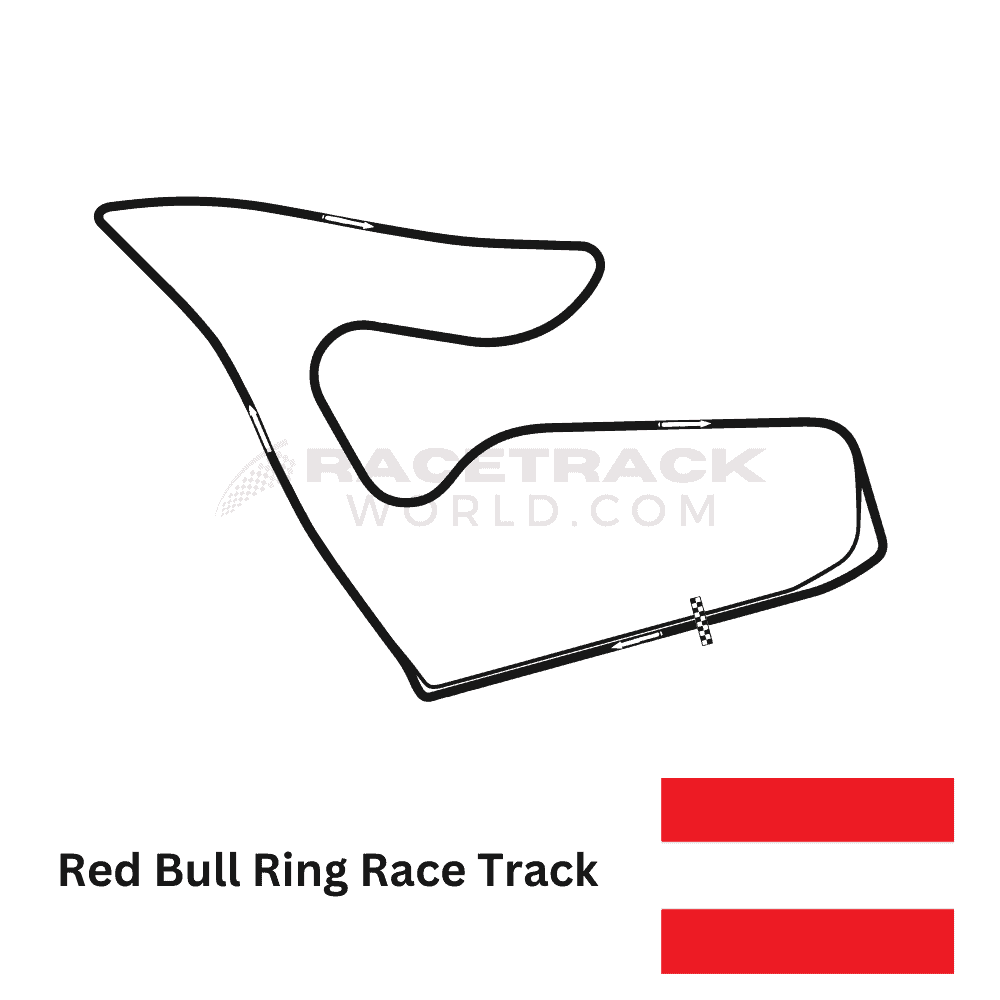
Set in the hills of Styria, the Red Bull Ring is a short, fast 4.326 km, 10-turn circuit with roughly 65 metres of elevation change between its lowest and highest points, giving the lap a rollercoaster character despite its compact length. Long straights connect a handful of heavy-braking corners, producing some of the closest, most overtaking-friendly racing on the modern F1 calendar. The track's short lap time and repeated hard braking zones — particularly into Turns 1, 3 and 4 — put a premium on braking stability and traction out of slow corners, while the circuit's mountain backdrop makes it one of the most scenic venues in motorsport.
Named corners and sections
- Turn 1 (Niki Lauda Kurve). A tight, uphill-braking right-hander named after Austrian F1 champion Niki Lauda; the primary overtaking spot on the opening lap.
- Remus. A fast downhill right-hander named after the Remus exhaust brand, a long-time circuit sponsor; a key setup corner leading into the following complex.
- Rindt. A corner named after 1970 posthumous world champion Jochen Rindt, part of the circuit's tradition of honouring Austrian motorsport figures in its corner names.
Configurations
| Layout | Length | Used for |
|---|---|---|
| Red Bull Ring (2011-present) | 4.32 km | 10 turns; current F1/MotoGP layout after a €70 million reconstruction |
| A1-Ring (1996-2003) | 4.32 km | shortened, safety-focused rebuild of the Österreichring |
| Österreichring (1969-1995) | 5.91 km | longer, higher-speed original layout before 1990s safety reconfiguration |
Events and race weekends
The Red Bull Ring hosts the Formula 1 Austrian Grand Prix, a fixture since the circuit's 2011 reopening and, historically, since the track's earliest days as the Österreichring. MotoGP's Austrian round returned to the venue in 2016 after a long absence and has become a fan favourite for its fast, flowing layout. DTM, Ferrari Challenge and a range of club and historic racing events fill out the rest of the calendar.
| Event | Series | When | Notes |
|---|---|---|---|
| Formula 1 Austrian Grand Prix | Formula 1 | June/July | held at the circuit since its 2011 reopening as the Red Bull Ring |
| Austrian motorcycle Grand Prix | MotoGP | September | returned to the calendar in 2016 |
| DTM Red Bull Ring | DTM | varies | |
| Ferrari Challenge | Ferrari Challenge | varies |
Getting there and parking
The Red Bull Ring sits in a rural part of Styria, roughly an hour's drive from Graz and about two hours from Vienna. There is no station at the circuit itself; the nearest railway station is Knittelfeld, from which free shuttle buses run roughly every 20 minutes to the track on event days, with regional trains linking Knittelfeld to Graz in about 80 minutes.
- Graz Airport (GRZ) · about 60 min drive
- Vienna International Airport (VIE) · about 130 min drive
Parking
General parking fields surround the circuit and are typically included with race tickets; arriving early is strongly recommended for the Austrian Grand Prix given the circuit's rural, single-road access.
Take the train to Knittelfeld and use the free shuttle buses on Grand Prix weekend — road access into the valley gets heavily congested, and the circuit's remote setting means traffic can back up for hours.
Hotels and camping near Red Bull Ring
The Red Bull Ring's remote, rural location means nearby towns like Knittelfeld and Judenburg have only modest hotel stock, so many visitors either camp or base themselves further out in Graz, which offers a much larger range of accommodation within roughly an hour's drive. Rooms across the whole region sell out and prices climb sharply for the Austrian Grand Prix weekend.
Where to look
Knittelfeld and Judenburg are the closest towns with hotels; Graz, about an hour's drive away, offers the widest choice of accommodation in the region.
Camping
Extensive official camping fields surround the circuit for the Austrian Grand Prix and MotoGP weekends, giving the event a strong festival atmosphere that many fans consider part of the circuit's charm.
RV
Dedicated motorhome and caravan areas are available within the official camping fields for major race weekends, bookable through the circuit's ticketing system well in advance.
Track days, driving experiences and lap records
The Red Bull Ring hosts a regular program of car and motorcycle track days and driving experiences alongside its championship race calendar, run both in-house and through third-party organisers, making use of the circuit's short, fast layout for both amateur and professional testing.
Who runs days here
Lap records
| Category | Time | Driver | Car | Year |
|---|---|---|---|---|
| F1 | 1:07.924 | Oscar Piastri | McLaren MCL39 | 2025 |
| MotoGP | 1:29.519 | Francesco Bagnaia | Ducati Desmosedici GP24 | 2024 |
Spectator guide
The Red Bull Ring's compact, hillside layout gives many grandstands and general-admission slopes sweeping views over multiple corners at once, a rarity among modern F1 circuits, with the surrounding Styrian mountains adding a dramatic backdrop. The circuit's short lap length means even standing areas can offer sightlines to several parts of the track.
Seating
Grandstands cluster around Turn 1, Turn 3 and the final corners near the start-finish straight; hillside general-admission areas overlook much of the rest of the lap.
Best places to watch
The hillside above Turn 1 offers panoramic views of the opening-lap braking zone and much of the following sector, with the mountain scenery as a backdrop.
Weather
- June/July (F1): warm summer weather typical of the Austrian Alps, highs around 22-26°C, with a chance of afternoon thunderstorms
- August (MotoGP): similar warm conditions, highs around 22-25°C
History of Red Bull Ring
From Österreichring to a 1990s safety rebuild
The circuit opened in 1969 as the Österreichring, a fast, sweeping layout built into the Styrian hillside that quickly became one of the most spectacular tracks on the Formula 1 calendar, hosting the Austrian Grand Prix regularly from 1970. Its high speeds and limited run-off eventually raised safety concerns, and after the 1987 race the circuit dropped off the F1 calendar; it was significantly reconfigured in the mid-1990s and reopened in 1996 as the shorter, safety-focused A1-Ring, which brought F1 back to Austria from 1997 to 2003.
Closure and Red Bull's revival
Financial and contractual troubles closed the circuit again after 2003, and it sat largely dormant for several years until energy-drink company Red Bull, headquartered nearby, bought the site in 2004. Following a roughly €70 million reconstruction overseen by Hermann Tilke, the venue reopened in 2011 as the Red Bull Ring, restoring much of the site's dramatic elevation change within a modern, safety-compliant 4.326 km, 10-turn layout.
A modern fixture on two wheels and four
Formula 1 returned to the Red Bull Ring's calendar from 2014, and MotoGP followed with the revived Austrian Grand Prix from 2016, both quickly becoming fan favourites for the circuit's tight racing and scenic mountain setting. Today the venue combines its Grand Prix commitments with DTM, Ferrari Challenge, extensive public track days, and a large surrounding campsite culture that gives race weekends in the remote Styrian valley a strong festival atmosphere.
Frequently asked questions
How long is the Red Bull Ring?+
The current layout is 4.326 km (2.688 miles) with 10 turns, one of the shortest circuits on the modern Formula 1 calendar.
What was the Red Bull Ring called before?+
It opened in 1969 as the Österreichring, was rebuilt and renamed the A1-Ring for 1996-2003, and reopened as the Red Bull Ring in 2011 after Red Bull bought and rebuilt the venue.
What is the lap record at the Red Bull Ring?+
The Formula 1 lap record is 1:07.924, set by Oscar Piastri in a McLaren MCL39 in 2025; the MotoGP lap record is 1:29.519, set by Francesco Bagnaia in 2024.
How do you get to the Red Bull Ring without a car?+
The nearest railway station is Knittelfeld, with free shuttle buses running roughly every 20 minutes to the circuit on event days; Knittelfeld is about 80 minutes by train from Graz.
Where do fans camp for the Austrian Grand Prix?+
Extensive official camping fields surround the circuit for the Grand Prix and MotoGP weekends, giving the event a strong festival atmosphere that is a well-known part of the Red Bull Ring experience.
Who owns the Red Bull Ring?+
The circuit is owned by a Mateschitz family holding company tied to Red Bull, which bought and rebuilt the venue after it closed in the early 2000s, reopening it in 2011.
Other tracks nearby
- Motocross Orehova vas · 108 km · motocross
- Salzburgring · 136 km · road course
- Pannónia-Ring · 172 km · road course
- Automotodrom Grobnik · 205 km · road course
- Opatija Circuit (Preluk) · 210 km · historic circuit (defunct)
- Slovakia Ring · 230 km · road course
Facts checked against 4 sources including the official circuit website. Last reviewed 2026-09-10.