
Salzburgring
Salzburgring at a glance
- Location
- Plainfeld, Salzburg
- Type
- road course
- Length
- 4.241 km (2.635 mi)
- Turns
- 15
- Direction
- clockwise
- Surface
- asphalt
- Elevation change
- 82 ft
- Opened
- 1969
- Owner
- Land Salzburg (public ownership via Salzburgring Betriebsgesellschaft)
- Address
- Salzburgring 1
- Website
- salzburgring.com
Track map and layout
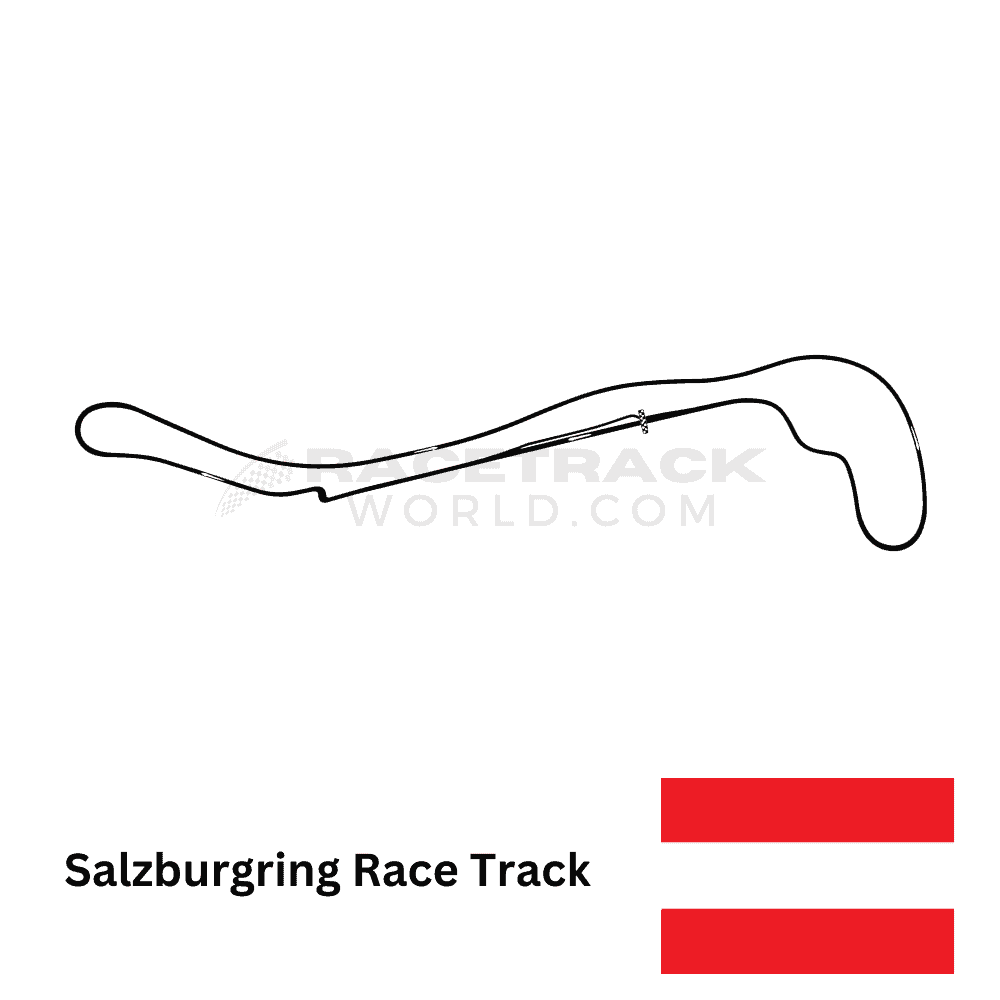
The Salzburgring is a natural-terrain circuit laid into a valley near Plainfeld, its 4.241 km, 15-turn lap following the contours of the surrounding wooded hillsides rather than a flattened, purpose-graded site. Roughly 25 metres of elevation change and a swift rhythm of corners give it a reputation as technically demanding and unforgiving for a track of its modest length, with the hillsides themselves forming natural grandstands for spectators. The circuit runs clockwise from a start-finish straight through a sequence of medium- and high-speed corners that reward smoothness and momentum rather than heavy braking, characteristic of many circuits built in this era before purpose-built run-off became standard.
Named corners and sections
- Nockstein. A fast section named after the nearby Nockstein hill, used as a reference point for track-day driving groups and one of the circuit's quicker sequences.
Configurations
| Layout | Length | Used for |
|---|---|---|
| Grand Prix circuit | 4.24 km | current permanent layout, in use since 1998 revisions |
Events and race weekends
The Salzburgring's modern calendar centres on national and regional touring car and single-seater racing, including TCR Eastern Europe and Formula 4 CEZ rounds, alongside the Motorsportfestival weekend featuring ADAC GT Masters and the historic-car Oldtimer Festival and Gaisbergrennen hillclimb-adjacent events. The circuit also hosts the large-scale Electric Love electronic music festival each July, which is unrelated to motorsport but is one of its highest-attendance events of the year.
| Event | Series | When | Notes |
|---|---|---|---|
| Motorsportfestival Salzburgring (ADAC GT Masters) | ADAC GT Masters and support races | September | flagship modern racing weekend |
| Oldtimer Festival | Historic motorsport | August | classic car and bike racing and parades |
| TCR Eastern Europe Touring Car round | TCR Eastern Europe | varies | regional touring car championship |
| Electric Love Festival | Music festival | July | held on the circuit grounds, not a race event |
Getting there and parking
The Salzburgring sits about 13 km east of Salzburg city in the Salzkammergut region, a roughly 20-minute drive. Public transport is available via bus route 150 from Salzburg, taking around 40 minutes; there is no dedicated rail station at the circuit, and most fans arrive by car or shuttle for events.
- Salzburg Airport (SZG) · about 25 min drive
- Munich Airport (MUC) · about 110 min drive
Parking
Circuit parking is available on-site for event days; specific pricing is set by each event promoter and varies by race weekend.
Book Salzburg city hotels well ahead of the Motorsportfestival and Electric Love weekends, as both draw large crowds and the town of Plainfeld itself has very limited accommodation.
Hotels and camping near Salzburgring
Most visitors base themselves in Salzburg city, about 20 minutes' drive or a short bus ride away, which offers the widest range of hotels and easy onward travel to the circuit. Plainfeld and the surrounding Salzkammergut villages have a handful of guesthouses and countryside hotels for those who prefer to stay closer to the track.
Where to look
Salzburg city centre for the widest hotel choice and transport links; Plainfeld and nearby Salzkammergut villages for those wanting to stay close to the gates.
Camping
Some events, notably Electric Love, run large-scale onsite camping on the circuit grounds; motorsport race weekends typically do not offer dedicated fan camping in the way larger European circuits do.
Track days, driving experiences and lap records
The Salzburgring runs open track days where road-legal and non-road-legal cars can book free-driving sessions, split into groups by vehicle type; no racing licence is required, only registration in advance. Third-party organisers such as Pistenclub and drive-in-motion run scheduled track-day dates through the season, some offering guided laps or coaching in the customer's own car or a provided vehicle.
Who runs days here
Typical cost: Guided track-day packages including hotel and coaching start from around €1,595; open track-day entry pricing varies by organiser
Lap records
| Category | Time | Driver | Car | Year |
|---|---|---|---|---|
| F3 | 1:16.843 | Akash Nandy | Dallara F308 | 2015 |
Spectator guide
The Salzburgring's natural bowl-like setting means the surrounding hillsides act as informal grandstands, giving many spectators long sightlines across multiple corners without needing a ticketed seat, a legacy of its natural-terrain design from the late 1960s.
Seating
Formal grandstands are concentrated near the start-finish straight; much of the rest of the circuit is watched from grassy hillside embankments.
Best places to watch
The hillside above the Nockstein sequence offers sweeping views across several corners and is a favourite free vantage point for race weekends.
Weather
- September (Motorsportfestival): cool Alpine autumn, typically 12-18°C with a chance of rain
- July (Electric Love): warm summer, typically 22-27°C
History of Salzburgring
A natural-terrain circuit for the jet age
Construction of the Salzburgring began in 1968 on hilly farmland east of Salzburg near the village of Plainfeld, and the circuit opened in September 1969. Rather than levelling the site, engineers built the track to follow the natural contours of the valley and surrounding hillsides, giving it roughly 25 metres of elevation change packed into a compact 4.2 km lap and a reputation for technical, flowing corners that rewarded car control over outright braking power.
Grand Prix and Grand Prix motorcycle era
Through the 1970s and into the 1990s the Salzburgring was a regular stop for Formula 2, the European Touring Car Championship and other top-level international series, and it became the long-time home of the Austrian motorcycle Grand Prix, hosting the event until 1995. Its natural-terrain layout, exciting in period, increasingly fell short of evolving international safety standards for run-off and barriers, and top-tier motorcycle and car championships gradually moved away.
Modern era: club racing, festivals and track days
Since the late 1990s the Salzburgring has settled into a role as a busy regional and national motorsport venue, hosting touring car series such as TCR Eastern Europe, Formula 4 CEZ racing, historic-car events including the Oldtimer Festival, and the ADAC GT Masters-headlined Motorsportfestival weekend. The circuit also runs a regular calendar of public track days for road and race cars, and its grounds double as the site of the large Electric Love electronic music festival each July, bringing a very different crowd to the valley than its motorsport weekends. The track remains publicly owned via the state of Salzburg and continues to operate as an active club-racing and track-day facility today.
Frequently asked questions
How long is the Salzburgring?+
The circuit is 4.241 km (2.635 miles) long with 15 turns, run in a clockwise direction.
Why is the Salzburgring called a natural-terrain circuit?+
It was built by following the existing contours of the hilly valley near Plainfeld rather than flattening the site, giving it around 25 metres of elevation change and hillsides that double as natural spectator viewing areas.
Does the Salzburgring still host international racing?+
It hosts national and regional series such as TCR Eastern Europe and Formula 4 CEZ, plus historic events, but it no longer hosts top-tier world championships like the motorcycle Grand Prix, which left after 1995.
Can the public drive the Salzburgring?+
Yes. The circuit runs open track days for road-legal and non-road-legal cars, split into groups by vehicle type, with no racing licence required, plus third-party organised track-day and coaching packages.
How do you get to the Salzburgring without a car?+
Bus route 150 runs from Salzburg city to the circuit in around 40 minutes; there is no dedicated rail station at the track itself.
Other tracks nearby
- Red Bull Ring · 136 km · road course
- Kramolín (Automoto klub Nepomuk) · 190 km · motocross
- Motorsport Club Nürnberg (Norisring organiser) · 234 km · club
- Norisring · 234 km · street circuit
- Motocross Orehova vas · 240 km · motocross
- Loketské Serpentiny · 265 km · motocross
Facts checked against 5 sources including the official circuit website. Last reviewed 2026-09-10.