Race Track World Logo
Home/Europe/Isle OF MAN/St John's Short Course

St John's Short Course

St John's Short Course at a glance

Location
St John's, Isle of Man
Type
historic circuit (defunct)
Length
25.49 km (15.84 mi)
Direction
anti-clockwise
Surface
asphalt
Elevation change
780 ft
Opened
1907
Owner
Isle of Man Government (public roads); no longer used for racing

Track map and layout

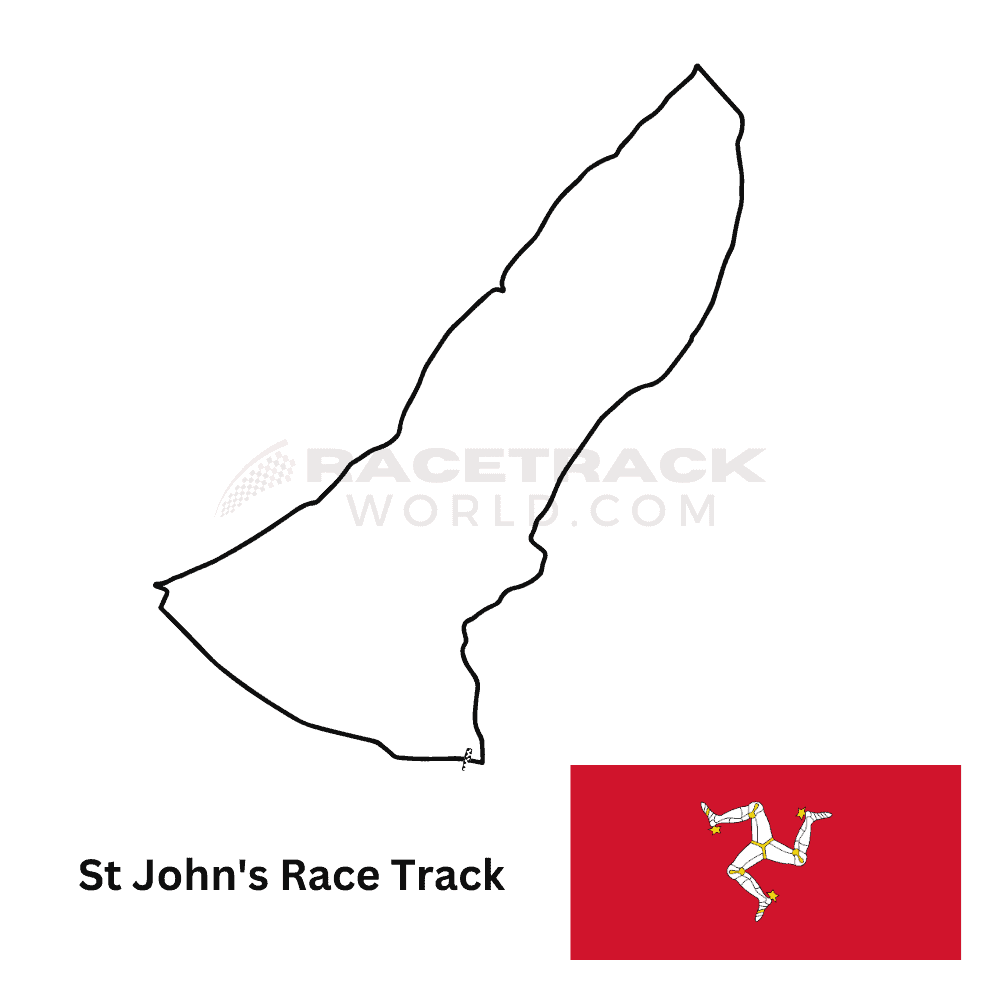
Isle Of Man St Johns Race Track
St John's Short Course track layout

The St John's Short Course was the very first Isle of Man TT circuit, a 15.84-mile (25.49km) loop of ordinary public roads starting and finishing at Tynwald Green in St John's, in the island's central valley. From the start the route followed the Peel road to Ballacraine, then turned onto the road through Ballig Bridge, Glen Helen, Creg Willey's Hill and the long Cronk-y-Voddy straight, past St John's Chapel at the course's highest point around 780ft above sea level, down to Barregarrow and Kirk Michael, before turning again onto the coast road through the Devil's Elbow and Knocksharry into Peel and back out to St John's. It was chosen specifically because it avoided the steep climb over Snaefell mountain, which the fragile motorcycles of 1907 could not reliably manage, in contrast to the longer Mountain Course used from 1911 onward.

Named corners and sections

  • Ballacraine. The junction where the course turned off the Peel road onto the loop through Glen Helen and Cronk-y-Voddy; still a well-known landmark on today's road network.
  • Cronk-y-Voddy straight. A long straight past St John's Chapel, the highest point of the course at around 780ft above sea level.
  • Devil's Elbow. A tight bend on the coast road between Kirk Michael and Peel.

Configurations

LayoutLengthUsed for
St John's Short Course25.49 kmThe only configuration; used for the TT from 1907 to 1910

Events and race weekends

No racing has used the St John's Short Course since 1910, when the TT moved to the longer Mountain Course as motorcycles became powerful enough to race over Snaefell mountain. No revival of racing on this route has taken place since, and none is planned; the roads are in everyday public use.

Getting there and parking

St John's sits in the Isle of Man's central valley, about 15-20 minutes' drive from Douglas and a similar distance from Ronaldsway Airport in the south. The village is served by island bus routes running between Douglas and Peel, and by the Isle of Man's road network generally; there is no rail station at St John's itself.

  • Isle of Man Airport (Ronaldsway) (IOM) · about 25 min drive

Parking

Ordinary roadside and village parking is available in St John's, Kirk Michael, Peel and Ballacraine; no special arrangements exist since there is no event to attend.

Visit Isle of Man lists the loop as one of its official heritage driving routes, so a printed or downloaded route map from the tourist board is a straightforward way to follow the old course accurately.

Hotels and camping near St John's Short Course

There is no race meeting to plan a stay around, so visitors interested in the old course simply base themselves wherever suits a wider Isle of Man trip. Peel, a working fishing town on the west coast that the course passes through, has the most hotel and B&B choice of the villages directly on the loop; Douglas, a short drive away, has the island's widest range of accommodation and is the more common base for a general visit.

Where to look

Peel for the closest choice of hotels and guesthouses directly on the old course; Douglas, a short drive away, for the widest range of accommodation on the island.

Track days, driving experiences and lap records

There has never been any bookable track-day access to the St John's Short Course, and there cannot be one now: it is simply a loop of ordinary public roads carrying everyday traffic. What a visitor can do is drive or cycle the route itself at legal speed, following the A1, A3 and A4 through St John's, Ballacraine, Kirk Michael and Peel; Visit Isle of Man promotes exactly this loop as one of its official heritage driving routes for exploring the island's motorsport history.

Lap records

CategoryTimeDriverCarYear
1907 TT (single-cylinder)38.21mph averageCharlie CollierMatchless1907
1910 TT (fastest lap)53.15mph averageHarry BowenBAT1910

Spectator guide

There is nothing to spectate at today; the course only exists as public roads. Visitors instead treat a drive of the loop as a self-guided historical trip, often combined with stops at Peel Castle, Glen Helen and the other attractions the route passes close to.

Best places to watch

Ballacraine junction and the Cronk-y-Voddy straight are the most recognisable and easily located points from the original course.

History of St John's Short Course

Motorcycling's first TT course

When the Auto-Cycle Club needed a closed public-road course for the first Isle of Man motorcycle Tourist Trophy in 1907, it settled on a 15.84-mile loop through the central valley and west coast, starting and finishing at Tynwald Green in St John's. Unlike the car TT, which had used the more demanding roads over Snaefell mountain since 1904, this Short Course avoided the mountain climb because the fragile motorcycles of the day could not be relied on to manage it. The first race, on 28 May 1907, was for road-legal touring motorcycles complete with silencers, saddles, pedals and mudguards, won by Charlie Collier's Matchless in the single-cylinder class, with Rem Fowler's Norton-Peugeot winning the twin-cylinder class.

Four years of growing speed

The TT returned in 1908, 1909 and 1910, each year with entries growing faster and rules evolving, including the eventual abandonment of fuel-consumption limits in favour of engine-capacity restrictions to keep speeds manageable. By 1910, Harry Bowen's BAT had lifted the lap record to 53.15mph, over 15mph quicker than the 1907 winning average, on narrow lanes and verges never designed for that pace.

Moving to the mountain

With speeds climbing and motorcycle engineering improving fast, organisers judged after 1910 that the sport had outgrown the Short Course and switched the TT to the longer course over Snaefell mountain used by the car races, creating today's Mountain Course from 1911. St John's never hosted the TT again.

What survives today

The roads used for the 1907-1910 races, the A1 from St John's towards Peel, the loop through Ballacraine, Glen Helen and Cronk-y-Voddy, and the coast road through Kirk Michael and Peel, remain in everyday use as part of the Isle of Man's ordinary road network. Visit Isle of Man now promotes the loop as one of its official heritage driving routes, letting visitors retrace the earliest TT course by car or bicycle past landmarks such as Ballacraine, St John's Chapel and the Devil's Elbow, even though nothing purpose-built from the racing era remains to see.

Frequently asked questions

Does the St John's Short Course still exist?+

The roads still exist and carry everyday traffic, but no racing has used the course since 1910; it survives only as an ordinary road loop, now promoted as a heritage driving route.

How long was the original TT course at St John's?+

15.84 miles (25.49km) per lap, run from Tynwald Green in St John's through Ballacraine, Kirk Michael and Peel and back.

Why did the TT move away from the St John's course?+

After 1910, organisers judged that rising speeds and improving motorcycle engineering meant the sport had outgrown the Short Course, and moved the TT to the longer Mountain Course over Snaefell for 1911.

Why didn't the first TT use the mountain road from the start?+

The motorcycles of 1907 were not powerful or reliable enough to be trusted with the steep climb over Snaefell that the car TT already used, so organisers chose the flatter St John's loop instead.

Can you drive the old St John's TT course today?+

Yes. The A1, A3 and A4 roads used for the 1907-1910 races are ordinary public roads, and Visit Isle of Man lists the loop as one of its official heritage driving routes.

Who won the first Isle of Man TT in 1907?+

Charlie Collier won the single-cylinder class on a Matchless, and Rem Fowler won the twin-cylinder class on a Norton-Peugeot, both racing on the St John's Short Course.

Other tracks nearby

Facts checked against 5 sources including the official circuit website. Last reviewed 2026-09-10.