
Circuito di Pescara
Circuito di Pescara at a glance
- Location
- Pescara, Abruzzo
- Type
- historic circuit (defunct)
- Length
- 25.801 km (16.032 mi)
- Direction
- clockwise
- Surface
- asphalt (public roads)
- Elevation change
- 607 ft
- Opened
- 1924
- Owner
- Comune di Pescara / regional public roads (site preserved via re-enactment events)
Track map and layout
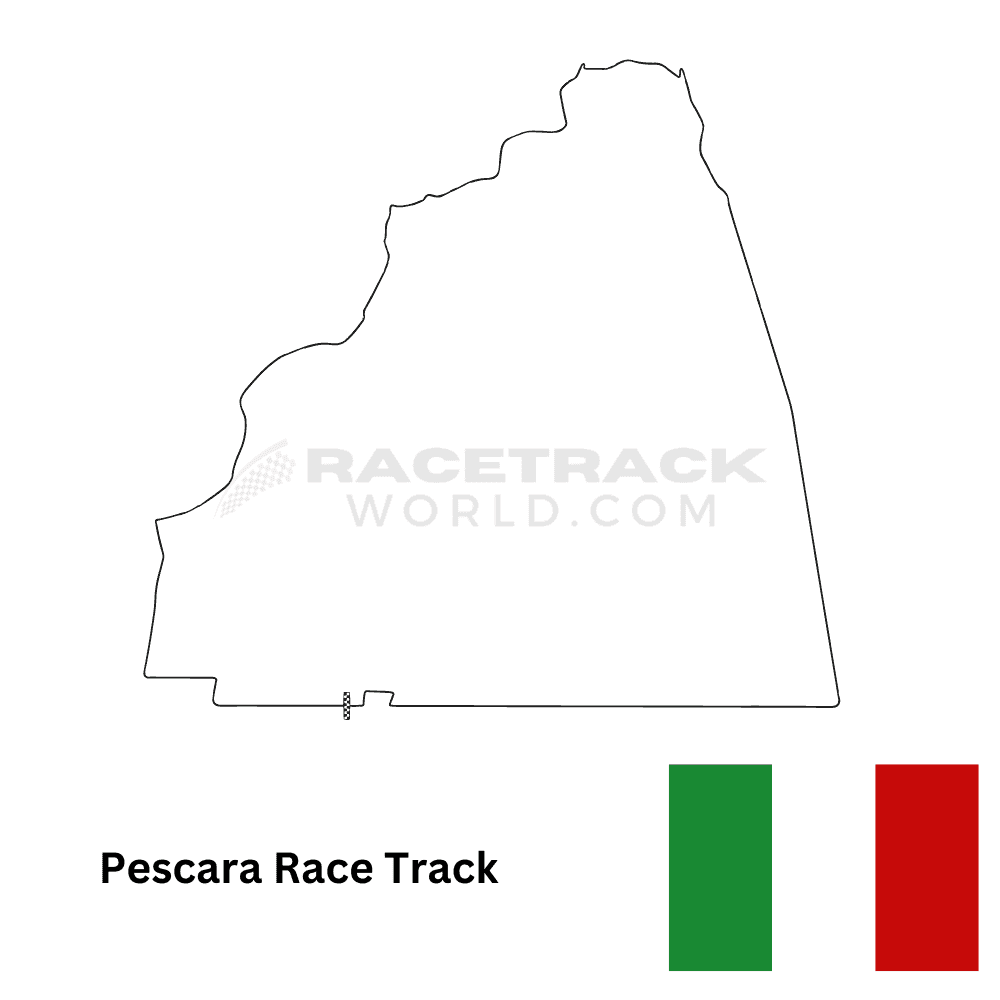
The Circuito di Pescara was a vast, roughly triangular road circuit stitched together from ordinary public roads linking Pescara with the towns and countryside of the Abruzzo hinterland, making it the longest circuit ever to host a Formula One World Championship race at 25.801 km. The lap started at what is now Piazza Duca degli Abruzzi, ran inland along the Pescara river through Villa Raspa and up to the hill town of Spoltore, the circuit's highest point at around 607 feet above sea level, before sweeping through Cappelle sul Tavo and dropping back towards the Adriatic coast for a long, flat-out blast on the Via Vestina known as the kilometro lanciato (flying kilometre). With minimal run-off, crowds pressing close to the road edge and top speeds exceeding 170 mph on the coastal straight, it was regarded as one of the most demanding and dangerous circuits of its era.
Configurations
| Layout | Length | Used for |
|---|---|---|
| Grand Prix circuit (1934-1961) | 25.80 km | 25.801 km, used for the 1957 Formula One World Championship round |
| Original road course (1924-1933) | 25.57 km | 25.578 km, the circuit's first configuration |
Events and race weekends
No motor races have been held on the full circuit since it was permanently retired in 1961. The Coppa Acerbo, the sports car and Grand Prix race that made the circuit famous, ran on the roads from 1924 to 1961 with wartime and occasional gaps, and the circuit's single Formula One World Championship race, the 1957 Pescara Grand Prix, was won by Stirling Moss. Today the city periodically stages a historic re-enactment of the Coppa Acerbo, bringing vintage racing and road cars back onto stretches of the original roads for a parade-style event rather than competitive racing.
Getting there and parking
The former circuit's start line sits in central Pescara, a mid-sized city on Italy's Adriatic coast with its own airport just south of town. Pescara Centrale railway station has direct connections along the Adriatic coastal line to Bologna, Ancona and Bari, as well as inland services towards Rome, making rail a practical way to reach the city before exploring the old circuit roads by car or on foot.
- Abruzzo Airport (Pescara) (PSR) · about 15 min drive
Parking
No dedicated parking for the former circuit; visitors use normal city and roadside parking in Pescara and the villages of Spoltore and Cappelle sul Tavo along the old route.
Pescara Centrale station is well connected along the Adriatic coast, and much of the old circuit can be explored by car or bicycle using ordinary public roads, since roughly 80% of the original route remains largely unchanged.
Hotels and camping near Circuito di Pescara
Pescara itself, a beach city with a full range of hotels along its seafront and centre, is the obvious base, sitting right at the circuit's start/finish point. The inland villages of Spoltore and Cappelle sul Tavo, passed through on the old route, offer a quieter alternative for visitors wanting to explore the hillier section of the circuit at a slower pace.
Where to look
Pescara's seafront and city centre have the widest choice of hotels, right at the old circuit's start line; Spoltore and Cappelle sul Tavo offer smaller, quieter options inland along the route.
Track days, driving experiences and lap records
There is no organised track-day or timed-lap access to the former circuit; the roads are part of Pescara's ordinary public road network and carry normal traffic. Visitors can drive or cycle the surviving public roads that made up roughly 80% of the original route in their own vehicles, following the general shape of the lap from the city out to Spoltore and Cappelle sul Tavo and back along the coast, but no competitive or closed-road lapping is possible outside occasional historic re-enactment events.
Lap records
| Category | Time | Driver | Car | Year |
|---|---|---|---|---|
| Formula One (1957 Pescara Grand Prix) | — | Stirling Moss | Vanwall | 1957 |
Spectator guide
There is no regular spectator event at the former circuit today; visits are self-guided drives or walks along the surviving public roads. The occasional historic Coppa Acerbo re-enactment in Pescara draws crowds for a parade of vintage cars through the city rather than competitive racing, with details and road closures announced by the Comune di Pescara ahead of each edition.
Seating
No permanent grandstands or spectator infrastructure survive from the circuit's racing era.
Best places to watch
Piazza Duca degli Abruzzi, the old start/finish point, and the coastal Via Vestina stretch that formed the flying kilometre are the most evocative and easily identified sections of the original route today.
Weather
- May-September: warm to hot Adriatic coastal climate, highs typically 24-30°C
History of Circuito di Pescara
The longest road circuit in Grand Prix history
The Circuito di Pescara opened in 1924 on public roads linking the Adriatic city of Pescara with the hill towns of Spoltore and Cappelle sul Tavo in the Abruzzo countryside, forming a roughly triangular lap of over 25 km, among the longest road circuits ever used for major international racing. It quickly became home to the Coppa Acerbo, named for local aviator and politician Tito Acerbo, which drew leading Italian and international drivers and manufacturers through the late 1920s and 1930s, when Pescara ranked alongside circuits such as the Nürburgring and Targa Florio as one of Europe's great road-racing tests.
Formula One's only visit
The race continued after the Second World War, and in 1957 the Pescara Grand Prix was elevated to a round of the Formula One World Championship, a one-off necessitated by the Suez Crisis disrupting that year's calendar. Run over the full 25.801 km lap in front of a reported 200,000 spectators, the race was won in commanding fashion by Stirling Moss in a Vanwall, and it remains, to this day, the longest circuit ever to host a Formula One World Championship race. The circuit also hosted rounds of the World Sportscar Championship through the late 1950s and into 1961.
Closure and what survives
By the early 1960s, growing car speeds, minimal safety margins along a route lined with buildings, ditches and unprotected crowds made Pescara impossible to certify safely, and the circuit staged its last major race, a World Sportscar Championship round, in August 1961 before being permanently retired. Unlike many abandoned road circuits, however, Pescara's route was never bypassed or built over: the roads remain in everyday use as part of the local network, and an estimated 80% of the original 1924 layout can still be driven or cycled today. The city periodically revives the Coppa Acerbo name for historic re-enactment events, bringing vintage racing and road cars back onto the old roads in a celebratory, non-competitive format that keeps the circuit's memory alive for a new generation.
Frequently asked questions
Can you still drive the Pescara circuit today?+
Yes, in large part. The roads that made up roughly 80% of the original 25.8 km circuit remain in everyday use as ordinary public roads around Pescara, Spoltore and Cappelle sul Tavo, and can be driven or cycled by visitors, though not as a closed, competitive lap.
How long was the Pescara circuit?+
The Grand Prix-era layout used from 1934 to 1961, including the 1957 Formula One race, was 25.801 km (16.032 miles); the original 1924-1933 course was a very similar 25.578 km (15.893 miles).
Is Pescara really the longest circuit ever to host a Formula One race?+
Yes. The 1957 Pescara Grand Prix, run over the full 25.801 km lap and won by Stirling Moss, remains the longest circuit ever to host a round of the Formula One World Championship.
Why did Pescara stop hosting races?+
Rising car speeds made it impossible to guarantee the safety of drivers and the large crowds who gathered along the unprotected public roads, and the circuit held its last major race, a World Sportscar Championship round, in August 1961 before being permanently retired.
What was the Coppa Acerbo?+
The Coppa Acerbo was the sports car and Grand Prix race held on the Pescara circuit from 1924 to 1961 (with wartime and occasional gaps), named after local aviator and politician Tito Acerbo; the city periodically revives the name for historic re-enactment events on the old roads today.
Other tracks nearby
- Autodromo Vallelunga Piero Taruffi · 151 km · road course
- Circuito Cittadino dell'EUR · 156 km · historic circuit (defunct)
- Autodromo dell'Umbria Mario Umberto Borzacchini · 172 km · road course
- Misano World Circuit Marco Simoncelli · 204 km · road course
- Autodromo del Levante · 271 km · road course
- Mugello Circuit · 282 km · road course
Facts checked against 3 sources including the official circuit website. Last reviewed 2026-09-11.