
Circuito de Madrid Jarama – RACE
Circuito de Madrid Jarama – RACE at a glance
- Location
- San Sebastián de los Reyes, Community of Madrid
- Type
- road course
- Length
- 3.85 km (2.392 mi)
- Turns
- 14
- Direction
- clockwise
- Surface
- asphalt
- Opened
- 1967
- Owner
- Real Automóvil Club de España (RACE)
- Address
- Autovía A-1, km 28
- Phone
- +34 91 657 08 75
- Website
- jarama.org
Track map and layout
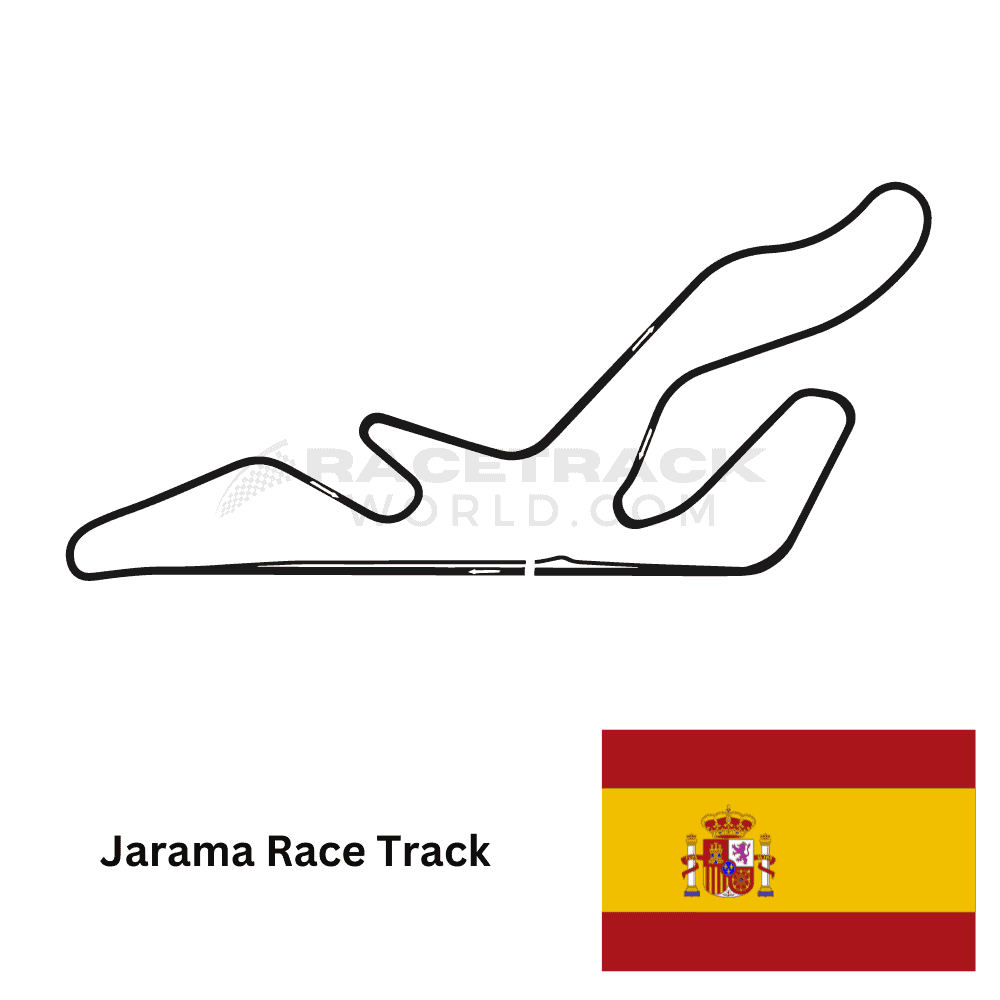
Jarama, designed by Dutch architect John Hugenholtz, was Spain's first permanent racing circuit and remains one of Europe's classic short, technical tracks. The current layout runs clockwise over 3.850 km and 14 corners, tighter and more compact than the original configuration used in its Formula 1 years. A short main straight leads into a demanding sequence of medium and slow corners with little room to build speed, which historically made overtaking difficult in single-seaters but suits the touring cars, GT machinery and historic racing the circuit hosts today. Its close, undulating layout and proximity to Madrid have kept it popular for testing, driver training and club racing long after losing its Grand Prix status.
Named corners and sections
- Nuvolari. The left-hand kink that opens the lap after the main straight, named after Italian pre-war racing legend Tazio Nuvolari.
- Fangio. A heavy braking zone named after five-time world champion Juan Manuel Fangio, immediately after Nuvolari.
- Varzi, Le Mans, Farina and Pegaso. A right-left-right-left combination named after Achille Varzi, the Le Mans 24 Hours, Giuseppe Farina and the Pegaso marque.
- Ascari. A fast downhill sweeper named after Alberto Ascari.
- Portago. A heavy-braking, downshift-heavy corner named after Spanish driver Alfonso de Portago.
- Bugatti and Monza. The closing sequence of the lap, named after the Bugatti marque and Monza's Autodromo Nazionale, leading back onto the main straight.
Configurations
| Layout | Length | Used for |
|---|---|---|
| Current Grand Prix Circuit | 3.85 km | 14 turns; in use since 1991 reconfiguration |
| Original Circuit (1967-1979) | 3.40 km | 15 turns; the layout used during Jarama's Formula 1 years |
Events and race weekends
Jarama no longer hosts a world championship round but stays busy with national and European racing. TCR Spain, the Spanish F4 championship and domestic touring car series race here through spring and summer, and the circuit was confirmed as an early host venue for Formula E's Madrid ePrix era from 2026. The Jarama Classic historic race meeting draws vintage single-seaters, touring cars and GT machinery each June, and the FIA European Truck Racing Championship visits in autumn.
| Event | Series | When | Notes |
|---|---|---|---|
| Jarama Classic | Historic racing | June | vintage single-seater, touring car and GT racing |
| TCR Spain | Touring cars | Various | |
| F4 Spanish Championship | Formula 4 | August | |
| FIA European Truck Racing Championship | Truck racing | October |
Getting there and parking
Jarama sits beside the A-1 motorway at San Sebastián de los Reyes, about 25-30 minutes north of central Madrid and close to Madrid-Barajas Airport. It is the most accessible circuit on this list for visitors flying into the Spanish capital. There is no dedicated rail station at the circuit; Cercanías commuter trains reach San Sebastián de los Reyes, from where it is a short taxi ride to the gates.
- Madrid-Barajas Airport (MAD) · about 30 min drive
Parking
General parking is available around the circuit and is typically included with event tickets; access is straightforward given the circuit's proximity to Madrid's motorway network.
Jarama is close enough to central Madrid for a day trip; combine a visit with sightseeing in the capital rather than booking overnight accommodation near the circuit.
Hotels and camping near Circuito de Madrid Jarama – RACE
Because Jarama is only about 25-30 minutes from central Madrid, the vast majority of visitors simply stay in the capital, which offers by far the largest choice of hotels, transport links and things to do outside race days. A smaller number of hotels are available in San Sebastián de los Reyes and other northern Madrid suburbs closer to the circuit itself.
Where to look
Madrid city offers the widest range of accommodation and is an easy 25-30 minute drive or train-plus-taxi journey from the circuit; San Sebastián de los Reyes has a smaller selection closer to the gates.
Camping
The circuit does not have a significant dedicated spectator campsite; given its short drive from Madrid, camping is uncommon here compared with Spain's more remote circuits.
Track days, driving experiences and lap records
Jarama is one of the most heavily used circuits in Spain for car and motorcycle track days, driver training and manufacturer testing, thanks to its short, technical layout and easy access from Madrid. The circuit runs its own driving school and events programme, and several European track-day organisers regularly book the venue.
Who runs days here
Lap records
| Category | Time | Driver | Car | Year |
|---|---|---|---|---|
| Formula E (current Grand Prix Circuit) | 1:32.941 | Nyck de Vries | Mahindra M12Electro | 2026 |
| LMP900 | 1:23.034 | Emanuele Pirro | Audi R8 | 2001 |
Spectator guide
Jarama's compact layout means most grandstands and general admission areas give views of several corners at once, a legacy of its original design for close, competitive club racing rather than long straight-line speed. The circuit's small scale compared with Spain's newer venues makes it an easy, low-key day out for motorsport fans based in Madrid.
Seating
Grandstands line the main straight and the tighter infield corners; general admission areas cover much of the surrounding high ground.
Best places to watch
The infield high ground overlooking the middle corners gives views of multiple turns without needing a grandstand ticket.
Weather
- June (Jarama Classic): warm and dry, highs typically 28-32°C in Madrid's continental summer climate
History of Circuito de Madrid Jarama – RACE
Spain's first permanent circuit
Circuito del Jarama opened in July 1967 in San Sebastián de los Reyes, just north of Madrid, becoming Spain's first purpose-built permanent racing circuit. Designed by Dutch architect John Hugenholtz, who also designed Zandvoort and Suzuka, its short, twisting layout was intended to test driver skill in tight corners rather than reward outright horsepower on long straights. The circuit quickly became Spain's home for international motorsport and hosted the Spanish Grand Prix on nine occasions between 1968 and 1981.
Formula 1 years
Jarama staged Formula 1 races in 1968, 1970, 1972, 1974 and every year from 1976 to 1979, plus a final race in 1981. That 1981 Spanish Grand Prix produced one of the sport's most celebrated defensive drives, as Gilles Villeneuve held off four faster cars in his Ferrari to win by just over a second, the last victory of his career. By the early 1980s, however, Jarama's narrow, low-grip layout and limited safety run-off were considered outdated for top-level single-seater racing, and Formula 1 moved on to the newly built Circuit de Barcelona-Catalunya after a brief spell at Jerez.
Life after Formula 1
Acquired by the Real Automóvil Club de España (RACE) in 1981, Jarama has continued as one of Spain's busiest circuits for national racing, testing and track days, thanks largely to its proximity to Madrid. It has hosted rounds of Formula E, Superleague Formula, sports car endurance racing and European truck racing, and renamed itself Circuito de Madrid Jarama – RACE in 2022 to reflect its ownership and its role serving the capital. The Jarama Classic historic meeting keeps the circuit's Formula 1 era alive each summer with vintage single-seaters and touring cars on track.
Frequently asked questions
How long is Circuito del Jarama?+
The current layout is 3.850 km (2.392 miles) with 14 corners; the original 1967-1979 layout used during Jarama's Formula 1 years was 3.404 km (2.115 miles) with 15 corners.
Did Formula 1 race at Jarama?+
Yes. Jarama hosted the Spanish Grand Prix nine times between 1968 and 1981, including Gilles Villeneuve's celebrated 1981 win, the last victory of his career.
Why did Jarama lose its Formula 1 race?+
By the early 1980s its narrow layout and limited safety run-off were considered outdated for top-level single-seater racing, and F1 moved to the newly built Circuit de Barcelona-Catalunya after briefly using Jerez.
Is Jarama close to Madrid?+
Yes. It sits beside the A-1 motorway roughly 25-30 minutes north of central Madrid, making it easily accessible as a day trip from the capital.
What events are held at Jarama today?+
The circuit hosts national and European series including TCR Spain, F4 Spanish Championship, Formula E, European Truck Racing and the historic Jarama Classic meeting, alongside frequent testing and track days.
Can the public drive Jarama?+
Yes. The circuit runs its own driving school and track days, and third-party organisers such as EuropaTrackdays and Trackdays.es regularly hold events there.
Other tracks nearby
- Circuito Internacional Comunidad de Madrid · 46 km · motocross
- Circuito de Albacete · 235 km · road course
- Circuito de Navarra · 246 km · road course
- Circuit Ricardo Tormo · 281 km · road course
- MotorLand Aragón · 289 km · road course
- Valencia Street Circuit · 306 km · historic circuit (defunct)
Facts checked against 4 sources including the official circuit website. Last reviewed 2026-09-10.