
Valencia Street Circuit
Valencia Street Circuit at a glance
- Location
- Valencia, Valencian Community
- Type
- historic circuit (defunct)
- Length
- 5.419 km (3.367 mi)
- Turns
- 25
- Direction
- clockwise
- Surface
- asphalt (public roads)
- Opened
- 2008
- Owner
- Generalitat Valenciana / Valmor Sport (defunct)
Track map and layout
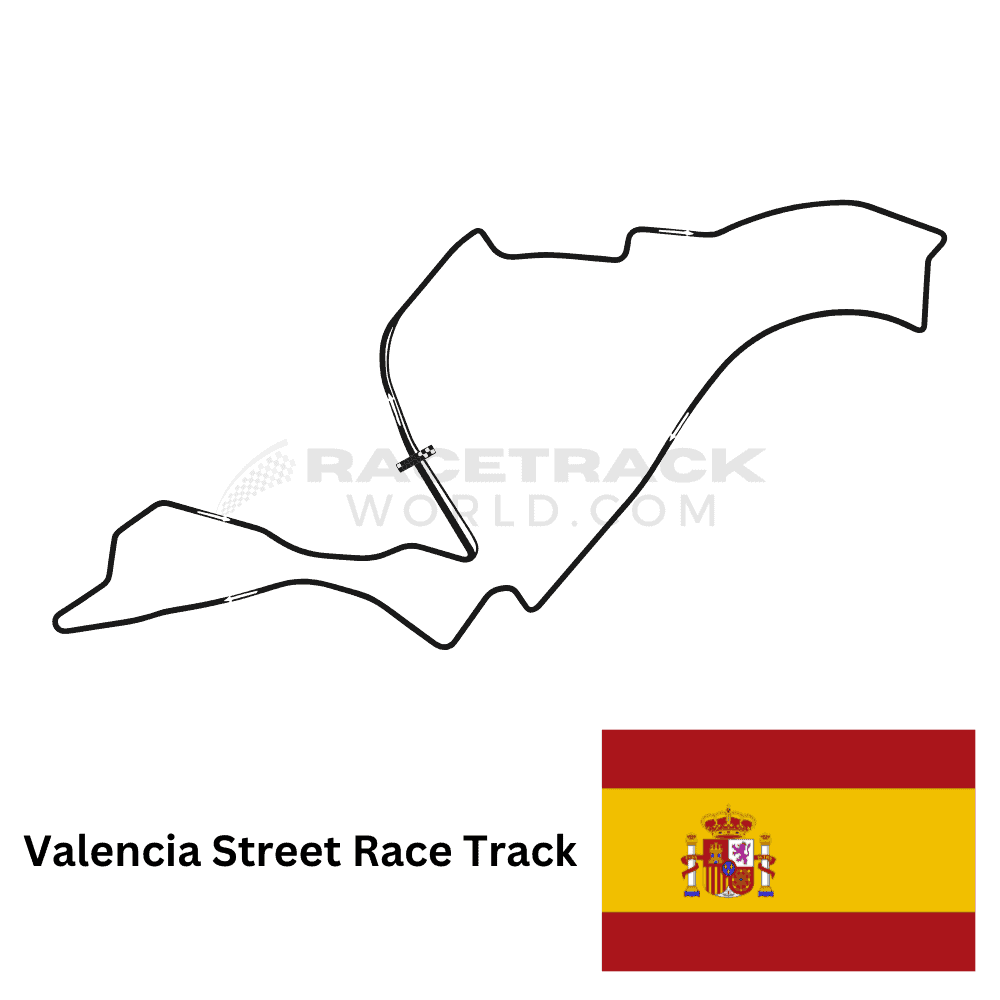
The Valencia Street Circuit was a Hermann Tilke-designed temporary street track laid out around the Marina Real Juan Carlos I, the América's Cup port complex built for the 2007 sailing event. The 5.419 km, 25-turn lap (11 lefts, 14 rights) ran clockwise past the marina's modern buildings and included a distinctive section crossing a 140 m swing bridge over the port, a rare feature for a Formula 1 circuit. Long, low-speed sections through tight harbourside corners made overtaking difficult and the racing generally processional, one of the criticisms that contributed to the event's short life.
Configurations
| Layout | Length | Used for |
|---|---|---|
| Full circuit | 5.42 km | 5.419 km, 25 turns; used for the European Grand Prix 2008-2012 |
Events and race weekends
The circuit hosted the Formula 1 European Grand Prix in each of its five seasons, from 2008 to 2012, run alongside Spain's other Grand Prix at Circuit de Barcelona-Catalunya. It also held GP2 and other support races during those weekends. No F1 or major motorsport event has been held on the circuit since the 2012 race, and none is planned; the roads remain part of the ordinary Valencia street network in the marina area.
Getting there and parking
The former circuit occupies streets around Valencia's Marina Real, close to the city centre and well connected by public transport. Most visitors fly into Valencia's own airport and reach the port area by taxi, bus or Metrovalencia; the harbourside location is an easy add-on to a city visit rather than requiring a special trip.
- Valencia Airport (VLC) · about 20 min drive
Parking
Public street and marina parking is available around the port area, as for any Valencia city visit; no dedicated circuit-related parking exists any longer.
Metrovalencia and city bus routes reach the Marina Real area directly, making a car unnecessary for a visit.
Hotels and camping near Valencia Street Circuit
As part of central Valencia, the old circuit area sits within easy reach of the city's full range of hotels; the Cabanyal and Marina districts nearest the port offer some accommodation, while the historic centre a short distance inland has by far the widest hotel choice.
Where to look
Marina/Cabanyal districts for proximity to the old circuit and beach; Valencia's historic centre (Ciutat Vella) for the widest hotel selection.
Track days, driving experiences and lap records
There are no track days, closed-road sessions or organised driving events on the former Valencia Street Circuit. The roads are open public streets used for everyday marina and port traffic, and parts of the site have, since around 2022, become home to informal settlements of shacks built by homeless residents, a situation reported extensively in the Spanish press as a stark contrast to the venue's Grand Prix past.
Lap records
| Category | Time | Driver | Car | Year |
|---|---|---|---|---|
| F1 outright (2009 European GP) | 1:38.683 | Timo Glock | Toyota TF109 | 2009 |
Spectator guide
There is no racing to spectate today; the former circuit is simply part of the city's marina street network, though enthusiasts sometimes walk or cycle sections of the old route to see remnants of the F1-era infrastructure and the swing bridge. Valencia's Mediterranean climate makes the port area pleasant for most of the year, with hot summers and mild winters.
Best places to watch
The area around the swing bridge and marina buildings retains the most recognisable F1-era character.
Weather
- Jun-Sep: Hot, humid Mediterranean summer, highs around 84-90°F (29-32°C)
- Dec-Feb: Mild winter, highs around 60-63°F (16-17°C)
History of Valencia Street Circuit
Built for a Grand Prix
The Valencia Street Circuit was built around the Marina Real Juan Carlos I, the América's Cup port complex constructed for the 2007 sailing event, and designed by architect Hermann Tilke. It opened on 26 July 2008 with the inaugural European Grand Prix, a 5.419 km, 25-turn lap that wound through the marina and crossed a distinctive 140 m swing bridge over the port — a novel feature for a modern Formula 1 track and a visual signature of the race broadcasts.
Five seasons of racing
Valencia hosted the European Grand Prix in each of its five seasons from 2008 to 2012, run in the same years as the separate Spanish Grand Prix at Circuit de Barcelona-Catalunya — an unusual arrangement that gave Spain two F1 races a year. Timo Glock's 1:38.683 in a Toyota TF109 during the 2009 race stands as the circuit's lap record. Despite the striking setting, the tight, low-speed street layout made overtaking difficult, and the races were frequently criticised as processional, echoing complaints levelled at other Tilke-designed street circuits of the era.
The end of the deal and the cost
A planned arrangement to alternate Spain's Grand Prix between Valencia and Barcelona fell through, and the 2012 race turned out to be Valencia's last Formula 1 event. The project's finances became a long-running political and financial controversy in the region: reporting has put the public cost at roughly €300 million, including construction, several years of hosting fees, television rights and debts assumed by the regional government after the promoter Valmor Sport collapsed.
Today
The circuit's roads remain part of Valencia's ordinary street network around the marina, open to everyday traffic, with no races or organised events held there since 2012. Since around 2022, sections of the site have become home to informal settlements built by homeless residents from various backgrounds, a situation widely covered in the Spanish press as an emblem of the project's unresolved legacy. There is no confirmed plan, as of 2026, to redevelop the area or revive motorsport use of the site.
Frequently asked questions
Can you still visit the Valencia Street Circuit?+
Yes, in the sense that the roads are ordinary public streets around Valencia's Marina Real that anyone can walk, cycle or drive through as part of the port area. There is no racing, track days or organised motorsport activity there.
Why did Formula 1 stop racing in Valencia?+
A planned deal to alternate Spain's Grand Prix between Valencia and Barcelona's Circuit de Barcelona-Catalunya fell through, and after five seasons (2008-2012) the European Grand Prix was not renewed; the promoter later collapsed under heavy debts.
How long was the Valencia Street Circuit?+
The full lap was 5.419 km (3.37 miles) with 25 turns, run clockwise and including a crossing of a 140-metre swing bridge over the marina.
What is at the old circuit site today?+
The roads remain part of the city's marina street network. Sections of the surrounding area have, since around 2022, become informal settlements of shacks built by homeless residents, a situation widely reported in the Spanish press.
How much did the Valencia circuit cost?+
Spanish media reporting has put the total public cost at roughly €300 million across construction, hosting fees paid over its five F1 seasons, television rights and debts later assumed by the regional government.
Other tracks nearby
- Circuit Ricardo Tormo · 26 km · road course
- Circuito de Albacete · 136 km · road course
- MotorLand Aragón · 180 km · road course
- Circuit de Calafat · 191 km · road course
- Parcmotor Castellolí · 292 km · road course
- Circuit de Montjuïc · 298 km · historic circuit (defunct)
Facts checked against 3 sources including the official circuit website. Last reviewed 2026-09-11.