
Birmingham Superprix
Birmingham Superprix at a glance
- Location
- Birmingham
- Type
- historic circuit (defunct)
- Length
- 3.974 km (2.469 mi)
- Turns
- 7
- Direction
- counter-clockwise
- Surface
- asphalt
- Opened
- 1986
- Address
- Bristol Street
Track map and layout
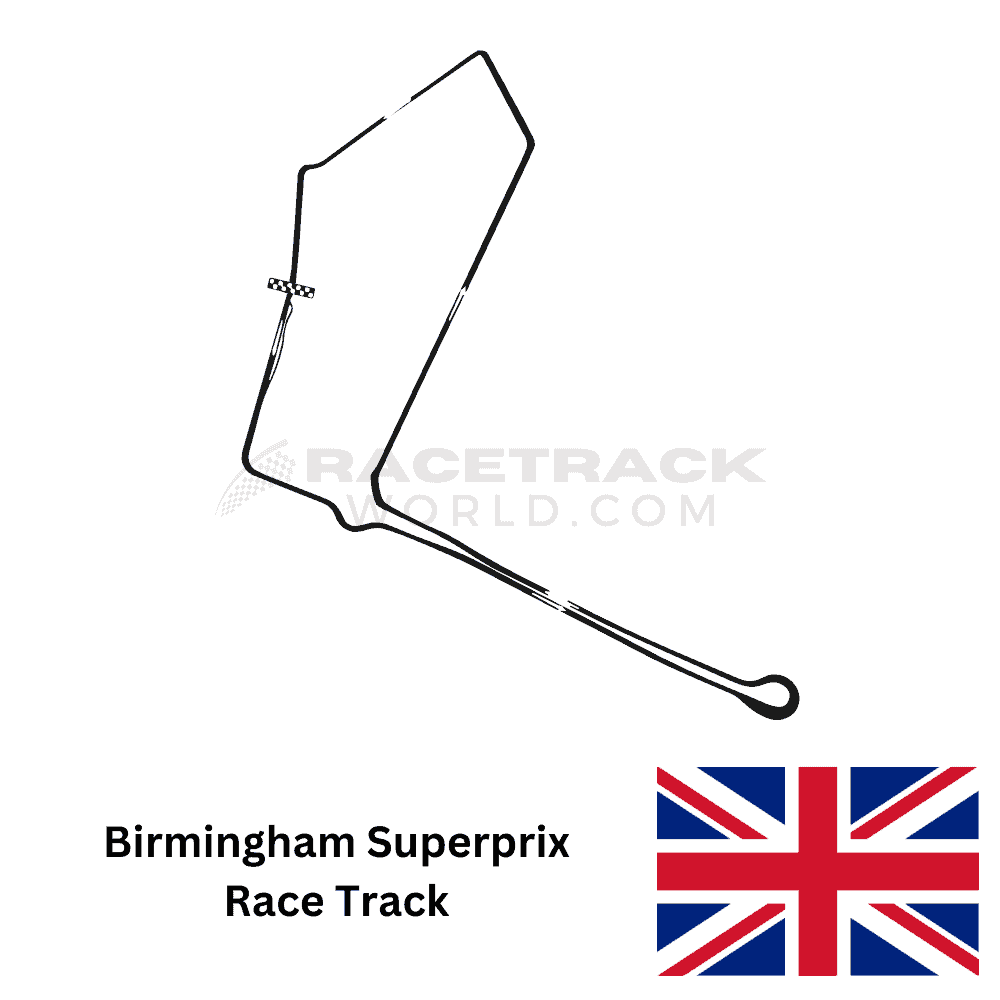
The Superprix used a 2.469-mile (3.974km) loop of ordinary Birmingham streets just south of the city centre, run anticlockwise from a start/finish on Bristol Street. Cars dropped onto the dual-carriageway Belgrave Middleway before a right-left-right chicane through the Belgrave Interchange, then out to a tight hairpin formed from the Haden Circus roundabout (Halfords Corner), back past Holts Corner, and along Sherlock Street and Pershore Street before rejoining Bristol Street via Bromsgrove Street. With only seven corners but plenty of dual-carriageway width followed by tight, bumpy sections around drain covers and kerbs, it rewarded car control over pure straight-line speed and was notoriously hard on brakes and suspension for the single-seaters that headlined it.
Named corners and sections
- Belgrave Interchange. A right-left-right chicane thrown across the dual-carriageway Belgrave Middleway to slow the field.
- Halfords Corner. A tight hairpin built out of the Haden Circus roundabout, one of the circuit's key overtaking points.
- Holts Corner. A fast corner on the run back towards Bristol Street.
Configurations
| Layout | Length | Used for |
|---|---|---|
| Street circuit | 3.97 km | The only layout used across all five Superprix meetings, 1986-1990 |
Events and race weekends
The Birmingham Superprix ran once a year over the August bank holiday from 1986 to 1990, headlined every year by a round of the international Formula 3000 championship - a rare street race for the category outside Monaco and Pau. Support races varied by year and included the British Touring Car Championship in 1988-1990 (the 1988 BTCC race was cancelled after the F3000 race overran) plus Thundersports and sports car events in earlier years. There is no annual event today: the meeting was discontinued after 1990 and has never been revived.
Getting there and parking
The old circuit was public road, and it still is: Bristol Street (A38) and Belgrave Middleway (A4540) remain ordinary, busy Birmingham through-routes a short walk south of Birmingham New Street station and the city centre. Anyone wanting to trace the old lap today is really just walking or driving normal city streets rather than visiting a preserved venue, so there is nothing venue-specific to plan around.
- Birmingham Airport (BHX)
Parking
No event parking exists; visitors would use ordinary Birmingham city-centre parking, same as for any other city-centre errand.
Bristol Street Motors, the corner named after the local dealership, and the Haden Circus roundabout (once Halfords Corner) are the easiest reference points for spotting the old layout on a map today.
Hotels and camping near Birmingham Superprix
Since the race has not run since 1990, there is no race-weekend accommodation pattern to describe; visitors combining a look at the old streets with a Birmingham city break should simply book in Birmingham city centre, which is a short walk from the old start/finish on Bristol Street and has the full range of UK city-centre hotel options.
Where to look
Birmingham city centre, within walking distance of Bristol Street and New Street station.
Track days, driving experiences and lap records
There is no track-day access to the Birmingham Superprix route - it was, and remains, ordinary public road subject to normal traffic law, not a circuit anyone can book out for driving.
Lap records
| Category | Time | Driver | Car | Year |
|---|---|---|---|---|
| F3000 | 1:22.910 | Roberto Moreno | Ralt RT21 | 1987 |
| BTCC (Group A) | 1:35.700 | Robb Gravett | Ford Sierra RS500 Cosworth | 1990 |
Spectator guide
There is no current spectator event at the Birmingham Superprix site; when it ran, crowds lined the closed public streets and temporary grandstands around the Belgrave Interchange and Bristol Street, but none of that infrastructure remains today.
History of Birmingham Superprix
Birmingham's bid for a Monaco of its own
The Birmingham Superprix opened on 25-26 August 1986, closing off streets just south of the city centre to bring a round of the international Formula 3000 championship to an English city for the first time since Birmingham had lobbied hard to stage a genuine street race in the mould of Monaco or Pau. The debut meeting was drenched by the tail end of Hurricane Charley, and the feature F3000 race was red-flagged on lap 24 with half points awarded to winner Luis Perez-Sala.
Five years of city-centre racing
The event returned every August bank holiday through 1990, headlined each year by F3000 and, from 1988, supported by the British Touring Car Championship (the 1988 BTCC race was cancelled when the F3000 race overran its road-closure time limit). Stefano Modena won the 1987 F3000 race, in which Roberto Moreno set the circuit's outright lap record of 1:22.910; Moreno himself won in 1988 after two restarts, and a young Jean Alesi took victory in 1989 in front of what was remembered as a genuine carnival atmosphere in the city. The final meeting in 1990 saw Eric van de Poele win a chaotic F3000 race that only 11 of 30 starters finished, while Andy Rouse took the BTCC honours.
A quiet end, not a dramatic one
The Superprix did not end through a crash or a ban; after 1990 the right to organise the event was put out to tender and no one came forward, so the race simply lapsed. There was no 1991 event, and Birmingham never returned to the international calendar in the same way.
What is there now
Bristol Street, Belgrave Middleway, Sherlock Street and Pershore Street are all still ordinary, busy Birmingham roads carrying everyday traffic; nothing on the ground marks where grandstands, pit garages or the Belgrave Interchange chicane once stood. The only lasting trace is in photographs, race results and the memories of a generation of British motorsport fans who saw F3000 stars race on streets they otherwise drove or walked every day.
Frequently asked questions
Does the Birmingham Superprix circuit still exist?+
No. It was a temporary street circuit that ran on public roads only during race week each August from 1986 to 1990; the streets are now ordinary Birmingham roads with no trace of the racing.
Why did the Birmingham Superprix stop?+
After the 1990 event the organisation of the race was put out to tender and no bidder came forward to run it, so the meeting was simply not held again.
What racing series raced at the Birmingham Superprix?+
The headline event every year was the international Formula 3000 championship, supported at various points by the British Touring Car Championship, Thundersports and sports car races.
How long was the Birmingham Superprix circuit?+
2.469 miles (3.974km) with seven corners, run anticlockwise on closed public streets south of Birmingham city centre.
Can you still see the old circuit layout in Birmingham?+
Yes - Bristol Street, Belgrave Middleway, Sherlock Street and Pershore Street are all still in everyday use as normal city roads, so the route can be walked or driven, though nothing marks it as a former race circuit.
Who holds the Birmingham Superprix lap record?+
Roberto Moreno set the outright F3000 lap record of 1:22.910 in a Ralt RT21 in 1987; Robb Gravett holds the BTCC Group A record of 1:35.700 in a Ford Sierra RS500 Cosworth from 1990.
Other tracks nearby
- Mallory Park · 41 km · road course
- Donington Park · 53 km · road course
- Silverstone Circuit · 75 km · road course
- Rockingham Motor Speedway · 84 km · historic circuit (dormant)
- Oulton Park · 92 km · road course
- Bedford Autodrome · 100 km · road course
Facts checked against 5 sources including the official circuit website. Last reviewed 2026-09-10.