
Indianapolis Motor Speedway
Indianapolis Motor Speedway at a glance
- Location
- Speedway, Indiana
- Type
- road course & oval
- Length
- 2.5 mi (4.023 km)
- Turns
- 4
- Direction
- counter-clockwise
- Banking
- 9.2° in the turns
- Surface
- asphalt
- Opened
- 1909
- Owner
- Penske Entertainment
- Capacity
- 257,325
- Address
- 4790 W 16th St
- Phone
- +1-317-492-6700
Track map and layout
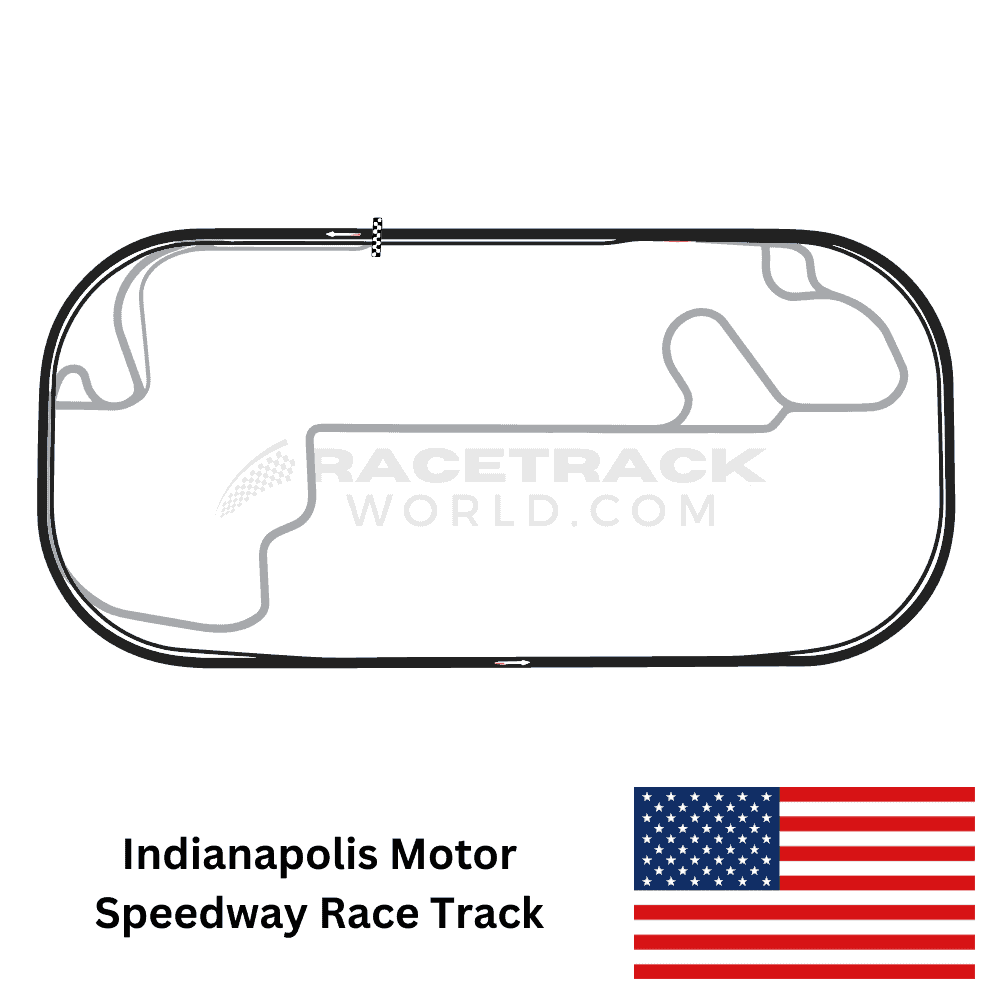
The 'Brickyard' is a 2.5-mile rectangular oval with four gently banked, 9.2-degree turns, far shallower than a NASCAR intermediate or superspeedway, which puts more of the challenge on precision and less on raw banking-assisted grip. The track's original surface, laid with 3.2 million bricks in 1909, has been almost entirely paved over with asphalt, but a single yard of brick remains exposed at the start/finish line as a nod to the track's origins and the tradition of winners kissing the bricks. A dedicated infield road course, added in 2000 and reworked several times since, weaves through the infield and part of the oval and is used for MotoGP and other road-racing events, giving the Speedway two genuinely different personalities depending on the event.
Named corners and sections
- Yard of Bricks. The exposed strip of original brick paving at the start/finish line, where winners traditionally kneel and kiss the ground.
- Turn 1. The first of the oval's four shallow-banked corners, a critical braking and setup point for the long straights that follow.
Configurations
| Layout | Length | Used for |
|---|---|---|
| 2.5-mile oval | 2.5 mi | Used for the Indianapolis 500 and NASCAR Brickyard 400 |
| Road course (Grand Prix layout) | 2.439 mi | Infield/oval hybrid layout used for MotoGP and other road-racing events, reconfigured over the years |
Events and race weekends
The Indianapolis 500 in late May is the Speedway's defining event and one of motorsport's biggest single-day spectacles worldwide, run since 1911 (with wartime interruptions) as part of a full 'Month of May' schedule of practice and qualifying. NASCAR's Brickyard 400 runs on the oval in July (the Cup Series raced the road course as the Verizon 200 from 2021 to 2023), and the track also hosts IndyCar's Sonsio Grand Prix on the road course. MotoGP raced on the infield layout from 2008 to 2015.
| Event | Series | When | Notes |
|---|---|---|---|
| Indianapolis 500 | IndyCar | May | Run on the oval; the Speedway's signature event since 1911 |
| Brickyard 400 | NASCAR Cup | July | Run on the oval |
| Sonsio Grand Prix | IndyCar | May | Run on the road course, part of Month of May |
Getting there and parking
Indianapolis International Airport is about 20-25 minutes from the Speedway, making it an easy fly-in option for Indy 500 weekend. The track sits within the town of Speedway, Indiana, minutes from downtown Indianapolis via Interstate 465.
- Indianapolis International Airport (IND) · about 20 min drive
Parking
Daily parking is limited to vehicles no larger than a standard 10x20-foot spot, with lots available for around $15 depending on location; spaces are limited and fill quickly on race day.
Arrive very early for the Indy 500, since traffic into Speedway, Indiana is some of the heaviest of any single-day sporting event in the country.
Hotels and camping near Indianapolis Motor Speedway
Downtown Indianapolis, about 15-20 minutes from the track, has the largest hotel supply and is the default base for most visitors, while towns closer to the Speedway itself fill up fast for Indy 500 weekend. Booking well ahead of the Month of May is essential given the scale of the event.
Where to look
Downtown Indianapolis and the town of Speedway, Indiana immediately surrounding the track.
Camping
On-site camping is available for the Indy 500 and other major events, with both tent and RV passes sold separately and wristbands included per pass.
RV
RV camping passes cover 20x40-foot spaces and include amenities such as portable restrooms, waste pump-out and non-potable water fill during major events.
Track days, driving experiences and lap records
The Speedway offers guided track tours and, on select dates, ride-along and driving experiences in IndyCar-style two-seaters through an on-site partner program. There is no general public HPDE program on the oval, but the infield road course occasionally hosts club and manufacturer track days organized separately from race events.
Who runs days here
Lap records
| Category | Time | Driver | Car | Year |
|---|---|---|---|---|
| Indy 500 qualifying, one lap | — | Arie Luyendyk | Reynard-Ford | 1996 |
| Indy 500 pole speed | — | Scott McLaughlin | Dallara-Chevrolet | 2024 |
Spectator guide
Indianapolis Motor Speedway is the largest sports venue in the world by permanent seating capacity, with grandstands stretching the length of both straights and around the corners, giving a huge range of viewing options and price points.
Seating
Paddock, Penthouse, Tower Terrace, Turn and Stand grandstands cover the frontstretch and all four corners, with named sections along the main straight offering the closest views of pit lane and the yard of bricks.
Best places to watch
Seats near the yard of bricks on the frontstretch see the start, finish and Victory Lane celebration; Turn 1 and Turn 3 grandstands are popular for watching overtaking and close racing into the corners.
Bag policy
For the Indianapolis 500, coolers up to 18 x 15 x 15 inches are allowed and may be hard or soft-sided, with food, water, soft drinks, beer and wine in non-glass containers. Umbrellas and folding chairs are permitted; rules differ for other IMS events.
Weather
- May: Mild and variable, highs in the 70s°F with a chance of rain during Month of May events
- Jul: Hot and humid, highs in the 80s-90s°F for the Brickyard weekend
History of Indianapolis Motor Speedway
Founding a proving ground
Indianapolis Motor Speedway was built in 1909 by a group led by Carl Fisher as a testing ground for the young American automobile industry. The original surface of crushed stone and tar proved dangerous, and within months the track was repaved with 3.2 million bricks, earning it the enduring nickname 'The Brickyard.' The first Indianapolis 500 was run in 1911 and was won by Ray Harroun, establishing a Memorial Day weekend tradition that has continued, with only wartime interruptions, ever since.
A century of racing
Through the 20th century the Speedway became the single most prestigious venue in open-wheel racing, and by the 1930s asphalt had gradually replaced most of the brick surface, leaving only the start/finish-line strip that gave rise to the 'Yard of Bricks' tradition of winners kneeling to kiss the ground. The Speedway added NASCAR's Brickyard 400 in 1994, instantly becoming one of stock car racing's most coveted wins, and hosted Formula One's United States Grand Prix on a purpose-built infield road course from 2000 to 2007.
Modern era
Ownership of the Speedway and the IndyCar Series passed to Penske Entertainment in 2020, bringing new investment into facility upgrades while preserving the track's historic character. Today the Speedway anchors a full 'Month of May' of practice, qualifying and the Indy 500 itself, still the largest single-day sporting event in the world by attendance, alongside its NASCAR and MotoGP dates and a road course used for IndyCar's own Grand Prix of Indianapolis. Few venues in any sport carry the combination of scale, history and continuity that Indianapolis Motor Speedway has sustained for well over a hundred years.
Frequently asked questions
How long is Indianapolis Motor Speedway?+
The oval is 2.5 miles per lap; the infield road course used for MotoGP and IndyCar's Grand Prix runs roughly 2.4 miles.
Why is Indianapolis Motor Speedway called the Brickyard?+
The track was originally paved with 3.2 million bricks in 1909; today only a yard of brick remains exposed at the start/finish line, though the nickname stuck.
What is the seating capacity of Indianapolis Motor Speedway?+
Permanent seating capacity is about 257,325, making it the largest sports venue in the world; total capacity including infield can exceed 300,000 for the Indy 500.
When is the Indianapolis 500?+
The Indy 500 runs over Memorial Day weekend in late May as the centerpiece of the Speedway's Month of May.
What is the nearest airport to Indianapolis Motor Speedway?+
Indianapolis International Airport is roughly 20-25 minutes from the track.
Can I camp at Indianapolis Motor Speedway?+
Yes, on-site tent and RV camping passes are sold for the Indy 500 and other major events, each including a set number of wristbands.
Other tracks nearby
- Putnam Park Road Course · 31 mi · road course
- Ironman Raceway · 39 mi · motocross
- Kentucky Speedway · 103 mi · oval
- RedBud MX · 142 mi · motocross
- Chicagoland Speedway · 150 mi · oval
- GingerMan Raceway · 180 mi · road course
Facts checked against 6 sources including the official circuit website. Last reviewed 2026-09-09.