- Home
- South America
- Argentina
- Autódromo Oscar y Juan Gálvez (Buenos Aires)
Track guide · road course
Autódromo Oscar y Juan Gálvez (Buenos Aires)
Autódromo Oscar y Juan Gálvez (Buenos Aires) at a glanceChecked 2026-09-11
- Length
- 4.101 km2.548 mi
- Turns
- 16
- Opened
- 1952
- Capacity
- 45,000
- Location
- Buenos Aires, Ciudad Autónoma de Buenos Aires
- Type
- road course
- Surface
- asphalt
- Owner
- City of Buenos Aires (Secretaría de Deportes, Gobierno de la Ciudad)
- Address
- Av. Coronel Roca 6902
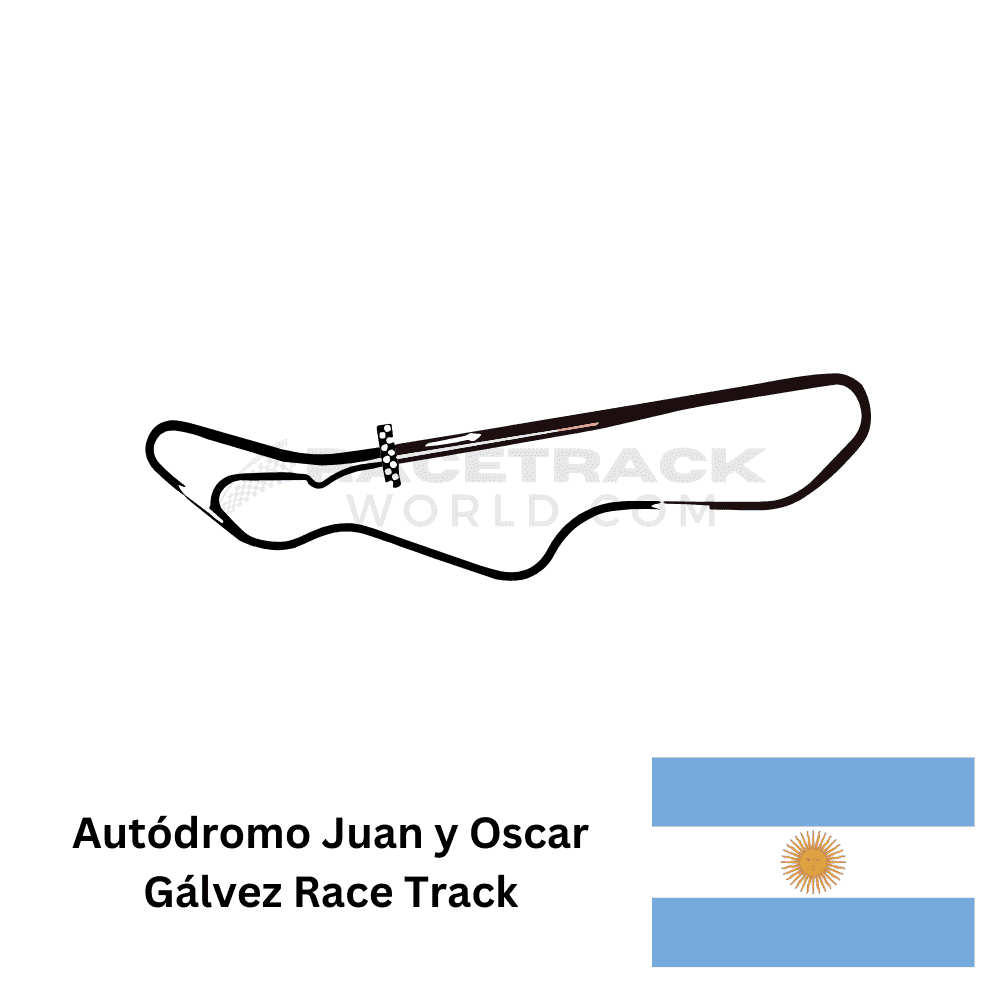
Track map and layout
Built on reclaimed swampland beside the Riachuelo in the southern reaches of Buenos Aires, the Autódromo Gálvez is really a family of interlocking layouts rather than a single track, sharing pit straight and infield sections that can be combined into configurations from around 3.4 km up to almost 6 km. The circuit in most regular use, No. 6, runs 4.101 km (2.548 miles) over 16 corners and is the layout used by Turismo Carretera, TC2000 and Súper TC2000 for most modern racing. A longer variant of No. 6, extended with the "S del Ciervo" chicane, was used for Formula 1 in the 1990s. The terrain is essentially flat, and the lap mixes long straights with tight, technical infield corners, rewarding both power and precise braking. As of 2026 the venue is undergoing a major renovation aimed at hosting MotoGP from 2027, so some events have temporarily moved elsewhere while work continues.
Named corners and sections
S del Ciervo.
A chicane added to lengthen the No. 6 layout for Formula 1 use in the 1990s.
Curvón Salotto.
One of the circuit's faster sweeping corners, named for the Salotto family associated with early Argentine motorsport.
Chicana de Ascari.
A tight chicane named after Alberto Ascari, who raced and won at the circuit in the 1950s.
Tobogán.
A section known locally as the "toboggan" for its rolling, undulating feel despite the circuit's generally flat terrain.
Viborita.
A snaking sequence of corners ("little snake") in the infield that demands a smooth line.
Ombú.
A corner named after the ombú tree, a native South American species associated with the pampas.
Configurations
No. 6
4.10 kmthe standard modern layout used by TC, TC2000 and Súper TC2000
No. 6 (Senna S / F1 variant)
4.26 kmused for the Argentine Grand Prix, 1995-1998
No. 8
3.38 kma shorter infield layout also used for TC2000 support races
No. 9
3.35 kmused for the Argentine Grand Prix, 1971-1973
No. 12
5.65 kma longer combined layout used for some endurance and support events
No. 15
5.97 kmthe longest regularly used configuration, hosting the Argentine Grand Prix from 1974 to 1981
Events and race weekends
The Autódromo Gálvez is Argentina's most important motor racing venue and the traditional home of Turismo Carretera (TC), TC2000, Súper TC2000, Top Race and Turismo Nacional, the domestic touring-car and stock-car categories that dominate Argentine motorsport. It hosted the Argentine Grand Prix, a round of the Formula 1 World Championship, on and off between 1953 and 1998, with legends including Fangio, Ascari and Schumacher winning there. Formula 1 has not returned since 1998, but the circuit remains in near-constant domestic use most weekends of the year. A major renovation begun in 2026 is intended to bring MotoGP's Argentine Grand Prix back to the venue from 2027; while work is under way, some 2026 TC2000 rounds, including the traditional season-opening street race, have been run on a temporary city-street layout in the surrounding Parque de la Ciudad/Parque Roca precinct rather than on the permanent circuit.
TC2000 / Súper TC2000 rounds
TC2000 / Súper TC2000the circuit's most frequent tenant, with several rounds held most seasons
Annual eventWhen—Multiple datesTurismo Carretera rounds
Turismo Carretera (TC)Argentina's premier stock-car category races here most years
Annual eventWhen—Multiple datesTurismo Nacional rounds
Turismo NacionalAnnual eventWhen—Multiple dates
Getting there and parking
The circuit sits in the Villa Lugano/Villa Riachuelo area in the far south of Buenos Aires city, close to Parque Roca. It is reachable by Subte Line E to Plaza de los Virreyes, connecting to the Premetro tram to General Savio station, which sits between Villa Lugano and Villa Riachuelo a short walk from the venue; a wide range of city colectivo (bus) lines, including 21, 28, 32, 36, 80, 91, 101, 114, 115, 117, 140, 141, 143, 150, 185 and 298, also serve the surrounding streets. Both Buenos Aires international airports are a drive of well under an hour away, though traffic on event days should be allowed for.
- EZEMinistro Pistarini International Airport (Ezeiza) (EZE)about 35 mindrive
- AEPJorge Newbery Airfield (Aeroparque) (AEP)about 30 mindrive
Parking
General parking areas operate around the circuit for race meetings; on the biggest domestic race weekends, using the Subte/Premetro combination or a bus is generally easier than driving given congestion on Av. Roca.
TipCombine Subte Line E with the Premetro to General Savio station rather than driving on big TC or TC2000 weekends; check in advance whether an event is running at the permanent circuit or on the temporary street layout, since some 2026 dates have moved during the renovation.
Hotels and camping near Autódromo Oscar y Juan Gálvez (Buenos Aires)
The circuit is well within central Buenos Aires, so most visitors simply base themselves in the city rather than near the track itself. Palermo and Recoleta offer the widest choice of hotels, restaurants and nightlife, roughly 30-40 minutes from the circuit by car or public transport, while Villa Lugano and Parque Patricios sit closer to the venue and tend to be more budget-oriented. Buenos Aires has ample hotel stock year-round, though rooms can tighten around major TC or TC2000 weekends and, once it returns to the calendar, around MotoGP.
Where to look
Palermo and Recoleta for the widest choice of hotels and nightlife; Villa Lugano and Parque Patricios for something closer to the circuit and generally cheaper.
Track days, driving experiences and lap records
The Autódromo Gálvez is a working municipal racing facility rather than a members' club, and it is used almost every weekend by Argentina's national touring-car and stock-car categories. Public track days for private cars or motorcycles are not a regular, advertised feature of the venue in the way they are at some circuits abroad; test and practice sessions for TC, TC2000 and Turismo Nacional teams are not open to the general public. Visitors wanting to experience the track first-hand are best served by attending a race weekend rather than seeking a self-drive session.
Lap records
| Category | Time | Driver | Car | Year |
|---|---|---|---|---|
| Formula 1 (No. 6, Senna S variant) | 1:27.981 | Gerhard Berger | Benetton B197 | 1997 |
| Formula 1 (No. 15) | 1:45.287 | Nelson Piquet | Brabham BT49C | 1981 |
| TC2000 (No. 8) | 1:18.970 | Matías Rossi | — | 2025 |
Drive Autódromo Oscar y Juan Gálvez (Buenos Aires) in a sim
These racing games and simulators include Autódromo Oscar y Juan Gálvez (Buenos Aires) as official content. Mods and community tracks are not listed.
Automobilista 2
base gameLayoutsBuenos Aires Circuito No.12; Buenos Aires Circuito No.15; Buenos Aires Circuito No.6; Buenos Aires Circuito No.6 S; Buenos Aires Circuito No.7; Buenos Aires Circuito No.8; Buenos Aires Circuito No.9
Building a sim rig? Four example setups from $279 → · Every real track in sim racing games
Checked against each publisher’s track list in October 2026 (read 19 Oct 2026).
Spectator guide
Grandstands and general terraces line the pit straight and several infield corners, giving spectators a chance to see cars pass more than once per lap thanks to the circuit's compact, interlocking layout. Argentine race weekends, especially Turismo Carretera dates, draw large, vocal crowds and a strong barbecue-and-flags atmosphere in the general admission areas. Buenos Aires's climate is generally mild, though summer (December-February) race weekends can be hot and occasionally wet.
Seating
Numbered grandstands run along the main straight; general admission terraces and hillside areas overlook several infield corners on the combined layouts.
Best places to watch
General admission areas around the infield corners let fans see the field pass multiple times per lap on the shorter configurations.
Weather
- December-February: hot and humid, with highs around 28-30°C and a chance of summer storms
- June-August: cooler and drier, with highs around 14-17°C
History of Autódromo Oscar y Juan Gálvez (Buenos Aires)
Built on reclaimed swampland
The Autódromo de Buenos Aires opened on 9 March 1952 on marshy ground beside the Riachuelo in the south of the city, inaugurated by President Juan Domingo Perón and originally named Autódromo 17 de Octubre after the Peronist "Loyalty Day". After the 1955 coup that overthrew Perón, the venue was renamed the Autódromo Municipal, a name it kept for decades before eventually being renamed for Juan and Oscar Gálvez, two of Argentina's most famous racing brothers, who did much to popularise motorsport in the country from the 1940s onwards.
Formula 1 years
The circuit joined the Formula 1 World Championship calendar for the first Argentine Grand Prix in 1953 and hosted the race, on various layouts, on and off through 1998. Juan Manuel Fangio, Argentina's own five-time world champion, won at his home circuit, and other winners over the decades included Alberto Ascari, Jim Clark and, in the 1990s revival, Michael Schumacher. The race used several of the circuit's interlocking configurations over the years, from the short No. 9 layout in the early 1970s to the long No. 15 route through 1981, before a modernised, extended version of No. 6 hosted the final Formula 1 races between 1995 and 1998.
Argentina's home of touring cars
Since losing Formula 1 at the end of the 1990s, the Autódromo Gálvez has remained the beating heart of Argentine domestic motorsport, hosting Turismo Carretera, TC2000, Súper TC2000, Top Race and Turismo Nacional on a near-weekly basis. In the mid-2020s the venue entered a new phase, with the City of Buenos Aires announcing a major renovation programme aimed at bringing top-level international racing back, specifically a return of MotoGP's Argentine Grand Prix from 2027, the category's first visit to the country in years. Construction work began in early 2026, and while it continues, some events, including the traditional season-opening TC2000 date, have been temporarily run on a purpose-built street circuit nearby in the Parque de la Ciudad/Parque Roca area rather than on the permanent track.
Frequently asked questions
How long is the Autódromo Gálvez?
It depends on the configuration used. The most common modern layout, No. 6, is 4.101 km (2.548 miles) with 16 corners; other combined layouts range from around 3.4 km up to almost 6 km.
Does Formula 1 still race at the Autódromo Gálvez?
No. The circuit hosted the Argentine Grand Prix on and off from 1953 to 1998, but Formula 1 has not returned since. A renovation begun in 2026 is aimed at bringing MotoGP back from 2027, not F1.
Why is the circuit sometimes called Autódromo de Buenos Aires?
That was its long-standing generic name before it was formally named after racing brothers Juan and Oscar Gálvez; both names are still used interchangeably.
What racing categories use the circuit today?
It is the primary home of Argentina's Turismo Carretera, TC2000, Súper TC2000, Top Race and Turismo Nacional championships, which race there on a near-weekly basis through the season.
How do you get to the Autódromo Gálvez without a car?
Take Subte Line E to Plaza de los Virreyes, then the Premetro to General Savio station, a short walk from the circuit in the Villa Lugano/Villa Riachuelo area; numerous city bus (colectivo) lines also serve the surrounding streets.
Can the public drive on the track?
There are no regular, publicly advertised track days for private cars or motorcycles at the venue; it is used almost exclusively for domestic race meetings and team testing.
Which racing games and sims have Autódromo Oscar y Juan Gálvez (Buenos Aires)?
Autódromo Oscar y Juan Gálvez (Buenos Aires) is officially available in Automobilista 2. Some of these include it in the base game and others sell it as paid content; the table above shows which.
Other tracks nearby
Facts checked against 5 sources including the official circuit website. Last reviewed 2026-09-11.