
Autódromo José Carlos Pace (Interlagos)
Autódromo José Carlos Pace (Interlagos) at a glance
- Location
- São Paulo, São Paulo
- Type
- road course
- Length
- 4.309 km (2.677 mi)
- Turns
- 15
- Direction
- counter-clockwise
- Surface
- asphalt
- Opened
- 1940
- Owner
- São Paulo City Hall (Prefeitura de São Paulo)
- Capacity
- 60,000
- Website
- f1saopaulo.com.br/interlagos
Track map and layout
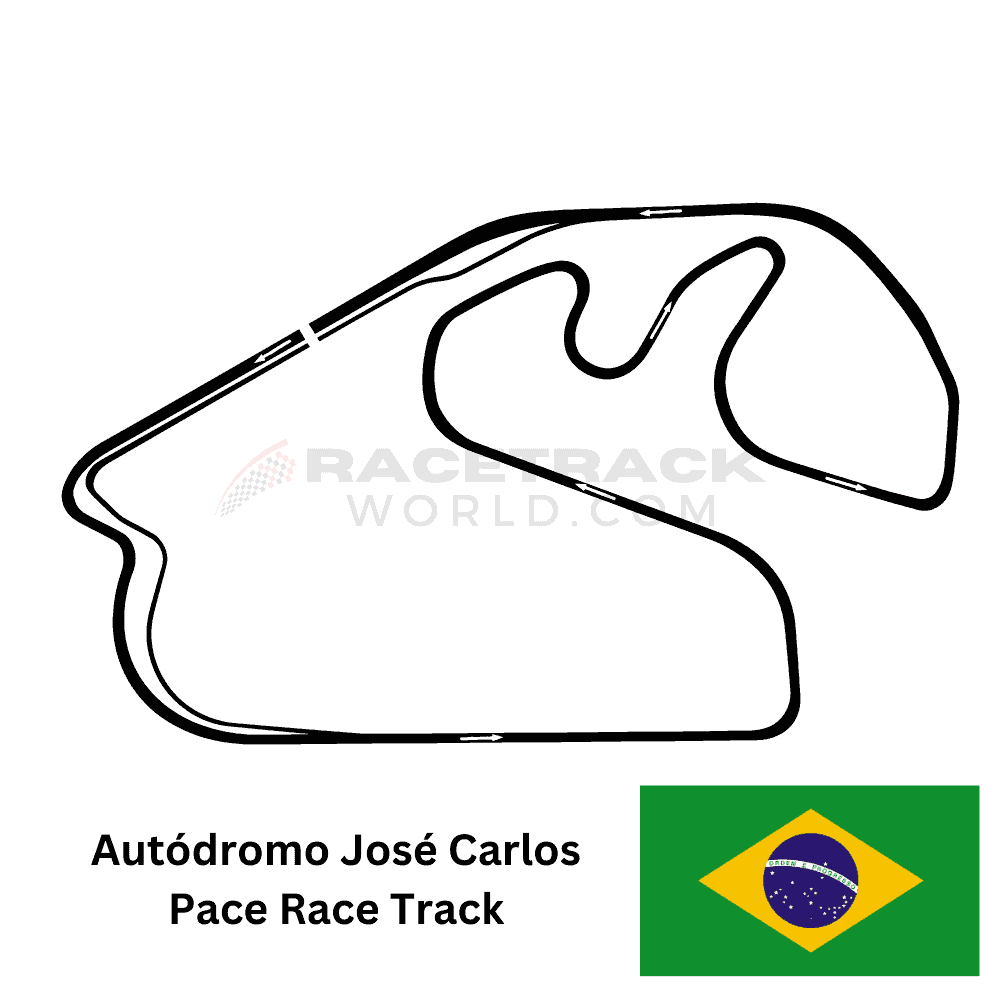
Widely known simply as Interlagos, the circuit runs 4.309 km (2.677 miles) counter-clockwise over 15 corners on genuinely hilly terrain south of São Paulo, between the Guarapiranga and Billings reservoirs ("Interlagos" means "between lakes" in Portuguese). The short pit straight leads into the alternating left-right S do Senna, plunging downhill into the wide, banked Curva do Sol and the long Reta Oposta back straight, historically the circuit's best overtaking zone. The lap then works through a tighter, twistier infield of downhill and uphill corners, including the horseshoe-shaped Ferradura and the tight Bico de Pato hairpin, before climbing the 10% Subida dos Boxes gradient back onto the pit straight. The combination of altitude, changeable weather and a short, punchy lap has made it one of the most demanding and unpredictable circuits on the calendar.
Named corners and sections
- S do Senna (Turns 1-2). A fast alternating left-right kink just after the start line, added in the 1990 redesign at Ayrton Senna's suggestion and named in his honour.
- Curva do Sol (Turn 3). A long, wide, downhill left-hander that carries big speed onto the Reta Oposta back straight.
- Reta Oposta. The circuit's longest straight, running back across the infield and the main slipstreaming and overtaking zone into Turn 4.
- Ferradura. A tight, horseshoe-shaped right-hand corner in the middle sector that demands a slow, precise turn-in.
- Bico de Pato (Duck's Beak). A tight hairpin in the closing sector, one of the slowest points on the lap.
- Subida dos Boxes. The steep, roughly 10% uphill climb from the final corner back onto the pit straight, notorious for wheelspin in the wet.
Configurations
| Layout | Length | Used for |
|---|---|---|
| Grand Prix Circuit (current, since 1999) | 4.31 km | used by F1, Stock Car, MotoGP-era and all modern racing |
| Original circuit (1940-1979) | 7.96 km | 7.960 km, 26-turn original layout, abandoned for safety reasons |
| 1980-1989 layout | 7.87 km | 7.873 km, 26 turns, used before the 1990 shortening |
Events and race weekends
Interlagos hosts the Formula 1 São Paulo Grand Prix each November, one of the most atmospheric and unpredictable races on the calendar thanks to São Paulo's changeable weather and the circuit's short, action-packed lap; it ran as the Brazilian Grand Prix from 1972 (non-championship in 1972, championship from 1973) with a break in the 1980s, before returning to an annual home in 1990. The circuit is also the traditional home of Brazil's Stock Car Pro Series, runs a round of the FIA World Endurance Championship (6 Hours of São Paulo) and the Mil Milhas Brasil endurance classic, and hosts major music festivals including Lollapalooza Brasil and The Town on non-race weekends.
| Event | Series | When | Notes |
|---|---|---|---|
| Formula 1 São Paulo Grand Prix | Formula 1 | November | ran as the Brazilian Grand Prix 1972-2019, renamed São Paulo GP from 2021; confirmed on the calendar to 2030 |
| Mil Milhas Brasil | Endurance racing | January | Brazil's classic 1000-mile endurance race |
| 6 Hours of São Paulo | FIA World Endurance Championship | July | |
| Stock Car Pro Series rounds | Stock Car Pro Series | Multiple dates | Interlagos is Brazilian Stock Car's traditional home venue, hosting several rounds a year |
| Lollapalooza Brasil | Music festival | March | held on the circuit's infield, not a motorsport event |
Getting there and parking
Interlagos sits in São Paulo's southern zone, about 25-30 km from the city centre and roughly 40-50 minutes from Guarulhos International Airport depending on traffic. The circuit has its own CPTM commuter rail station, Autódromo, on Line 9-Esmeralda, around 600-800 metres from the Setor G entrance gate, with shuttle buses laid on to other gates on event days; this is by far the easiest way to reach the venue during the Grand Prix, since road traffic around Interlagos backs up badly on race weekends.
- São Paulo-Guarulhos International Airport (GRU) · about 50 min drive
- São Paulo-Congonhas Airport (CGH) · about 20 min drive
Parking
Paid general parking areas operate around the circuit on event weekends, but they fill quickly and access roads congest heavily; most locals and visiting fans prefer the CPTM Autódromo station on Line 9-Esmeralda.
Take the CPTM Line 9-Esmeralda train to Autódromo station rather than driving for the Grand Prix weekend; allow extra time on race day as trains and shuttle buses get very busy from mid-morning.
Hotels and camping near Autódromo José Carlos Pace (Interlagos)
Most international visitors base themselves in central São Paulo, which offers by far the widest choice of hotels, and use the CPTM rail line or transfers to reach the circuit rather than staying nearby. Popular areas include Paulista Avenue, Itaim Bibi, Vila Olímpia and Moema for their hotel density, restaurants and nightlife, all roughly 30-45 minutes from the circuit by car or a train-plus-transfer combination; Santo Amaro, closer to Interlagos itself, offers a smaller, more budget-friendly and convenient option. Hotels across the city sell out and prices rise sharply around the November Grand Prix, so booking well ahead is recommended.
Where to look
Paulista Avenue, Itaim Bibi, Vila Olímpia and Moema for the widest hotel choice and nightlife; Santo Amaro for something closer to the circuit and generally cheaper.
Track days, driving experiences and lap records
Interlagos is a working public facility rather than a members' club, and it hosts frequent third-party car and motorcycle track days, driving schools and amateur racing series alongside its professional calendar; access for the general public to drive or ride is only through these organised programmes, not by simply turning up. Local operators including Kings Racing School run structured track-day sessions on the Grand Prix layout, and various motorcycle clubs organise dedicated bike track days through the circuit's booking system.
Who runs days here
Lap records
| Category | Time | Driver | Car | Year |
|---|---|---|---|---|
| Formula 1 (race lap, current layout) | 1:10.540 | Valtteri Bottas | Mercedes W09 | 2018 |
| Formula 1 (qualifying/pole, current layout) | 1:07.281 | Lewis Hamilton | Mercedes W09 | 2018 |
Spectator guide
Grandstands line the pit straight, the S do Senna/Curva do Sol opening sequence and several infield corners, giving close views of the start and the circuit's fastest sections; general admission hillside areas overlooking the Reta Oposta and the closing corners are popular budget options that let fans see several corners at once and soak up Interlagos's famously loud, passionate atmosphere. Rain is common at any time of year, so waterproofs are recommended even for general admission areas with limited cover.
Seating
Numbered grandstands run along the pit straight and around the S do Senna/Curva do Sol complex; general admission hillside terraces cover much of the infield and the final sector.
Best places to watch
The general admission hill overlooking Curva do Sol and the Reta Oposta gives sweeping views of the opening sequence and the main straight for a fraction of grandstand prices.
Weather
- November (F1 weekend): unpredictable; highs around 25-27°C with a high chance of sudden, heavy rain showers
History of Autódromo José Carlos Pace (Interlagos)
São Paulo's circuit "between the lakes"
The Autódromo de Interlagos opened on 12 May 1940 in São Paulo's southern zone, built on land between the Guarapiranga and Billings reservoirs that gives the circuit its name. Its original layout was a sprawling 7.960 km, 26-turn road course, one of the longest and most demanding tracks of its era, and it quickly became the heart of Brazilian motorsport. In 1985 the venue was renamed Autódromo José Carlos Pace in honour of the Brazilian Formula 1 driver, who had won the 1975 Brazilian Grand Prix at the circuit and died in a plane crash in 1977.
From championship venue to safety concerns
Interlagos joined the Formula 1 World Championship calendar in 1973 after hosting a non-championship race in 1972, and quickly built a reputation for producing exciting, often chaotic races, helped along by São Paulo's rapidly changing weather. By the late 1970s, though, the long original layout was considered outdated and unsafe by modern F1 standards, and the Brazilian Grand Prix moved away to Jacarepaguá in Rio de Janeiro for most of the 1980s. Interlagos itself continued hosting domestic and international racing on its full-length layout through the decade.
Shortened, modernised and reborn
In 1990 Interlagos was dramatically reconfigured, cut down to roughly half its original length at a cost of around $15 million, with the new, tighter infield section including the S do Senna kink, added at Ayrton Senna's own suggestion. The shortened circuit reclaimed the Brazilian Grand Prix that same year and has kept it, with the race renamed the São Paulo Grand Prix from 2021, ever since. The track's short, unpredictable lap has produced some of Formula 1's most dramatic championship deciders, including Kimi Räikkönen's title-clinching 2007 win and Lewis Hamilton's last-lap 2008 title decider against Felipe Massa. In August 2024, José Carlos Pace's remains were moved to the circuit that bears his name, making him the first deceased driver to be buried at a race track. Today Interlagos remains Brazil's flagship motorsport venue, hosting Stock Car Pro Series, endurance racing and, on non-race weekends, major music festivals including Lollapalooza Brasil.
Frequently asked questions
How long is the Interlagos circuit?+
The current Grand Prix layout is 4.309 km (2.677 miles) with 15 corners.
Why is it called Interlagos?+
Interlagos means "between lakes" in Portuguese, referring to the circuit's location between the Guarapiranga and Billings reservoirs in southern São Paulo.
Is Interlagos the same as the Brazilian Grand Prix venue?+
Yes. The circuit's official name is Autódromo José Carlos Pace, but it is almost always called Interlagos; it has hosted the Brazilian Grand Prix (renamed the São Paulo Grand Prix from 2021) in most years since 1973.
What is the F1 lap record at Interlagos?+
The race lap record on the current layout is 1:10.540, set by Valtteri Bottas in a Mercedes W09 in 2018; Lewis Hamilton set the fastest qualifying lap, 1:07.281, in the same car and year.
How do you get to Interlagos without a car?+
The circuit has its own CPTM commuter rail station, Autódromo, on Line 9-Esmeralda, about 600-800 metres from the Setor G gate, with shuttle buses to other gates on event days.
Where should I stay for the São Paulo Grand Prix?+
Most visitors stay in central São Paulo, in areas like Paulista Avenue, Itaim Bibi or Moema, and travel to the circuit by train or transfer; Santo Amaro is a closer, more budget-friendly alternative.
Other tracks nearby
- São Paulo Street Circuit (Anhembi) · 21 km · street circuit
- Autódromo Velo Città · 158 km · road course
- Ribeirão Preto Street Circuit · 311 km · historic circuit (defunct)
- Autódromo Internacional de Curitiba · 318 km · historic circuit (defunct)
- Autódromo Internacional Nelson Piquet (Jacarepaguá) · 347 km · historic circuit (defunct)
- Circuito Cacá Bueno (Galeão) · 366 km · historic circuit (defunct)
Facts checked against 4 sources including the official circuit website. Last reviewed 2026-09-11.