
Autódromo Internacional Nelson Piquet (Jacarepaguá)
Autódromo Internacional Nelson Piquet (Jacarepaguá) at a glance
- Location
- Rio de Janeiro, Rio de Janeiro
- Type
- historic circuit (defunct)
- Length
- 5.031 km (3.126 mi)
- Turns
- 11
- Direction
- clockwise
- Surface
- asphalt
- Opened
- 1978
- Owner
- formerly Rio de Janeiro state government (site demolished 2012)
- Capacity
- 90,000
Track map and layout
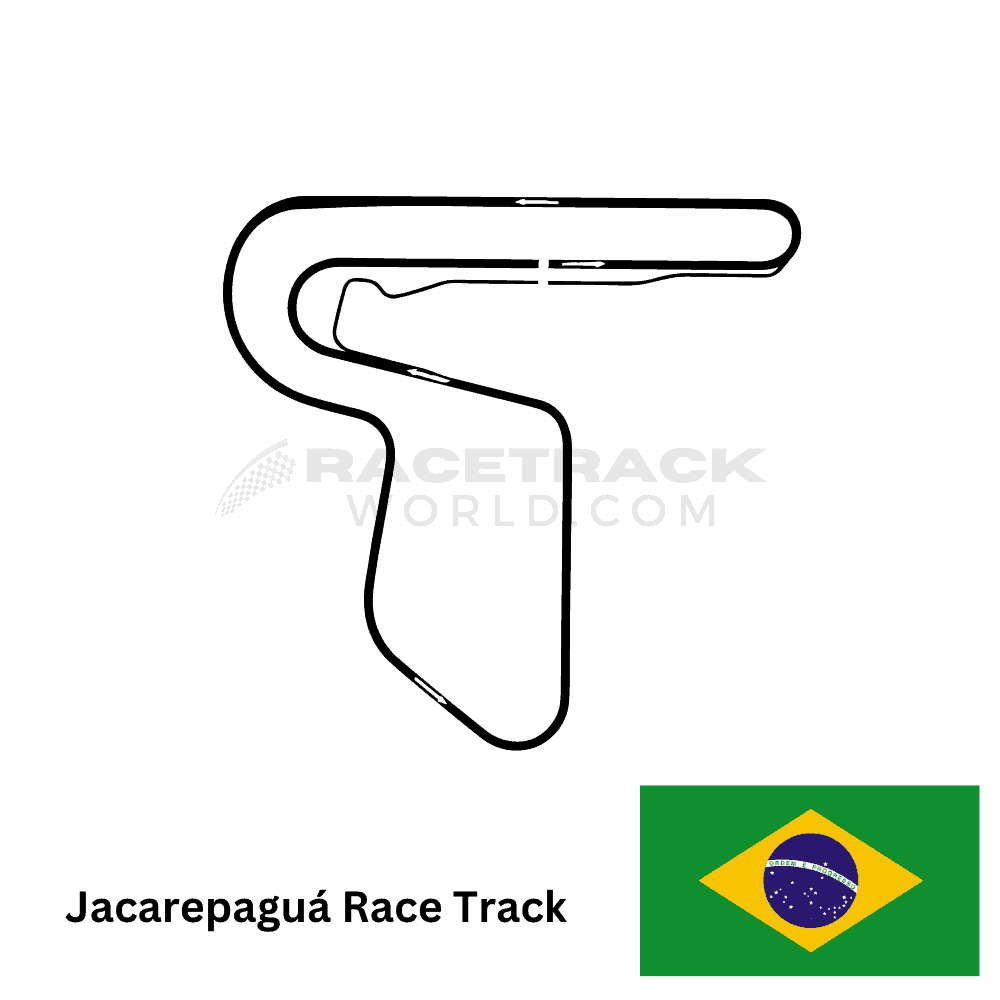
Also widely known simply as Jacarepaguá, this was a flat, fast circuit built on reclaimed marshland west of central Rio, between the districts of Jacarepaguá and Barra da Tijuca. Its original 5.031 km (3.126 mi), 11-turn Grand Prix layout combined a long pit straight with an even longer back straight, letting turbo-era Formula 1 cars top 300 km/h before a tight infield section slowed things down again. Giant grandstands ran almost the full length of the back straight, giving huge crowds a clear view of most of the lap. The layout was shortened and reprofiled more than once in the 1990s and 2000s to suit Stock Car Brasil and CART, and a separate oval, the Emerson Fittipaldi Speedway, was cut into the infield for short-track racing. None of it survives: the whole site was flattened in November 2012.
Configurations
| Layout | Length | Used for |
|---|---|---|
| Original Grand Prix circuit (1978-1995) | 5.03 km | 5.031 km, 11 turns, used for the Brazilian Grand Prix |
| Modified Grand Prix circuit (1996-2005) | 4.93 km | 4.933 km, 13 turns, used for CART and Stock Car |
| Short circuit (1996-2012) | 3.34 km | 3.336 km, 7 turns, the final Stock Car Brasil configuration |
| Emerson Fittipaldi Speedway | 3.00 km | 3.000 km oval, 4 turns, cut into the infield for short oval racing |
Events and race weekends
Jacarepaguá hosted the Formula 1 Brazilian Grand Prix ten times between 1978 and 1989 (alternating with Interlagos before taking the race outright from 1981), with Alain Prost winning five of those races. It also held CART's Rio 200 (1996-2000), motorcycle Grands Prix (1995-2004), and Stock Car Brasil rounds every year from 1979 until the track closed in 2012. No races have been held here since demolition, and there is no annual calendar to speak of any more.
Getting there and parking
The circuit no longer exists; its former footprint now sits inside the Barra Olympic Park, part of the same Barra da Tijuca district in Rio's west zone. Visitors coming to see the Olympic Park site fly into Rio's Galeão International Airport, about 45-60 minutes away by car depending on traffic, or the smaller domestic Santos Dumont Airport closer to the city centre. There is no rail link; taxis, rideshare and the BRT TransOeste busway (Terminal Alvorada / Jardim Oceânico stations) serve Barra da Tijuca.
- Rio de Janeiro-Galeão International Airport (GIG) · about 50 min drive
- Santos Dumont Airport (SDU) · about 40 min drive
There is nothing left to see of the circuit itself; the BRT TransOeste corridor is the easiest way to reach the surrounding Barra Olympic Park area without a car.
Hotels and camping near Autódromo Internacional Nelson Piquet (Jacarepaguá)
Anyone visiting the former site today would base themselves in Barra da Tijuca, the beachfront district that grew up around the old circuit and later hosted most of the 2016 Olympic venues, or further east in Copacabana/Ipanema for a more central Rio stay. There is no camping, RV or trackside accommodation culture associated with the site, since it has been redeveloped as Olympic Park infrastructure and residential areas.
Where to look
Barra da Tijuca (closest, beach-resort style hotels) or Copacabana/Ipanema/Leblon in central Rio for a more traditional base, roughly 45 minutes away.
Track days, driving experiences and lap records
There is no track-day or ride access of any kind; the circuit was demolished in November 2012 to build venues for the 2016 Summer Olympics, and the site is now occupied by Olympic Park sporting facilities and surrounding development. Nothing of the tarmac survives to drive or walk.
Lap records
| Category | Time | Driver | Car | Year |
|---|---|---|---|---|
| Formula 1 | 1:32.507 | Riccardo Patrese | Williams FW12C | 1989 |
Spectator guide
There is no event to attend; the former circuit grounds are now part of the Barra Olympic Park, a public park and sports complex left over from the 2016 Games, open for general recreational visits rather than motorsport.
Weather
- Dec-Mar: hot and humid, highs around 30-35°C (86-95°F)
- Jun-Aug: mildest months, highs around 25-27°C (77-81°F)
History of Autódromo Internacional Nelson Piquet (Jacarepaguá)
Reclaimed marshland to Grand Prix venue
Construction of what became the Autódromo Internacional Nelson Piquet began in 1971 on reclaimed marshland in Jacarepaguá, in Rio de Janeiro's fast-growing west zone. The track opened on 27 January 1978, initially named simply the Autódromo Internacional do Rio de Janeiro, and immediately took over hosting duties for the Brazilian Grand Prix from the disused Interlagos circuit in São Paulo (the two venues alternated in the early years before Jacarepaguá held the race outright from 1981).
The Formula 1 years
The flat, open layout, a long pit straight feeding an even longer back straight, suited the turbo era's power, and crowds packed the grandstands that lined most of the back stretch. Alain Prost became the circuit's dominant driver, winning five of the ten Brazilian Grands Prix held there between 1978 and 1989, including the emotional 1988 and 1989 wins for local hero Ayrton Senna's rival era. The track was renamed for triple champion Nelson Piquet, Brazil's other F1 star of the period, during his career. Rising costs and Interlagos's redevelopment saw Formula 1 return to São Paulo for 1990, ending Jacarepaguá's decade as Brazil's Grand Prix host.
Life after F1
The circuit stayed busy without Formula 1: CART's Rio 200 ran from 1996 to 2000, motorcycle Grands Prix visited between 1995 and 2004, and Stock Car Brasil, Brazil's biggest domestic series, raced there every season from 1979 until closure. Reconfigurations in the 1990s and 2000s shortened the lap and added an infield oval, the Emerson Fittipaldi Speedway, for short-track events.
Demolition for the Olympics
Rio's successful bid for the 2016 Summer Olympics sealed the circuit's fate: the site was earmarked for the Barra Olympic Park, and the entire track was demolished in November 2012. Today there is nothing left to visit of the racing surface itself; the land forms part of the Olympic Park's sporting venues and surrounding development in Barra da Tijuca.
Frequently asked questions
Does the Jacarepaguá circuit still exist?+
No. The Autódromo Internacional Nelson Piquet was completely demolished in November 2012 to make way for venues built for the 2016 Rio Olympics. Nothing of the track survives.
Can you visit the site today?+
You can visit the area, which is now the Barra Olympic Park in Rio's Barra da Tijuca district, but there is no trace of the former circuit to see.
How many Brazilian Grands Prix were held at Jacarepaguá?+
Ten, between 1978 and 1989. Alain Prost was the most successful driver there, with five wins.
Why was the circuit named after Nelson Piquet?+
It was renamed in honour of the three-time Formula 1 World Champion during his racing career, after opening in 1978 as the Autódromo Internacional do Rio de Janeiro.
What replaced Jacarepaguá as Brazil's Grand Prix venue?+
The Autódromo José Carlos Pace at Interlagos in São Paulo, which took over the Brazilian Grand Prix from 1990 onward and still hosts it today.
Other tracks nearby
- Circuito Cacá Bueno (Galeão) · 24 km · historic circuit (defunct)
- São Paulo Street Circuit (Anhembi) · 338 km · street circuit
- Autódromo José Carlos Pace (Interlagos) · 347 km · road course
- Autódromo Velo Città · 362 km · road course
- Circuito dos Cristais · 475 km · road course & oval
- Ribeirão Preto Street Circuit · 500 km · historic circuit (defunct)
Facts checked against 4 sources including the official circuit website. Last reviewed 2026-09-11.