
Richmond Raceway
Richmond Raceway at a glance
- Location
- Richmond, Virginia
- Type
- oval
- Length
- 0.75 mi (1.207 km)
- Turns
- 4
- Direction
- counter-clockwise
- Banking
- 14° in the turns, 8° on the frontstretch, 2° on the backstretch
- Surface
- asphalt
- Opened
- 1946
- Owner
- NASCAR
- Capacity
- 51,000
- Address
- 600 East Laburnum Avenue
- Phone
- +1 804-228-7500
- Website
- richmondraceway.com
Track map and layout
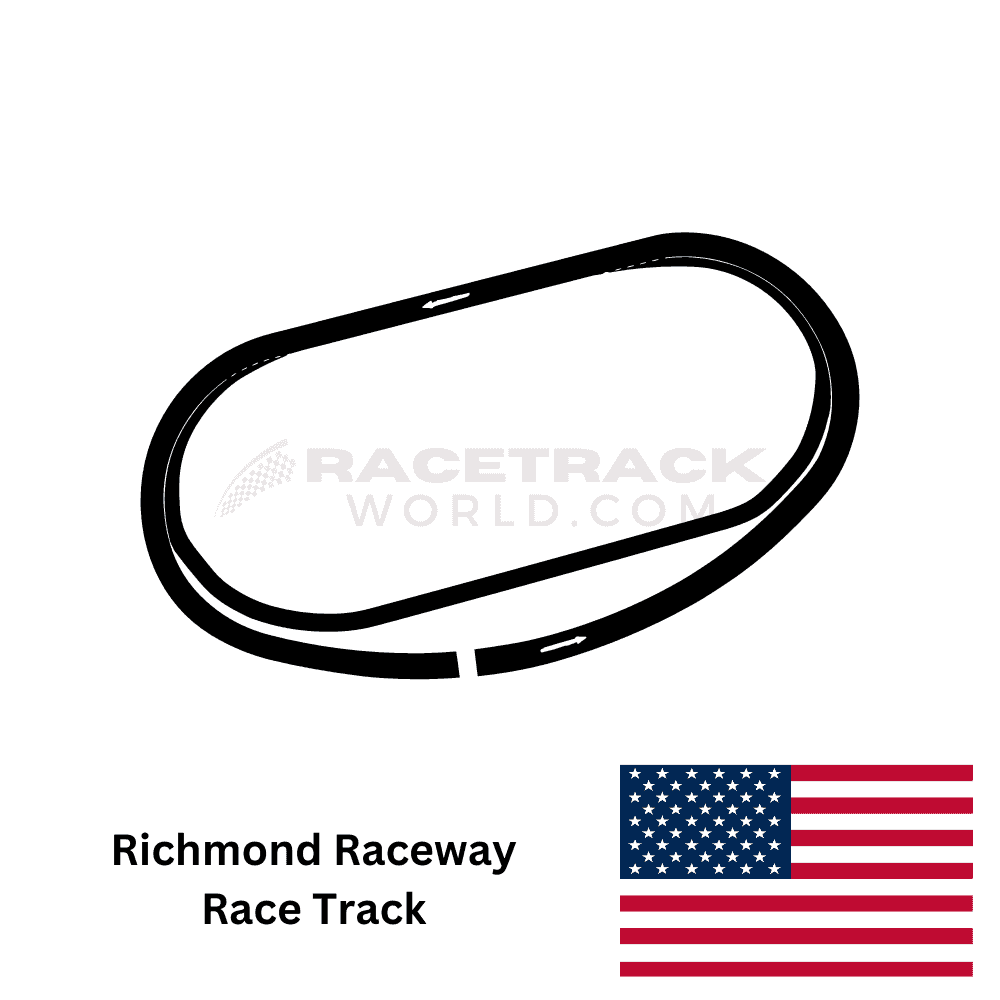
Richmond Raceway is often called America's premier short track, a D-shaped 0.75-mile oval that packs high speeds into a tight footprint. The turns are banked at 14 degrees while the frontstretch carries 8 degrees and the backstretch just 2 degrees, an asymmetry that rewards drivers who can carry momentum through the flatter, trickier backstretch. Cars reach speeds well above 120 mph on a track short enough that lapped traffic and door-to-door racing are constant, giving Richmond a reputation for close, physical short-track racing rather than the high-speed drafting of the superspeedways. The D-shape, adopted in a 1988 reconfiguration from an earlier oval, remains the layout used for every national series event today.
Configurations
| Layout | Length | Used for |
|---|---|---|
| D-shaped oval | 0.75 mi | current configuration since a 1988 reconstruction |
Events and race weekends
Richmond has hosted NASCAR Cup Series racing every year since 1953, making it one of the longest continuously running stops on the schedule, and it ran two Cup weekends a year until the spring race (the Toyota Owners 400) was dropped after 2024. It now hosts a single August Cup race, the Cook Out 400. IndyCar also raced at Richmond from 2001 to 2009 before departing the schedule.
| Event | Series | When | Notes |
|---|---|---|---|
| Cook Out 400 | NASCAR Cup Series | August | Richmond's only Cup Series race since 2025 |
Getting there and parking
Richmond Raceway sits just off Interstate 64 and US Route 360 in Richmond, Virginia, a few miles northeast of downtown. Richmond International Airport (RIC) is the closest airport, roughly 20-25 minutes away by car, and the track is easily reached from I-95 for visitors driving in from the Northeast Corridor. Race-day traffic concentrates on the Laburnum Avenue and I-64 approaches, so regulars build in extra time.
- Richmond International Airport (RIC) · about 22 min drive
Parking
General parking is available in surface lots around the raceway, with premium and preferred lots closer to the gates sold separately; lots typically open several hours before the green flag.
Enter camping lots through the gate assigned to your lot letter, and expect quiet hours in the campgrounds from 1 a.m. to 7 a.m.
Hotels and camping near Richmond Raceway
Richmond's compact size and central Virginia location mean visitors can stay almost anywhere in the metro and still reach the track in 20-30 minutes. Downtown Richmond offers the widest hotel selection with easy interstate access, while chain hotels cluster along I-64 and I-95 closer to the track. Rooms fill up fast for race weekends, especially the spring and late-summer Cup dates, so early booking is recommended.
Where to look
Downtown Richmond and hotels along the I-64/I-95 corridor near the raceway
Camping
Richmond Raceway offers reserved tent camping on-site outside the track gates for race weekends, separate from grandstand tickets.
RV
Reserved RV camping is available in multiple on-site lots with full, partial, or no hookups; entrance gate depends on the assigned lot.
Track days, driving experiences and lap records
Richmond Raceway's short, high-banked oval is available to the public through the Richard Petty Driving Experience, which runs both ride-along and behind-the-wheel stock car sessions at the track on scheduled dates tied to the racing calendar. Ride-alongs put guests in the passenger seat for laps at speeds up to roughly 165 mph with a professional driver, while driving experiences let participants pilot a stock car themselves after instruction, with packages ranging from a handful of laps up to a 40-lap advanced session.
Who runs days here
Typical cost: Driving experiences from around $199; ride-alongs priced per lap package, per Richard Petty Driving Experience
Lap records
| Category | Time | Driver | Car | Year |
|---|---|---|---|---|
| IndyCar qualifying | 0:15.9368 | Sam Hornish Jr. | — | 2004 |
| NASCAR Cup Series qualifying | 0:21.849 | Kevin Harvick | — | 2019 |
Spectator guide
Because Richmond is so compact, its grandstands wrap tightly around the D-shaped oval, putting fans closer to the action than at almost any other NASCAR national-series track. Multi-level grandstands line the frontstretch and both ends, and the track's small footprint means even seats far from the start/finish line still offer a clear view of most of the racing surface.
Seating
Frontstretch grandstands face pit road and the start/finish line; turn seating gives an up-close view of the high-speed, high-banked corners where much of the passing happens.
Best places to watch
Seats in the turns are prized by regulars for how close the action feels on a track this small, with cars visible on nearly every part of the lap.
Bag policy
Up to two bags per person, each no larger than 18 x 18 x 14 inches, plus one soft-sided cooler up to 14 x 14 x 14 inches with sealed food and drinks, alcohol included (no glass).
Weather
- April: mild spring weather, highs typically in the 60s-70s°F, chance of rain
- August: hot and humid, highs often in the upper 80s-90s°F
History of Richmond Raceway
From dirt bullring to NASCAR mainstay
Richmond Raceway opened on October 11, 1946, as a half-mile dirt oval with grandstand seating for about 3,200 fans, part of the first generation of tracks built to host the fledgling stock car racing scene that would become NASCAR. The track was paved in September 1968, and NASCAR Cup Series competition has run there every year since 1953, giving Richmond one of the longest unbroken tenures on the modern schedule.
Reinvention as a D-shaped oval
The defining change in the track's history came in 1988, when the original oval was reconfigured into the current 0.75-mile, D-shaped layout at a cost of roughly five million dollars. The new shape, with its asymmetric banking and slightly longer straights, produced faster, closer racing and cemented Richmond's reputation as the sport's premier short track. Grandstand capacity grew steadily through the 1990s and 2000s, peaking at more than 100,000 seats before the industry-wide trend toward smaller, more intimate crowds led to a series of grandstand removals starting in 2011.
IndyCar era and modern ownership
IndyCar raced at Richmond from 2001 through 2009 on the same oval configuration before leaving the schedule, and the track's history also includes a tragic early chapter: a spectator fatality in 1950, a reminder of the sport's rougher early decades. International Speedway Corporation owned and operated Richmond from 1999 until NASCAR itself took over ownership in 2019 as part of its broader consolidation of major ovals.
Today
Richmond hosted two NASCAR Cup Series weekends a year until 2024 and now hosts one, in August, and its short-track racing is consistently rated among the closest and most competitive on the calendar. The Richard Petty Driving Experience keeps the track open to the public between national broadcasts, letting fans drive or ride the same high-banked corners the Cup Series contests each August.
Frequently asked questions
How long is Richmond Raceway?+
It is a 0.75-mile, D-shaped oval with four turns banked at 14 degrees.
How fast do cars go at Richmond Raceway?+
NASCAR Cup Series cars have run qualifying laps around 123 mph, with Kevin Harvick's 0:21.849 lap in 2019 among the track's quickest Cup laps.
Who owns Richmond Raceway?+
NASCAR has owned and operated the track since 2019, taking over from International Speedway Corporation, which owned it from 1999.
Can the public drive Richmond Raceway?+
Yes, the Richard Petty Driving Experience runs scheduled ride-along and behind-the-wheel stock car sessions at the track.
Is there camping at Richmond Raceway?+
Yes, reserved tent and RV camping are available on-site outside the track gates for race weekends, sold separately from tickets.
When did Richmond Raceway become a D-shaped oval?+
The track was reconfigured from its earlier oval into the current 0.75-mile D-shape in 1988.
Other tracks nearby
- Summit Point Motorsports Park · 117 mi · road course
- Virginia International Raceway (VIR) · 121 mi · road course
- Martinsville Speedway · 149 mi · oval
- Dover Motor Speedway · 151 mi · oval
- New Jersey Motorsports Park · 177 mi · road course
- Charlotte Motor Speedway · 238 mi · road course & oval
Facts checked against 7 sources including the official circuit website. Last reviewed 2026-09-09.